 Interview by Pascale Caron
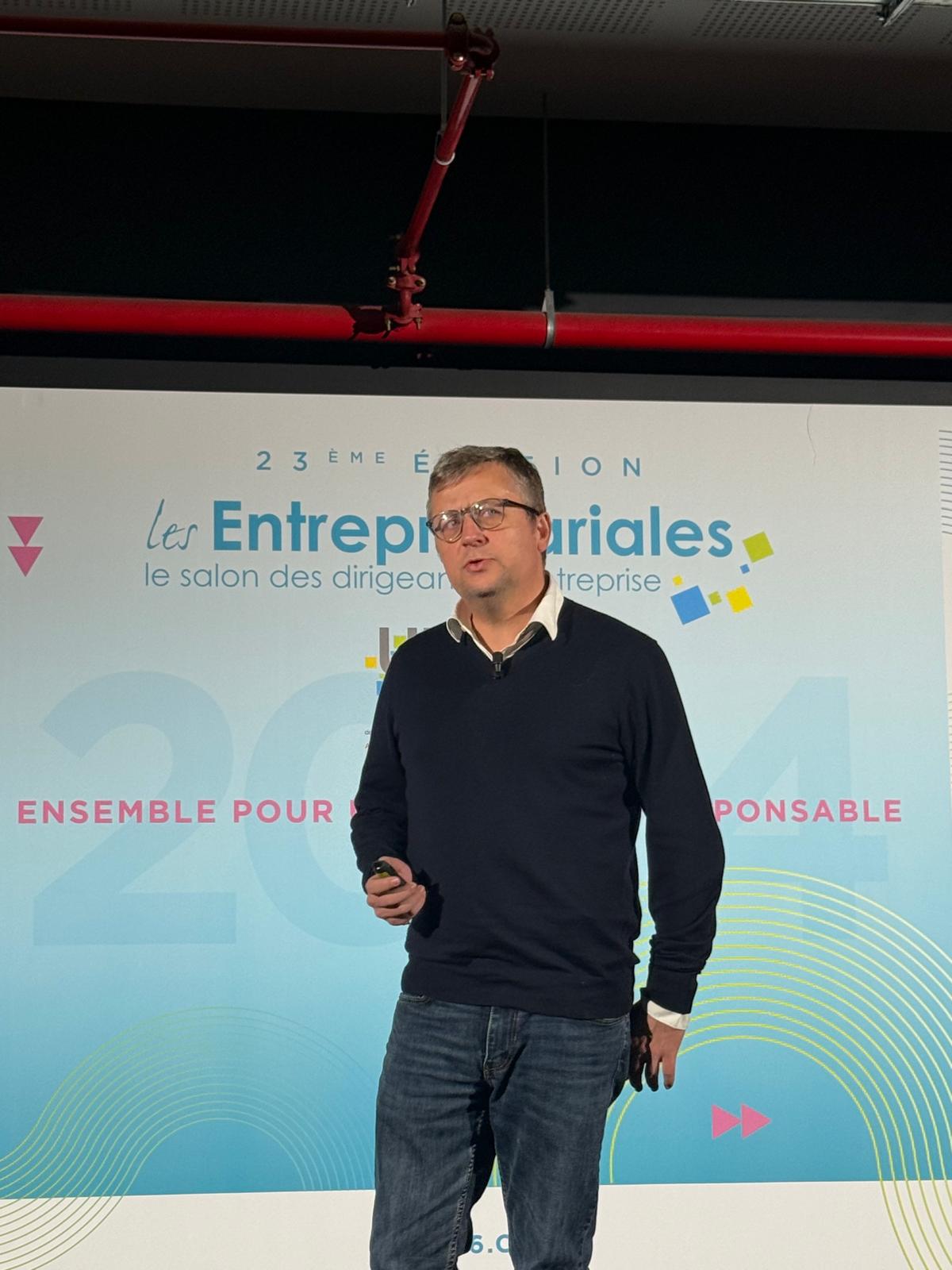
The 23rd Entreprenariales Fair welcomed Jean-Pierre Goux, writer and president of OneHome and Biosphere Economics, for an exceptional conference entitled “The Blue Revolution: how to make the ecological transition desirable and irresistible?”. This conference organized by Tribune Côte d’Azur, explored an ambitious project blending science, ecology and collective narrative to transform our relationship with the planet.
From the beginning of his talk, Jean-Pierre Goux shared the intimate origin of his reflection. Born in Nice in 1973, he grew up observing the fascinating blue of the Nice sky. This childhood wonder quickly merged with ecological awareness. At the age of five, a book about endangered species deeply affected him, planting the seeds of a lifelong commitment. For Goux, this color, symbol of dreams and intensity, became the guiding thread of his quest: to reconcile humanity and the biosphere.
This passion for blue was nurtured during his adolescence at Masséna high school and at MAMAC where he discovered the work of Yves Klein, master of Klein Blue. Klein had wished to “paint the world blue” to elevate the human spirit, a project that Jean-Pierre Goux adopted as a metaphor for global ecological transformation.
Jean-Pierre Goux emphasized the crucial role of narratives in changing mindsets. According to him, humanity today lacks a modern myth capable of catalyzing an irresistible ecological transition. Drawing on biological and cosmological evolution, he proposes a poetic and scientific vision where humanity becomes an organ of the biosphere, contributing to its balance.
To illustrate this idea, he evokes the iconic image of Earth seen from space. This photograph, nicknamed Blue Marble, taken during the Apollo 17 mission, allowed humanity to discover itself for the first time as a unified entity. This “view from outside” transformed the astronauts, awakening in them a profound love for Earth — a feeling that Goux wishes to share with all humans through what he calls the Overview Effect. Jean-Pierre Goux then presented animated satellite images of Earth, accompanied by music by Agoria. A contemplative moment to remind us of the urgency and beauty of our planet. This project, launched by his NGO OneHome, embodies the first pillar of this blue revolution: reconnecting humanity to Earth to create a sustainable future.
Obstacles to transition: breaking down to better understand
Despite considerable efforts deployed in different sectors — circular economy, biomimicry, soil regeneration, and many others — Jean-Pierre Goux observes a “glass ceiling” blocking large-scale transition. This lies in the collective inability to imagine a unified and desirable vision for humanity.
He draws inspiration from past crises, such as the “great oxygenation” that transformed Earth 2.3 billion years ago. He proposes to rethink humanity as an organism capable of adapting and evolving toward a more harmonious form: Homo Biospheris. This new narrative, nourished by concepts such as regenerative economy and love of Earth, could be the engine of an irresistible transition.
The Little Prince: a universal symbol for humanity in transition
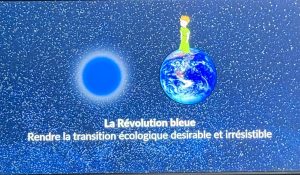
Jean-Pierre Goux reinterpreted The Little Prince by Antoine de Saint-Exupéry as a powerful allegory for humanity. According to him, the Little Prince represents a human collective dreaming of an existence in harmony with Earth. Through this symbol, he imagines a humanity capable of caring for the planet, exploring new horizons, and coexisting with other forms of life.
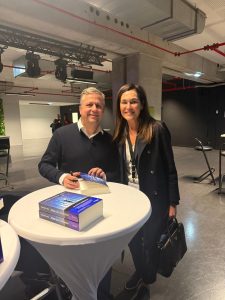
His novel trilogy The Blue Revolution, whose first volume The Little Princess was recently published, deals with this metamorphosis of humanity. In this work, he weaves together narrative, ecology and science to offer an optimistic and inspiring vision of our future.
He invited the audience to dream of a transformed humanity, capable of transcending its current limits to embrace a loving relationship with the biosphere. Through his approach blending science, art and philosophy, he demonstrated that the ecological transition can become an exciting collective project. An inspiring moment.