 An Unfiltered Economic Perspective
Interview by Pascale Caron
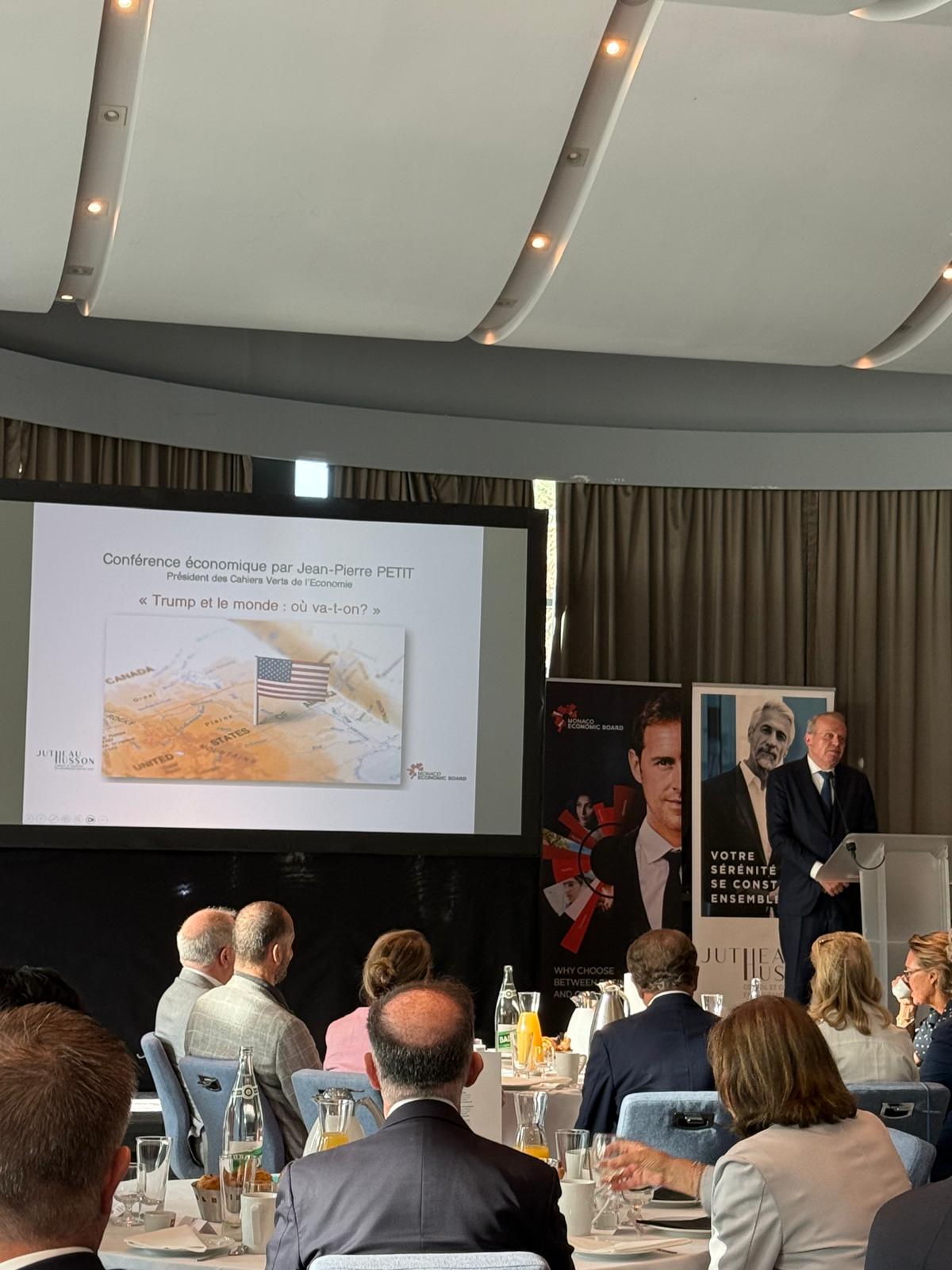
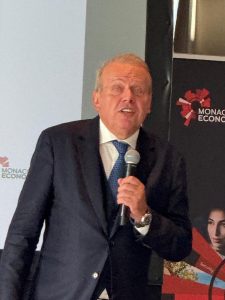
Organized by the Monaco Economic Board in partnership with Jutheau Husson, Jean-Pierre Petit’s conference offered a sharp analysis of contemporary geopolitics. President of the Cahiers Verts de l’Économie and former Chief Economist at Exane BNP Paribas, he advocates independent thinking based on the analysis of power dynamics rather than ideological norms.
This is not about commenting on intentions, but observing dynamics. According to him, Donald Trump’s return to power is not an anomaly. It is the sign of a changing era. Politics is becoming brutal again. Nation-states are taking back control. The era of multilateralism as a path to peace is over.
A President Who Acts, a World Being Reorganized
Donald Trump governs through confrontation. He does not hide his priorities: domestic sovereignty, external power dynamics. In Washington, he challenges the independence of federal agencies deemed too powerful. He marginalizes technocratic checks and balances. Internationally, he embraces a transactional vision: alliances are no longer ideological but ad-hoc, contractual, bilateral.
Jean-Pierre Petit emphasizes: this is not withdrawal. It is a strategy. What Trump is challenging is not globalization, but its asymmetrical logic. He wants to redefine the terms of trade, control industrial flows, and steer value chains. He uses the dollar, taxation, and tariff threats as instruments of power. And he gets results.
Europe Trapped by Structural Powerlessness
Faced with this, Europe proves incapable of formulating a coherent response. It loses itself in contradictory demands. It multiplies regulations but loses real sovereignty. It speaks of energy transition but imports American shale gas. It advocates social justice but depends on Chinese flows. It proclaims strategic autonomy but buys its weapons from the United States.
Jean-Pierre Petit dwells at length on the emblematic episode of the meeting between Ursula von der Leyen and Donald Trump. An “agreement” signed in Scotland, hastily, without tangible content, without negotiating leverage. Europe yielded without gaining. It suffered without retaliating. It financed without reciprocity.
An Economic View of Currency
Monetary policy is another indicator. As early as 2019, Trump had forced the Fed to ease its position. In 2025, he reaffirms that industrial sovereignty requires control over the cost of capital. Growth and employment must take precedence over fighting inflation, which has become secondary. The central bank becomes a political tool.
In Europe, the situation is reversed. The ECB, attached to its doctrine, is slow to react. It prioritizes short-term fiscal balances. It hinders productive investment. It accepts high real rates in a context of weak growth. Result: the gap widens.
Accelerated Deindustrialization
For Jean-Pierre Petit, the heart of Europe’s problem is productive capacity. Europe has dismantled its industrial tools. It no longer manufactures its critical infrastructure. It depends on its competitors for components, machinery, and technological platforms. Free trade, without strategy, has hollowed out territories.
The United States, on the contrary, is reshoring. They are investing massively. They are subsidizing key industries. They are protecting their markets. They are securing their resources. The Inflation Reduction Act (IRA) is an example: a coherent plan for industrial reconquest. Europe has no equivalent. It regulates. It prohibits. It compensates. But it no longer produces.
Technology as a Lever of Sovereignty
Technological sovereignty is becoming, according to Petit, the decisive fault line of the 21st century. Europe has fallen considerably behind. Semiconductors are Asian. The cloud is American. Artificial intelligence depends on foreign models. Critical infrastructure is under external control.
The United States, China, Israel, and South Korea have understood that technological dominance determines political sovereignty. They train, finance, and protect their sectors. Europe, meanwhile, applies regulations even before having built players capable of competing. Result: fragile companies, loss of know-how, dependent projects.
The Human Factor at the Heart of Decline
The assessment is all the more severe as Europe is also weakening its human capital. Jean-Pierre Petit discusses France with particular gravity. Declining education system. Reforms without results. Uncontrolled debt. Structural deficit. Declining productivity. Disincentive labor market. Obsolete training system.
France, he says, is in a state of human debt as much as financial debt. The country suffers from a loss of authority, a loss of competence, a loss of hope. The political personnel is unstable. Institutions are contested. The economy is on life support. Administration has replaced strategy.
The International Order Is No Longer Normative
The Ukrainian sequence, like the situation in Iran, confirms this change in approach. International law is being marginalized. Multilateral organizations are powerless. The UN no longer carries weight. The WTO is being circumvented. NATO is unbalanced. What matters now is the ability to deter, to negotiate under pressure, to strike quickly.
Trump is not seeking to impose a model. He wants to preserve an advantage. He does not burden himself with promises. He signs deals. He defuses or intensifies pressure according to the interest of the moment. He does not moralize. He acts. He disorients because he does not play by established rules. But he imposes his priorities.
Toward a Brutal Geoeconomy
This transformation of the world is also visible in the markets. Gold is rising, not because of rates, but as a sign of distrust toward institutions. Central banks themselves are buying gold. Currencies are being challenged. Debts are becoming unsustainable. Safe havens are becoming material again.
The world is becoming geoeconomic again. It is no longer agreements that matter, but assets. No longer treaties, but resources. No longer speeches, but factories. The logic of power no longer hides. It imposes itself.
Europe’s Historical Fatigue
Jean-Pierre Petit concludes with a crucial point: the question of elites. He cites Pareto. When a society no longer ensures the qualitative renewal of its elites, it enters decline. Europe is in this impasse. Its leaders no longer produce strategy. Its selection systems are exhausted. Administration takes precedence over competence. Conformism blocks innovation.
The brutality of the world to come will require elites capable of deciding, acting, and building. Without this, Europe will remain a spectator. The comfort of norms is no longer enough. The world demands strength. And vision.
Conclusion: Produce Power or Exit the Game
What Jean-Pierre Petit demonstrates in this conference is the necessity of thinking of power as production, not as a right. It does not flow from institutions. It rests on the mastery of economic, industrial, technological, and human levers.
Faced with an unstable world, governed by power dynamics, Europe must choose. Either it accepts its marginalization, or it returns to the path of strategy. This requires breaking with the illusion of rights without means, and rebuilding a capacity for action. Power is no longer an inheritance. It becomes a decision.