At WAICF 2025, Nicola Maillot from Thales Alenia Space delivered a captivating presentation on the growing role of artificial intelligence (AI) in the space industry. Far from being merely a futuristic concept, AI is now integrated into every stage of satellite lifecycles, from design and manufacturing to in-orbit operations.
Her presentation highlighted three major areas:
- Optimizing satellite manufacturing and management through AI.
- The impact of AI on Earth observation and space data management.
- The evolution of cloud infrastructures in space for more autonomous and efficient missions.
AI at the Heart of Satellite Manufacturing and Management
Artificial intelligence plays an essential role in optimizing the satellite manufacturing and management chain. This technology enables improvements in resource planning, defect management, and equipment maintenance.
Supply Chain Optimization with AI
Satellite manufacturing is an extremely complex and lengthy process, requiring optimal resource and time management. Thales Alenia Space uses AI to:
- Optimize the supply chain with a Control Tower, an AI-based system that enables real-time decision-making to prevent delays or production errors.
- Plan operations more efficiently and anticipate risks related to breakdowns or delivery delays.
- Improve material management and workflow management to reduce costs and waste.
Visual Inspection and Predictive Maintenance
AI is also used for inspecting satellites during manufacturing. For example, satellite solar panels are verified using AI image analysis systems, detecting potential defects invisible to the human eye.
Additionally, predictive AI enables anticipation of failures before they occur. Through real-time data analysis, AI can:
- Identify early warning signs of failure.
- Optimize maintenance operations to avoid unexpected downtime.
- Increase satellite reliability and durability.
Improving Satellite Simulation and Design
AI is also leveraged to accelerate satellite simulation and engineering. Using advanced predictive models, engineers can:
- Simulate the space environment (temperature, radiation, meteorite impacts).
- Test different designs and configurations to find the best options in record time.
- Reduce development time and costs by limiting design errors.
AI therefore makes satellites more efficient and more resilient, a major challenge in the face of long-duration space missions.
AI for Earth Observation and Space Data Exploitation
Earth observation is a field where AI has a considerable impact. It enables more efficient exploitation of satellite data and provides accurate information for natural resource management, environmental monitoring, and global security.
Analysis and Fusion of Space Data
Earth observation satellites, such as those in Europe’s Copernicus program, generate approximately 30 terabytes of data per day. AI is essential for:
- Fusing data from different sensors (radar, optical, infrared).
- Processing this data in real time to provide actionable information more quickly.
- Detecting environmental changes such as deforestation, rising water levels, or urban area evolution.
Advanced Detection of Environmental Changes
One presented use case concerned detecting changes on Earth using satellite images taken at different periods. This task is complex because:
- Images are never perfectly identical due to variations in angle, brightness, or atmospheric conditions.
- AI can correct these biases and accurately identify landscape evolution.
This technology is notably used for:
- Monitoring forests and biodiversity.
- Managing natural disasters (tracking floods, fires, hurricanes).
- Urbanization and infrastructure management.
Satellite Responsiveness Through Onboard AI
One challenge in Earth observation is the delay between image capture and analysis. To address this problem, Thales Alenia Space now integrates AI directly aboard satellites, enabling:
- Real-time image analysis to rapidly detect critical events (marine pollution, illegal trafficking, natural disasters).
- Transmission of only relevant data to ground stations, thereby reducing required bandwidth.
This capability is particularly useful in emergency situations, where rapid responses are essential for coordinating relief efforts.
AI and the Future of Space Cloud: Towards Orbital Data Centers?
One of the most fascinating innovations discussed during the presentation is the development of data centers in space. The objective is to externalize data storage and processing to:
- Reduce energy consumption and the environmental impact of terrestrial data centers.
- Exploit the cold of space for natural server cooling.
- Develop a more resilient infrastructure, less sensitive to cyberattacks and natural disasters.
This concept, which seemed utopian just a few years ago, is now in advanced study phase, with tests planned in the coming years.
AI for Optimizing Space Data Centers
To design these orbital data centers, AI plays a key role in optimizing:
- Energy and cooling management.
- Computing resource allocation to maximize efficiency.
- Predictive maintenance to ensure optimal operation over extended periods.
Connectivity and Management of Cloud Infrastructures in Orbit
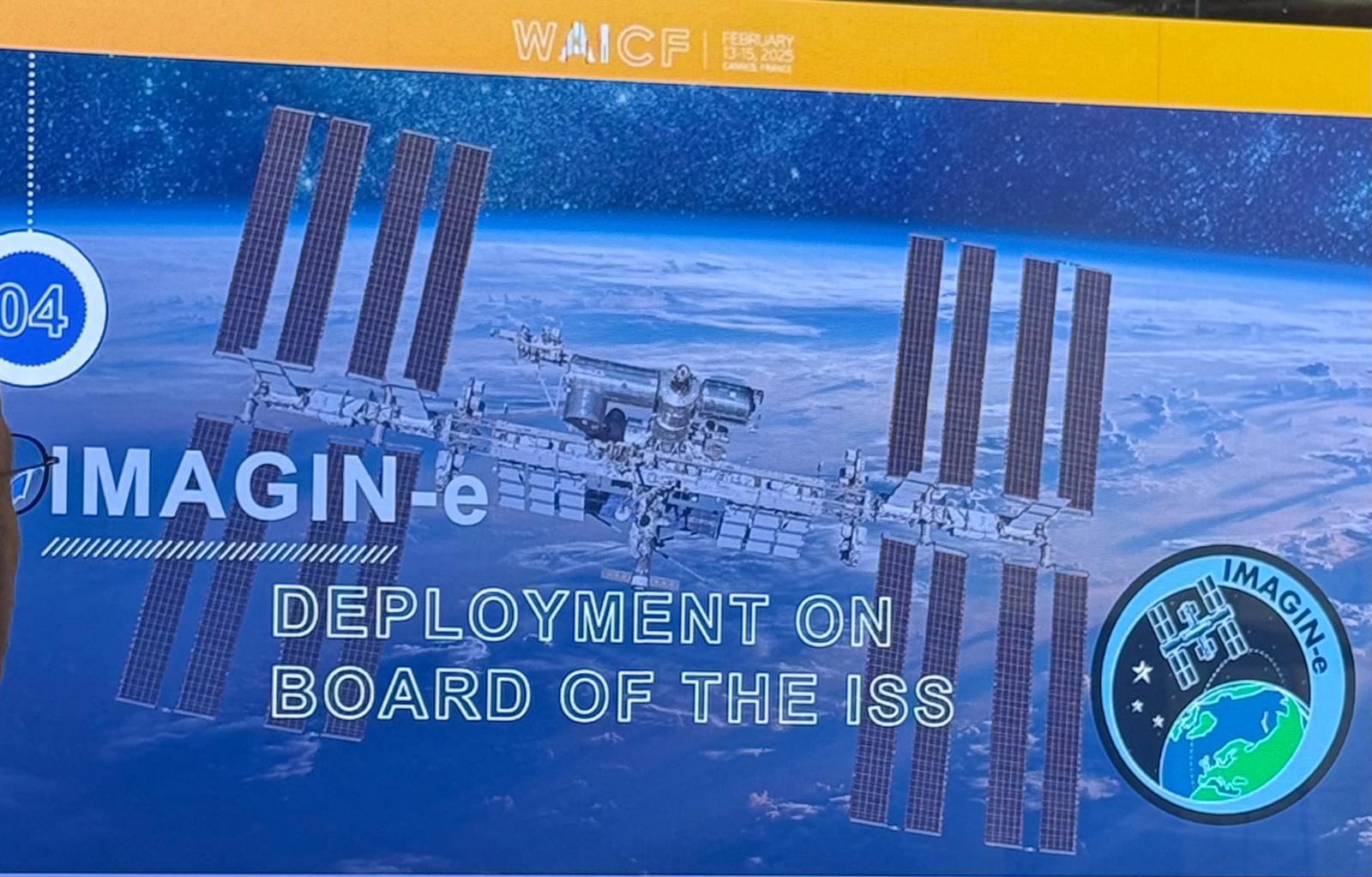
Another major project is integrating satellites with modern cloud infrastructures. Thales Alenia Space is working in collaboration with Microsoft to connect the ISS directly to Azure, enabling:
- More flexible and scalable management of space data.
- The ability to deploy AI models directly in space.
- Improved communications between satellites and ground stations.
This innovation opens the door to a new era of space computing, where AI and cloud will become standard tools for managing orbital missions.
AI, an Essential Driver for the Future of Space
Nicola Maillot’s presentation demonstrated how much artificial intelligence is revolutionizing the space industry. From satellite design to environmental data analysis, through cybersecurity and cloud infrastructures in orbit, AI is becoming an essential strategic element.
The space industry is thus entering a new era, where missions will be more autonomous, more precise, and more sustainable. AI no longer merely improves satellite performance: it paves the way for new ways of exploring and understanding our universe.