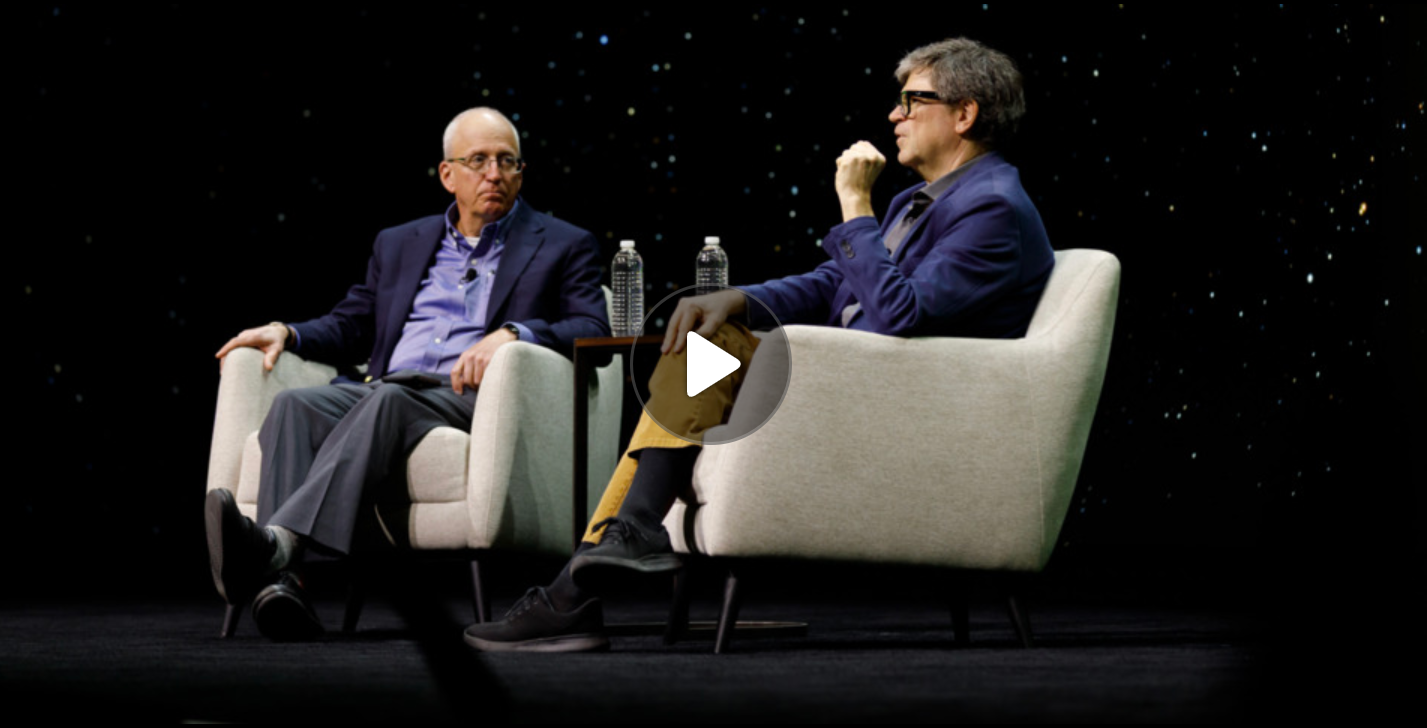
At GTC 2025, the most anticipated conference session wasn’t a spectacular keynote, but rather a dense intellectual exchange between two major figures of contemporary artificial intelligence. Yann LeCun, Chief AI Scientist at Meta, and Bill Dally, Chief Scientist at NVIDIA, took the stage to discuss the current limitations of artificial intelligence and the architectures of the future.
From the opening exchanges, the tone was set: this was neither marketing speculation nor vague predictions, but a rigorous return to the founding principles of AI, with a long-term perspective.
“I’m not really interested in LLMs anymore”
Dally asks:
“What’s been the most exciting development in the past year?”
LeCun responds, without hesitation:
“Too many to count. But I’m not so interested in LLMs anymore. They’re kind of the last thing.”
This statement contrasts sharply with the current media frenzy surrounding GPT-4o, Claude 3, or Gemini. For LeCun, language models are at the end of a fundamental research cycle. Recent progress stems from industrial refinements: more data, more compute, infrastructure optimization. In short, engineering rather than science.
A radical critique of the token paradigm
Why such disinterest? Because LLMs, according to LeCun, don’t model reality:
“The world is continuous and has low entropy. Predicting tokens, like language, is very high entropy. That doesn’t capture the world well.”
In other words, current models predict sequences of symbols without understanding the physical or causal constraints of the real world. They fail to predict video, plan actions, or develop stable memory.
From pixel prediction to anticipation in abstraction
Facing this impasse, LeCun proposes a breakthrough: JEPA, or Joint Embedding Predictive Architecture.
“We don’t want to predict the unpredictable. We want to model structure in abstract space, not in pixel space.”
JEPA learns to represent the world in a latent space and predict the evolution of these abstract representations. The goal is clear: reduce computational cost, avoid unnecessary noise, and build a more stable understanding of reality. This approach has already led to implementations like I-JEPA, DINOv2, and soon V-JEPA, designed for video sequence analysis.
Planning intelligence: from System 1 to System 2
LeCun draws on Daniel Kahneman’s work to distinguish two types of intelligence:
- System 1: fast, associative, automatic — this is what LLMs do.
- System 2: slow, analytical, planning — this is where future AI must head.
“We don’t have systems that can plan. Not even LLMs. We need a new kind of architecture.”
He proposes a new concept: AMI — Advanced Machine Intelligence, breaking away from the fuzzy fantasy of AGI (Artificial General Intelligence). For LeCun, human intelligence itself isn’t “general,” but adapted to a very particular physical and social world.
2028 horizon: a reasonable timeline
When will we see truly autonomous agents emerge? According to LeCun:
“We could see systems with persistent memory, basic reasoning and planning abilities in 3–5 years.”
Limited but reflective agents, capable of interacting in a constrained environment, are within reach. However, human-level intelligence integrating perception, language, logic, learning, and coordination will likely require a decade or more.
Hardware: compute, yes, but not just any kind
Bill Dally raises the hardware question. LeCun confirms:
“To run system 2 agents, we’ll need more compute. But we must use it better.”
He criticizes current waste: predicting every pixel of a video is an expensive and unnecessarily heavy task. JEPA architectures offer a far more economical alternative.
On emerging technologies:
- Quantum? “Interesting for physics, not for AI.”
- Optics? “Too noisy, not flexible enough.”
- Neuromorphic? Promising for edge computing, but not yet mature.
In short, CMOS remains the standard for the short and medium term.
Open source and diversity: the key to useful AI
LeCun emphasizes the importance of open source. He cites the success of Llama, with over a billion downloads, and ResNet, designed in Beijing at Microsoft Research.
“Open innovation scales faster, especially when it involves culturally and linguistically diverse communities.”
He advocates for pluralistic, multilingual, distributed AI, resistant to systemic biases. The opposite of closed ecosystems where innovation is centralized in a few laboratories.
AI as a tool, not a threat
On the security question, LeCun adopts a rational stance. He rejects catastrophist discourse about hostile superintelligence.
“If you want safer AI, build better AI. Not slower AI.”
Rather than imagining ineffective regulatory brakes, he advocates for more robust, more understandable, and better supervised AI. An AI that “knows when it doesn’t know” — that also learns from its own limitations.
Critical analysis: a necessary reconfiguration
This session provides a clear roadmap for researchers, developers, and decision-makers:
- Move beyond the illusion of LLMs as an end goal.
- Build systems architected around memory and planning.
- Invest in JEPA-like architectures.
- Foster intercontinental open innovation.
- Control the ecological cost of compute.
Conclusion: conceiving AI not as a text machine, but as an agent of reality
The LeCun-Dally conversation at GTC 2025 marks a turning point: the moment when major AI figures acknowledge that text generation isn’t enough. The future is being built elsewhere — in abstraction, world modeling, long-term memory, and reasoned planning.
AMI, according to LeCun, won’t replace humans. It will augment them, free them from repetitive tasks, and offer them a cognitive mirror. Provided this intelligence is open, explainable, ethical, and sovereign.
References
- LeCun, Y. & Dally, W. (2025). A Conversation at GTC25. NVIDIA On-Demand. Official video
- LeCun, Y. (2022). A Path Towards Autonomous Machine Intelligence. Meta AI.