
Should artificial intelligence be banned in higher education and organizations? The question, often posed in binary terms, masks a far more subtle issue. AI is not replacing human intelligence. It is shifting its boundaries. And this shift, if not mastered, could weaken precisely what institutions seek to develop: the ability to think.
The article The AI Cognitive Pyramid by Inara Scott offers a particularly structuring reading of this transformation. Its contribution is not technological, but cognitive. It is not about evaluating what AI enables us to do, but what it transforms in the very way we learn, reason, and decide.
The starting point is an empirical observation now recurring in scientific literature. AI usage improves visible performance, but does not guarantee and sometimes degrades actual learning. This paradox is not an anomaly. It is the product of a well-identified mechanism: cognitive offloading.
Our brain is designed to optimize effort. Faced with a system capable of producing complete, structured, often convincing responses, we spontaneously adopt a delegation posture. What was once a process—analyzing, structuring, arguing—becomes a product. And in this passage from process to result, an essential part of learning disappears.
This phenomenon is amplified by a characteristic specific to generative AI: its ability to produce fluent, coherent responses without obvious signals of uncertainty. This fluency creates a cognitive illusion. The user no longer perceives the distance between understanding and using. They confuse the quality of the text produced with the depth of their own understanding.
The studies cited in the article are particularly enlightening. In a study conducted with mathematics students, access to GPT-4 improved results by nearly 50% during the training phase. However, performance dropped significantly during evaluations conducted without assistance. This result highlights a critical dissociation: observable performance is not a reliable indicator of learning.
Another study shows that using ChatGPT improves the editorial quality of essays, but produces no gain in terms of understanding or knowledge transfer. Moreover, it reduces metacognitive engagement, that is, students’ ability to reflect on their own reasoning.
It is in this context that the cognitive pyramid takes on its full meaning. It does not propose a typology of uses, but a mapping of mental work. Each level corresponds to a specific redistribution of four fundamental cognitive functions: generation (producing an idea), evaluation (judging its validity), cognitive effort (going through difficulty), and encoding (anchoring knowledge in memory).
At the Executor level, these four functions are largely externalized. AI generates, structures, often implicitly evaluates. The user intervenes at the margin. This mode of use eliminates what researchers call “desirable difficulties.” Yet, these difficulties—the effort of recall, confrontation with error, the progressive construction of reasoning—are precisely the mechanisms that enable lasting learning.
One of the most interesting contributions of the article is to show that this externalization is not limited to a loss of effort. It modifies the very structure of knowledge. The cited authors mention three types of knowledge: knowledge from experience, knowledge linked to cultural context and social norms, and conceptual knowledge mobilized in solving abstract problems. Intensive use of AI in executor mode tends to weaken these three dimensions by reducing opportunities for direct confrontation with the problem.
As we progress through the pyramid, the situation evolves. The Guide level introduces a form of balance. AI structures reasoning but does not replace it. This role corresponds to tutoring systems. However, the article highlights a structural instability: the slide toward Executor mode. This phenomenon, called “role drift,” is not accidental. It results from how language models are trained: they are designed to be helpful, therefore to respond. Faced with ambiguity, they resolve it. Faced with difficulty, they simplify it.
This point is crucial. It means that the “intelligent” use of AI does not rest solely on the user, but on the architecture of interaction. Without explicit constraints, without pedagogical design, the drift toward cognitive substitution is inevitable.
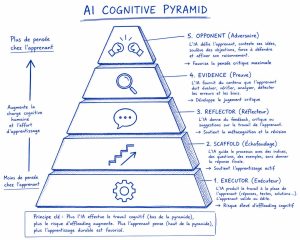 The Mirror level introduces a different logic. The initial effort is human. AI intervenes as a revealer. This configuration is particularly interesting because it preserves the generation effect, a well-documented mechanism in cognitive psychology: the act of producing information reinforces its memorization, even if it is subsequently corrected.
But it is in the upper levels that the model reveals its full power. The Listener level imposes a radical inversion. AI produces, but the human must judge. This situation mobilizes complex cognitive processes: activation of prior knowledge, comparison, verification, detection of inconsistencies. It transforms the user into a critical expert.
However, this level has an important limitation, often underestimated. It assumes a sufficient level of knowledge to evaluate AI. Without this, the user risks validating plausible errors. The article emphasizes that the weakest students are those who benefit least from AI, precisely because they do not have the necessary benchmarks to judge the quality of responses.
The Opponent level pushes this logic even further. AI becomes an intellectual adversary. It questions, contradicts, deconstructs. This type of interaction is part of the tradition of Socratic dialogue. It forces the user to make their assumptions explicit, to defend their positions, to revise their arguments.
This mechanism fully activates self-regulated learning processes. The individual no longer simply produces an answer. They continuously monitor, adjust, correct their reasoning. It is precisely this type of engagement that is associated with the deepest forms of learning.
But this increase in complexity has a cost. The article mentions a phenomenon still little explored: cognitive fatigue related to AI. Users who must constantly evaluate and supervise AI responses experience mental overload. This introduces a new tension: the most cognitively beneficial uses are also the most demanding.
This tension opens a field of strategic reflection. In organizations, AI is often deployed to optimize productivity. Yet, the most effective uses in the short term—Executor mode—are precisely those that risk eroding skills in the long term. Conversely, uses that strengthen thinking—Opponent mode—are more costly in time and effort.
Scott’s model does not resolve this tension. It makes it visible. It proposes a direction: progressively reduce dependence on Executor mode and increase situations where the individual must generate, evaluate, justify.
This orientation implies a profound transformation of learning design. It is no longer enough to provide access to AI. Interactions must be organized. Constraints must be imposed. Moments without assistance must be created. Traces of reasoning must be required. This also implies an evolution in the role of teachers and managers. They become architects of cognitive work. Their mission is no longer just to transmit content, but to structure the conditions under which thinking can develop.
Beyond pedagogy, this reflection questions the very nature of intelligence in a world where answers are instantly accessible. If information production is no longer a competitive advantage, then value shifts toward the ability to ask questions, to evaluate answers, to navigate uncertainty.
AI does not eliminate the need to think. It modifies its rules. And this is precisely where the issue lies. Because if we do not consciously structure our relationship with these tools, we risk becoming extremely proficient… without truly understanding what we are doing.
It is time to change our posture. To move from Executor mode to Opponent mode. And you, at what level of the pyramid do you operate most often?