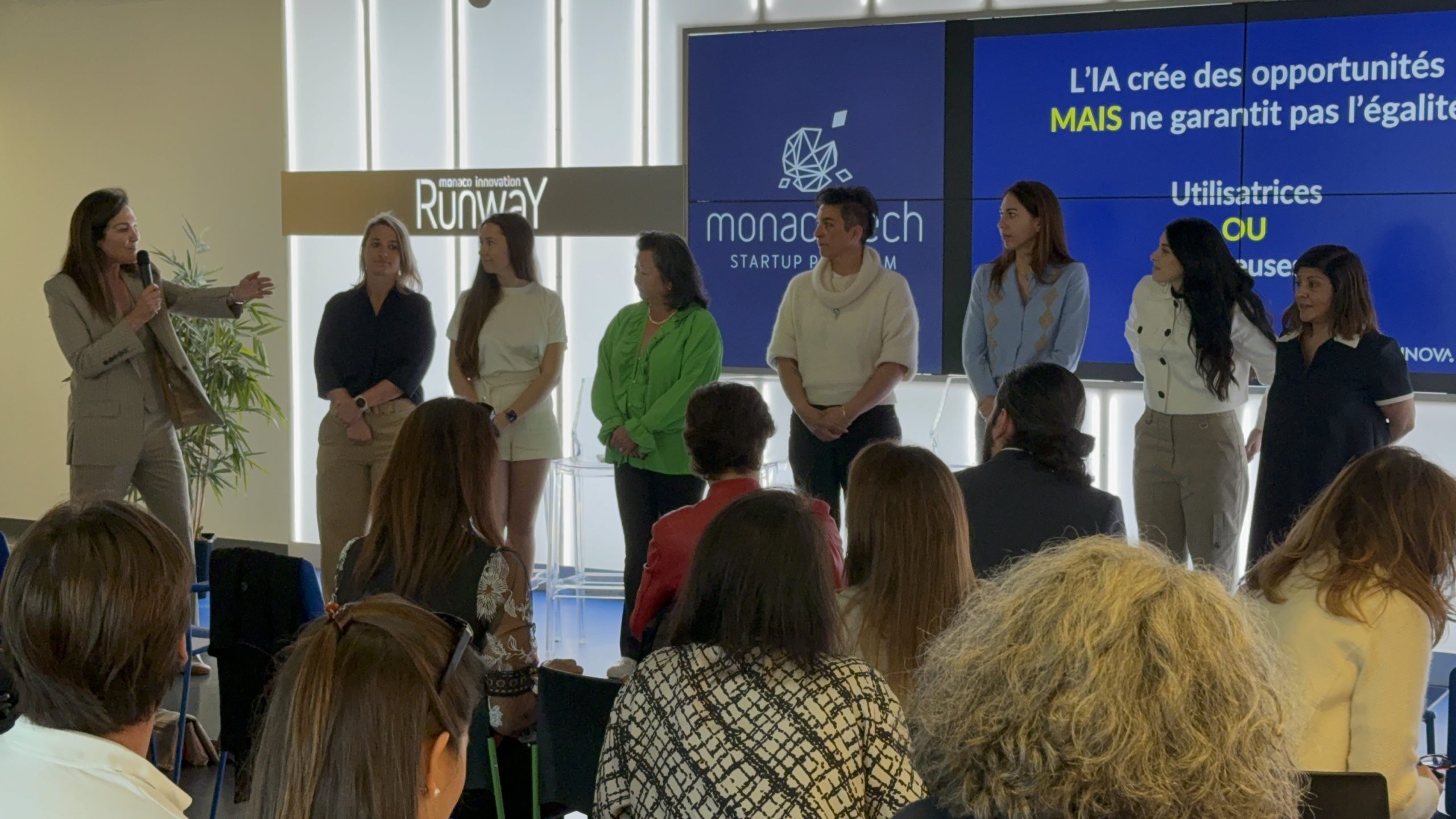
On April 17, 2026, for the Digital Woman Day, I moderated a conference organized in partnership with MonacoTech and the MWF Institute. In the presence of Ms. Céline Cottalorda, Interministerial Delegate for Women’s Rights of the Princely Government, and Théo Campana, her collaborator. The ambition of this gathering was not to comment on yet another technological trend, but to raise a fundamental question. In a world where artificial intelligence is becoming an invisible yet omnipresent infrastructure, who really holds the power to innovate… and above all, to decide?
AI as a Power Infrastructure, Not Just a Technological Tool
From the opening, I deliberately shifted the debate. Artificial intelligence is often described as a technical revolution. However, what I observe through my research and the interviews conducted as part of the EntrepreneurIA project is of a different nature. AI doesn’t simply optimize existing processes. It transforms the very conditions of value creation. It modifies the rules of entry into entrepreneurship, reduces certain structural dependencies, and enables isolated profiles to design, test, and deploy solutions with unprecedented speed. This evolution constitutes a rupture. But it remains profoundly ambivalent.
Apparent Democratization: A Reduction of Barriers Without Real Redistribution
Because while AI lowers barriers, it doesn’t mechanically correct asymmetries. The figures confirm this. Approximately 22% of artificial intelligence professionals are women. This imbalance is not trivial. It conditions the way systems are designed, trained, and deployed. Therefore, the central question is not whether women will use AI, but whether they will participate in its construction, direction, and governance.
WHAT06 and Tech4Elles: Acting on Self-Exclusion Mechanisms
This question requires going back to the root of the problem. Even before the company, even before training, a decisive stage takes place: career guidance. The intervention of Maeva Cecchi and Laure Gajetti, representatives of WHAT06, made visible a widely documented but still insufficiently addressed mechanism. The self-exclusion of young girls from technological fields doesn’t result from a lack of ability, but from a deficit of exposure, projection, and support. Their Tech4Elles initiative follows a logic of early intervention. By connecting young girls with mentors from the Tech industry, it directly acts on the representation of possibilities. This point is essential. In innovation dynamics, perceived legitimacy often precedes actual competence. However, one question remains: can these initiatives, still localized, produce a systemic effect without parallel transformation of educational and economic structures?
Entrepreneurship with AI: Trajectories That Reveal Ongoing Changes
The second part of the conference anchored these reflections in concrete entrepreneurial trajectories. Four female leaders spoke, each embodying a specific way of entering Tech and addressing structural issues.
With Legapass, Adélina Prokhorova is now part of a much deeper transformation than that of a simple digital transmission service. The core of the model has gradually shifted toward direct integration with notarial practices, in a context where the latter are themselves in transformation facing the digitalization of assets.
This positioning makes full sense when observing recent developments in the profession. Notaries are no longer solely public officers responsible for authenticating acts. They are becoming trusted third parties in an environment where assets are increasingly hybrid: real estate, digital data, digital identities, dematerialized documents. Systems like VigiNot already illustrate this evolution, by strengthening security and verification mechanisms in sensitive transactions.
With KLA Digital, Antonella Serine addressed a question that is becoming central in organizations: the governance of artificial intelligence systems. In my analysis of current transformations, this point appears as a major shift. Companies have long prioritized model performance. They now face a new requirement: understanding, documenting, and justifying the decisions made by these systems. The lack of real-time visibility, the difficulty in tracing decision-making processes, and the opacity of models constitute growing risks. We are entering a phase where performance alone is no longer sufficient. Accountability is becoming a structuring criterion. This transition, still incomplete, is nevertheless essential, particularly in a context of reinforced regulation.
The intervention of Claire Ferandier Sicard, founder of Etyc, fits into the structuring of environmental impact in the yachting sector. What her model reveals is a paradigm shift. Companies can no longer simply assert their commitment. They must demonstrate it, quantify it, trace it. AI plays here the role of orchestrator. It enables the collection, structuring, and analysis of complex data to produce reliable indicators. But this capability raises a critical question. Is AI a tool serving sustainability, or does it contribute, through its energy consumption, to aggravating the imbalances it claims to measure? This tension currently runs through all digital transformation strategies.
Nathalie Mindus extended this reflection by introducing a notion still too marginal in technological discourse: sobriety. In an environment dominated by acceleration and optimization, she proposes a more selective approach. The issue is no longer just knowing what technology allows us to do, but what is relevant to do. This distinction is fundamental. It invites us to move away from a logic of systematic innovation to reintroduce reflection on utility, impact, and responsibility. In a context where AI is becoming omnipresent, this capacity for discernment could constitute a major strategic advantage.
Yasmina Salmandjee: The Strategic Role of AI “Facilitators”
The conference concluded with an exchange with Yasmina Salmandjee, whose positioning as a “facilitator of generative AI” illuminates an often underestimated dimension: that of understanding. The adoption of generative AI tools is rapid. But it is accompanied by a deficit in mastery. This gap creates a form of cognitive dependence. Using without understanding amounts to delegating part of one’s decision-making capacity. In this context, pedagogy is not only about popularization. It becomes a lever for autonomy. Understanding AI means being able to question it, divert it, master it.
Artificial Intelligence Redefines the Rules of the Game.
If I had to retain the essence of this conference, I would formulate an unambiguous conclusion. Artificial intelligence redefines the rules of the game. It opens unprecedented opportunities, but it in no way guarantees their equitable distribution. The question is therefore not technological. It is political, economic, and social. What place will women take in this transformation? Will they primarily be users of systems designed by others, or will they become designers, decision-makers, and architects of these new infrastructures?
This question remains open. It calls for a collective response. But it requires, above all, individual awareness. In a world where AI increasingly structures our environments, learning to use it is no longer enough. It becomes necessary to learn to understand its logics, and above all to direct its purposes.