Article written by Pascale Caron for #EntrepreneurIA
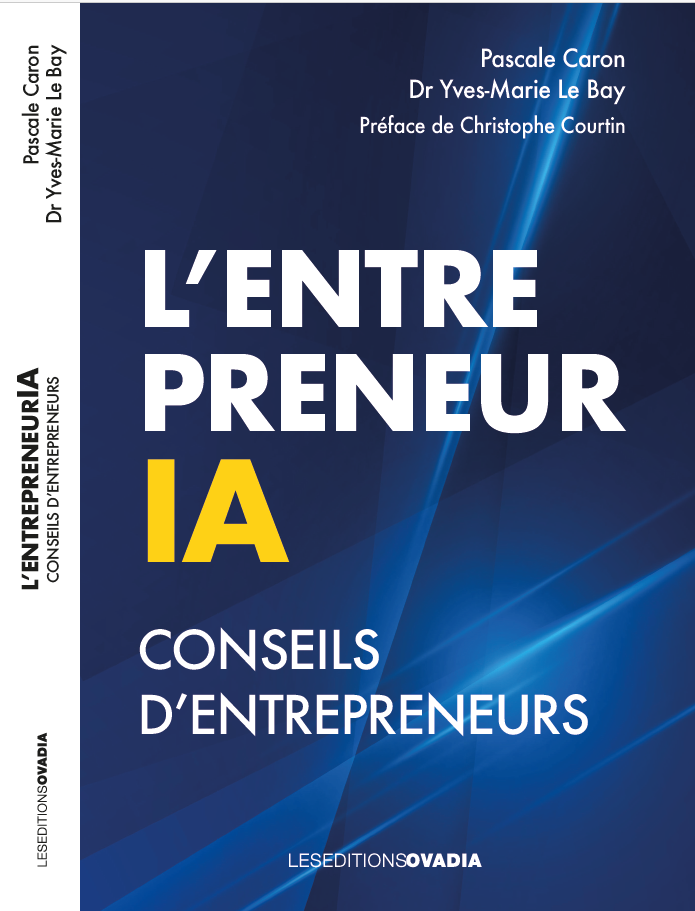
AI is transforming entrepreneurial discourse, but is it truly transforming businesses? This is the question the book L’EntrepreneurIA — Conseils d’entrepreneurs (EntrepreneurIA — Advice from Entrepreneurs), co-written by Pascale Caron and Yves-Marie Le Bay and published by Ovadia, attempts to answer. Unlike publications that theorize the impact of artificial intelligence on the economy or work, this book starts from the field. It gives voice to more than one hundred French business leaders. Not to provide a general overview, but to convey, through their own words, their practices, their doubts, their trade-offs. This is the uniqueness of this investigation: not to speak on behalf of entrepreneurs, but to make their experience heard. The book is situated at a pivotal moment. AI has become accessible, its applications are deploying at high speed, but companies are still struggling to move beyond the experimentation phase. We are witnessing a multiplication of tests, without always managing to structure a strategy. The book’s ambition is therefore to propose a framework for understanding based on living material: testimonials, concrete cases, feedback on failures or investments.
The work is the result of a duo of authors with strong complementarity.
Pascale Caron, engineer and entrepreneur, journalist and speaker, has been working for several years in contact with business leaders facing digitalization. She heads Yunova Consulting, supports AI projects in various sectors, and facilitates regular exchanges between researchers, industrialists, and innovators. Her approach, rooted in observation, draws from a critical perspective on dominant narratives of technology. She questions uses, appropriation logics, and forms of acculturation.
Alongside her, Dr. Yves-Marie Le Bay, lecturer-researcher, PhD in artificial intelligence applied to marketing, brings methodological rigor, academic depth, and a keen sense of pedagogy. He teaches at Université Côte d’Azur and EDHEC. Together, they have built a framework for understanding that is both lucid and accessible, avoiding simplifications while maintaining great analytical clarity.
The book is prefaced by Christophe Courtin.
Entrepreneur, investor, founder of Courtin Investment Group, he emphasizes from the very first lines the importance of a pragmatic perspective on AI. This preface does not seek to promote a model or a trend. It asserts a requirement: any technological integration must be examined in terms of its real value, its ability to fit into a clear and measurable strategy. AI, according to him, cannot be a gimmick. It must respond to operational needs, strengthen the leader’s vision, enhance execution quality. This framework set at the opening sets the tone for the book. It will not be about celebrating innovation for its own sake, but about understanding how it transforms — or fails to transform — organizations.
Throughout the interviews, several main themes emerge.
Far from disruptive promises, artificial intelligence is primarily used as a lever for efficiency. The most common uses involve content generation, automation of repetitive tasks, decision support, and optimization of internal processes. These are localized applications, with low entry costs, often driven by support functions: communications, marketing, customer service. For many companies, these initial experiments have freed up time, streamlined workflows, and improved responsiveness. But the testimonials also show the limitations of these approaches. As soon as one seeks to industrialize, to scale up, to integrate AI into critical processes, obstacles appear. Lack of reliable data, cultural resistance, legal uncertainty, absence of internal skills. AI then reveals the structural weaknesses of the organization. It is not a neutral accelerator. It acts as a revealer.
Behind the technical challenges, it is the role of the business leader that is being transformed.
Several interviewees speak of a shift in posture. It is no longer just about delegating innovation to experts or a technical department, but about getting involved in defining use cases, in strategic management, in data governance. AI does not merely modify processes; it redefines roles. It forces a different way of thinking about the value chain, anticipating human impacts, clarifying objectives. The book emphasizes this point: successful AI integration does not rest on the performance of models, but on the ability to create a framework for collective appropriation. The quality of dialogue between business units, decision-makers, and experts becomes a key success factor.
What the investigation reveals is also the need to move beyond trend-driven management.
Many of the business leaders interviewed emphasize the pressure to innovate, strategic mimicry, the desire to “do like others.” But very few regret having taken the time to ask the right questions: why this use case? For what benefit? On what timeline? Under what conditions of ethics, security, social impact? These simple questions, too often neglected, structure successful approaches. What L’EntrepreneurIA offers is not a manual of solutions, but a method of questioning. It does not say what to do. It helps to think and define one’s strategy.
This book finds its relevance in a period when discourse on AI is polarized.
On one side, excessive enthusiasm. On the other, fears of replacement and loss of control. Between these two poles, the authors propose another path: that of lucid analysis, based on observation, feedback, and confrontation with reality. It is addressed to those who are not seeking to be first, but to be most coherent. It is addressed to those who consider that artificial intelligence is only valuable through the human systems it strengthens, the values it serves, and the questions it forces us to formulate.
So will you be this EntrepreneurIA?