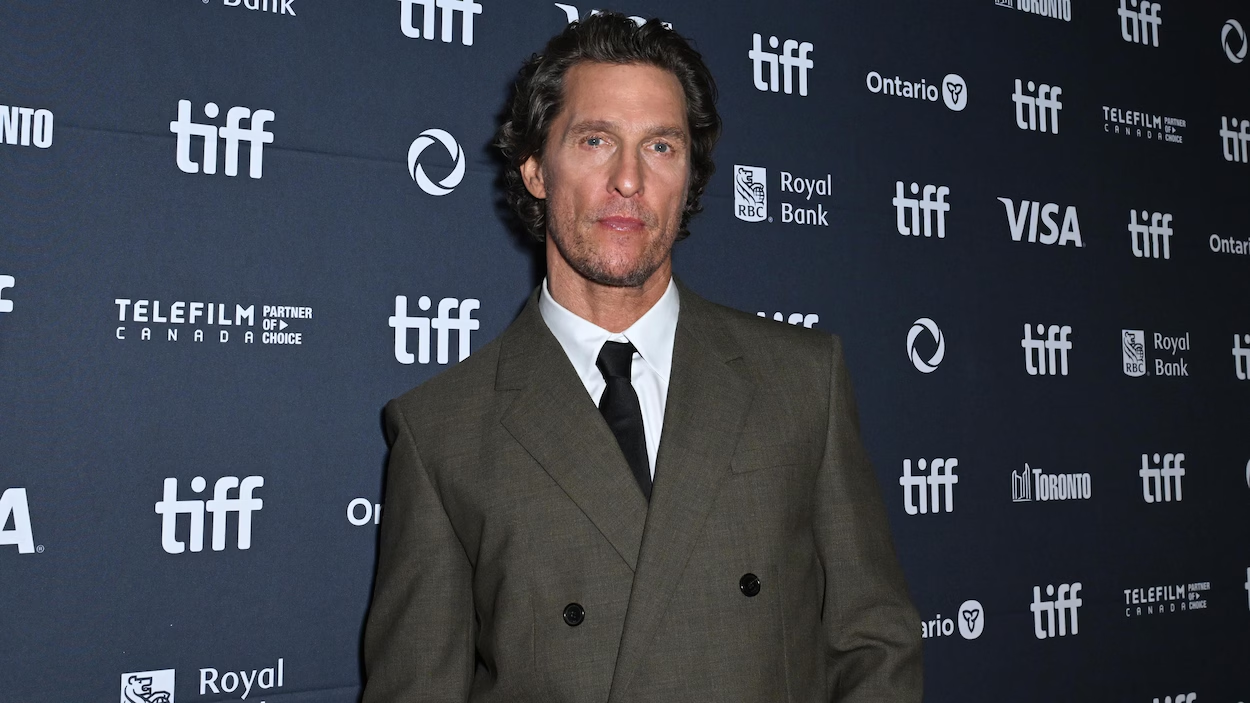
Matthew McConaughey doesn’t just endure artificial intelligence. He anticipates it, frames it, directs it. In a world where identities can be modeled, cloned, and commodified, the American actor draws a clear line: AI must not erode the integrity of human voices, but rather amplify their reach. His approach fits into a contemporary tension: protecting what defines us while exploring new forms of storytelling. In doing so, he opens a debate that goes beyond Hollywood. He engages creators, engineers, legal experts, and the general public.
A career built on narratives of humanity
McConaughey has never been content just to act. In Dallas Buyers Club (Oscar for Best Actor), Interstellar, True Detective, and Dazed and Confused, he explores figures of rupture: between the intimate and the cosmic, between individual suffering and collective issues. Time, memory, identity, and decision-making are at the heart of his roles.
This narrative foundation lends weight to his stance on artificial intelligence. For him, it’s neither a gimmick nor a technical fantasy. It’s a cultural turning point. When tools can reproduce his voice, face, and intonations without his authorization, an entire conception of the right to identity is shaken.
Eight trademarks filed to define boundaries
In 2025, McConaughey makes a strategic decision. He files eight trademarks with the USPTO (United States Patent and Trademark Office). These trademarks don’t just cover his name or image. They include clips and signature phrases—notably his famous “Alright, alright, alright” spoken in Dazed and Confused (1993).
This gesture is defensive, but clear-sighted. In a world saturated with deepfakes, the best protection often remains the one that’s anticipated. By registering his identity elements as trademarks, the actor equips himself with legal leverage. He’ll be able to react quickly if unauthorized AI-generated use were to circulate.
In a statement relayed by the Wall Street Journal, he clarifies:
“My team and I want to know that when my voice or image is used, it’s because I gave my consent. We want to establish a clear framework around ownership, where consent and attribution are the norm in a world shaped by AI.”
This strategy, however, doesn’t cover all potential uses. Trademark registration primarily protects commercial exploitation in a given context. It doesn’t replace image rights, personality rights, or recourse in cases of defamation or fraud. The legal framework remains fragmented.
Direct involvement in the AI ecosystem
McConaughey isn’t technophobic. He doesn’t just defend his rights. He invests. And he experiments.
In 2024, he becomes a shareholder in ElevenLabs, one of the most advanced companies in AI voice synthesis. The startup, valued at several billion dollars, develops technologies capable of reproducing a voice with striking realism from just a few minutes of recording.
With ElevenLabs, McConaughey designs an original project. His newsletter Lyrics of Livin’, previously distributed only in English, is translated into Spanish and read by an AI replica of his own voice. He oversees the process. He gives his consent. And he stands by the approach.
“I’m proud to be an investor in ElevenLabs. What doesn’t change is the power of storytelling and the creative potential these technologies can unleash.”
The choice is deliberate. It demonstrates that AI can serve to expand audiences, break through language barriers, without denying the author’s identity. Provided, always, that consent is explicit.
Pragmatic ethics in the face of widespread copying
This dual posture—legal and creative—gives McConaughey a unique position in the AI debate. He doesn’t call for banning voice clones. He doesn’t oppose technological advances. He asserts a clear line: AI must not dissolve the author.
- What McConaughey proposes is an implicit charter: AI is not a substitute for the person. It extends, with their consent. Any vocal or visual simulation must be framed by a contract.
- The public has a right to transparency: knowing whether what they hear is real or generated.
This position resonates with recent mobilizations by SAG-AFTRA (the American actors’ union), which demands minimum guarantees on AI uses in audiovisual: written authorization, limited duration, traceability, compensation.
Tools that aren’t sufficient for everyone
McConaughey can act this way because he has the means. He has a legal team. He’s heard. He can select his partners.
But the majority of creators don’t have this shield. Voice actors, voice-over artists, independent artists, documentary narrators, streamers: all are exposed to capture, duplication, and non-consensual exploitation of their voice. Some have already been cloned without their knowledge. Others see their work used to train models, without compensation or notification.
The McConaughey case thus shows a possible path. But it doesn’t solve the systemic question: how to protect vocal identities at scale? With what accessible tools? For which audiences?
An opening debate: frame, trace, attribute
The answers are still being constructed. Three paths are emerging.
- The contractual route: imposing standard clauses on clone usage. The quickest option, but reserved for those who negotiate.
- The sectoral route: defining common standards. Such as automatic labeling of AI-generated voices, or interoperable consent registries.
- The legislative route: several U.S. states are already adapting their legislation. Tennessee adopted the ELVIS Act in 2024, which strengthens voice protection against unauthorized AI uses. Europe, for its part, is pushing for transparency within the AI Act framework.
In this transition, McConaughey acts as a pioneer. He doesn’t impose a model, but he establishes a framework. And this framework can inspire.
What his example tells us about the future of creative industries
It’s not just the film world that’s concerned. Voice is becoming an asset. The boundaries between human narration and algorithmic reproduction are blurring. What we thought was intimate—timbre, intonation, breath—becomes replicable.
Faced with this transformation, creative industries must choose. Either they let it happen. Or they define new principles: explicit consent, systematic attribution, equitable value sharing.
By setting limits, McConaughey isn’t slowing down innovation. He’s establishing the conditions for its acceptability. He’s essentially saying: AI must not erase the human, it must augment without betraying.
References
- Wall Street Journal, McConaughey’s statement on uses of his voice and the importance of consent.
- USPTO (United States Patent and Trademark Office), trademark registrations filed between 2023 and 2025.
- Variety and People Magazine, timeline of trademark filings.
- ElevenLabs official website, announcement of McConaughey’s investment.
- Associated Press, abusive uses of voice AI and ElevenLabs’ response.
- SAG-AFTRA, documentation on union demands regarding AI.
- European Commission, AI Act regulation and transparency requirements.
- State of Tennessee, ELVIS Act, strengthening rights to voice and likeness.