
For two years, artificial intelligence has entered businesses through content generation. Text, images, code, summaries. Generative AI was initially perceived as a tool for augmenting individual productivity.
We are now entering a more structural phase: that of agentic AI.
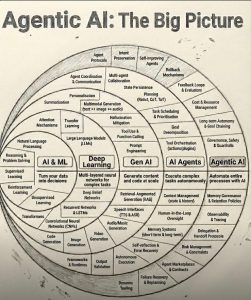
The diagram you see does not represent a single technology, but rather a maturity architecture. It shows how AI evolves, layer by layer, from classic machine learning to systems capable of acting autonomously in complex environments.
The visual “ Agentic AI: The Big Picture ” comes from a LinkedIn post by Brij Kishore Pandey.
For an entrepreneur, understanding this progression is not a theoretical exercise. It is a prerequisite for making the right investment, organizational, and governance decisions.
From Analytical AI to Agentic AI: A Layer-by-Layer Evolution
The most common mistake is to speak of “AI” as a homogeneous block. In reality, the diagram highlights five major functional layers, each addressing a different use case.
1 AI & Machine Learning: Transforming Data into Decisions
The first layer corresponds to traditional AI.
It relies on supervised, unsupervised, or reinforcement learning models. Its role is clear: analyze data, detect patterns, produce predictions.
In business, this layer powers:
- demand forecasting,
- fraud detection,
- logistics optimization,
- customer or financial scoring.
It is powerful, but fundamentally reactive. It does not decide. It illuminates.
2 Deep Learning: Managing Complexity
The next layer introduces deep neural networks.
CNN, RNN, LSTM, transformers. These architectures enable the processing of unstructured data: images, text, voice, video.
This is where AI becomes capable of recognizing, classifying, translating, and understanding complex forms.
But it remains encapsulated in specific tasks. Each model addresses a precise function.
3 Generative AI: Producing at Scale
The visible breakthrough for entrepreneurs appears with generative AI.
Large language models and multimodal systems now make it possible to produce content, code, analyses, and summaries at unprecedented speed.
This layer provides:
- generation of business texts,
- code production,
- conversational assistants,
- RAG, which connects AI to internal document databases.
But here again, AI awaits an instruction. It does not drive a process. It responds.
4 AI Agents: From Execution to Action
The real shift begins with the next layer: that of AI agents.
What is an AI agent?
An agent is not merely a model.
It is a system capable of: understanding an objective, breaking it down into subtasks, mobilizing tools, maintaining state, executing an action, self-correcting. In other words, the agent acts over time.
In a business, an agent can: orchestrate a marketing campaign, analyze an incident and trigger corrective actions, manage a financial workflow, coordinate multiple software tools. The agent is no longer just a generator. It becomes an executor.
The Key Building Blocks of Agenticity
The diagram highlights several essential components.
- Planning: ReAct, Chain-of-Thought, Tree-of-Thought. The agent reasons before acting.
- Goal decomposition: a strategic objective is transformed into operable tasks.
- Tool orchestration: the agent calls APIs, software, plugins.
- Context management: short and long memory, decision history.
- Human oversight: the human remains in the loop when risk requires it.
This layer already introduces a central question for the leader:
how far to delegate without losing control?
5 Agentic AI: Autonomy, Coordination, and Governance
The final layer of the diagram is the most strategic.
It goes beyond the isolated agent to enter coordinated agent systems.
Multi-Agents and Collaboration
Agentic AI relies on agents capable of: communicating with each other, distributing roles, negotiating priorities, coordinating complex actions. We are no longer talking about automating a task, but managing an end-to-end business process.
Persistence, Memory, and Long-Term Autonomy
An agentic system retains: the state of decisions, long-term objectives, constraints, the history of errors.
It can operate over long cycles.
This is what enables sustainable autonomy, but also what increases organizational risk.
Governance, Security, and Guardrails
The diagram emphasizes a point often underestimated: agentic AI cannot exist without governance.
Control mechanisms become central: rollback mechanisms, evaluators and feedback loops, cost and resource management, memory and retention policies, observability and traceability, risk and constraint management.
For an entrepreneur, this is where the credibility of the AI project is at stake.
What Agentic AI Concretely Changes for Entrepreneurs
Agentic AI transforms the relationship to the information system.
We are no longer just configuring tools.
We are delegating operational responsibilities.
This implies: a redefinition of human roles, a clarification of responsibilities, an upskilling of management in AI.
Performance is no longer measured solely in productivity gains.
It is measured in: orchestration capacity, reduction of internal friction, decision speed, coordination quality between systems.
Not all companies are ready. Agentic AI requires: formalized processes, governed data, a culture of objective-driven management, the ability to audit one’s own decisions. Without this, the agent becomes an amplifier of chaos.
Strategic Questions to Ask Before Adopting Agentic AI
For a leader, the challenge is not to follow a trend, but to ask the right questions.
- Which processes are truly delegable?
- Where is the red line of human control?
- How to audit a decision made by an agent?
- Who is responsible legally and operationally?
- What is the real cost of long-term autonomy?
- How to avoid the accumulation of cognitive and organizational debt?
Agentic AI is not a technology, it is a governance choice
The agentic AI diagram does not describe a distant future. It describes an architecture already being deployed. For entrepreneurs, the challenge is not knowing whether this evolution will happen, but how to approach it without naivety.
Agentic AI does not merely automate tasks. It redistributes the power to act within the company. And any redistribution of power requires strategic, human, and ethical reflection. This is the level at which the true value of AI is determined.