

 At the conference organized by the Monaco Economic Board at the Monaco Yacht Club, Edmund Shing, Global Chief Investment Officer at BNP Paribas Wealth Management, laid out a structured vision of the global economy and financial markets through 2026 for nearly an hour. His central message is clear: despite political noise and debt concerns, the growth-markets dynamic remains supported by powerful public policy backing, persistently higher inflation, and a geographic reshuffling of equity performance.
First pillar of his optimism: governments are not pulling back—quite the opposite.
In the United States, 2025 was “the year of taxes.” 2026 could become the year of tax cuts. On the horizon: the November midterm elections. To maintain control of the House of Representatives and the Senate, the Trump administration would have every interest in “giving something to voters” in the form of targeted household tax cuts.
In Europe, the dynamic is different but equally expansionary. The defense effort decided within NATO, combined with infrastructure plans—particularly in Germany—is fueling a wave of public spending. Shing reminds us with humor: German trains are “dangerously approaching British trains in terms of delays,” a sign that investments have become essential.
In Asia, Japan under Prime Minister Takahashi is strengthening support for domestic consumption. China, despite its real estate fragilities, remains in a logic of targeted activity support.
Everywhere, the same movement: major economies are embracing expansionary budgets to support growth and employment.
Second pillar: the progressive easing of monetary policies.
The curves projected on screen show the already initiated decline in global policy rates. The “global policy rate” is sliding from 4.5% to 3.5% and should continue its descent. In the eurozone, rates have already been brought down to around 2%, far from the 4% reached a few quarters earlier.
In the United States, the Fed is on a trajectory of gradual cuts, under dual influence: the economic cycle and political pressure. Donald Trump must appoint a new Federal Reserve Chair in May; he will “obviously choose someone favorable to lower rates,” Shing anticipates. Likely result: a smoothing of the inflation target.
According to him, the Fed and other central banks will durably accept inflation around 3%, not 2%, considering that “it’s close enough” to the official target. This shift is not just monetary; it’s fiscal: with high public debt, slightly higher inflation allows nominal GDP to grow faster and thus tax revenues, facilitating debt servicing.
In other words, a bit of inflation becomes an implicit solution to the debt problem, provided it remains tolerated by markets.
Public debt: a political risk more than an immediate one
On the slides devoted to debt-to-GDP ratios, France occupies a middle position. Yes, the debt is high. No, the country is not on the verge of collapse, insists Shing.
What interests him is not so much the stock of debt but its annual cost. He measures it as a proportion of each state’s tax revenues. By this measure, the situation appears counterintuitive: France finds itself in the middle of the pack, far behind the real weak link… the United States.
With higher rates, the cost of American debt already exceeds federal defense spending. Japan, conversely, displays colossal debt but very low financing costs, thanks to near-zero domestic rates.
The message delivered to the Monaco audience is nuanced: France’s fiscal trajectory is worrying for the long term, but the situation is far from “critical today.” The main alert concerns rather the United States, where the combination of high debt, rates still higher than the rest of the world, and dollar weakening could become explosive.
A new inflation regime: why 3% changes the game for portfolios
The projected charts show the decline in global inflation since the 2022 peak. On a planetary scale, it is stabilizing around 3%. In the eurozone, it returns close to 2% and could even drop below next year.
Yet Edmund Shing insists: we will not return to the pre-COVID world, marked by structurally sub-2% inflation. Demographic aging, geopolitical tensions, industrial relocations, energy transition, and underinvestment in commodities argue for a durably higher inflation regime.
What does this “3% regime” mean for investors? The tables he comments on live are clear:
- Between 2% and 4% inflation, equities are historically the best-performing asset in real return terms.
- Bonds offer more mediocre performance.
- Cash is systematically losing in terms of purchasing power.
In a world stabilized around 3% inflation, the portfolio core must therefore remain invested in equities, supplemented by real assets and certain targeted bond pockets.
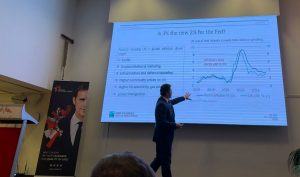 Commodities and strategic metals: the hidden face of AI
The photos projected on screen show rapidly rising price curves. Gold, silver, natural gas, commodity indices: many have reached new peaks.
For Shing, this is neither an accident nor a simple cycle effect. We are entering “a new era where commodities are no longer abundant.” Supply has increased little in years, due to lack of mining and energy investments. But demand is picking up, driven by:
- reindustrialization,
- the energy transition,
- digitalization and the explosion of generative AI, highly energy-intensive and therefore consuming gas, copper, and rare metals.
Copper occupies a special place in his demonstration. Essential to all electrical infrastructure, data centers, and electric vehicles, this metal becomes an indirect but powerful proxy for AI development. Mines are struggling to keep up, particularly in Chile and Indonesia. BNP Paribas targets a price of $13,000 per ton at 12 months, versus $11,000 currently, representing nearly 20% potential increase, with even greater leverage for mining companies.
Gold remains, according to him, a portfolio pillar. He reminds us that the yellow metal has gained about 60% this year, while Bitcoin offered neither protection nor stability. Central banks seeking diversification away from the dollar, Asian individuals using gold as savings, institutional investors: structural demand remains solid. Silver and platinum complete this “precious metals” block.
United States: when the AI bubble meets the energy constraint
Many investors present in Monaco are exposed to major American tech stocks. Edmund Shing directly addresses the question that concerns them: “Are we in an AI bubble?”
He doesn’t predict an immediate crash but highlights two major flaws:
- Uncertainty about the winners. As during the construction of railroads in the 19th century, the final beneficiaries could be less the infrastructure operators (the “Magnificent Seven”) than AI users in healthcare, banking, or industry. The analogy with companies that benefited from railways rather than the railroad companies themselves is deliberate.
- The cost of capital and energy. Cloud giants are multiplying data center projects, financed by massive debt issuances. Simultaneously, electricity and natural gas prices are soaring in the United States, driven precisely by this new demand. In some regions, data centers find themselves in direct competition with households and businesses for access to the electrical grid.
Shing anticipates that several U.S. states will impose constraints: obligation to build dedicated production capacity alongside new data centers, limitation of direct grid connections, or even targeted tariff increases. All factors likely to reduce the marginal profitability of AI investments and slow the bubble’s pace.
Europe: sluggish productivity but pockets of excellence
The projected slides leave little doubt: Europe has fallen behind in terms of growth. Between 2022 and 2025, U.S. and especially Chinese GDP grows faster than the eurozone’s. Labor productivity increases only 0.4% per year on average, versus 1.5% in the United States, and even becomes negative after COVID.
Another handicap: research and development efforts. Eurostat curves show a growing gap with Japan, South Korea, and the United States, which devote a much larger share of their GDP to innovation.
Yet Shing refuses the declinist discourse. He points to several structural assets:
- Robust employment growth, particularly in France, where the employment curve now follows that of the eurozone. Less unemployment means more purchasing power and consumption.
- A credit recovery: since 2024, loan growth has resumed, fueling investment. European banks fully benefit, with their stock prices having spectacularly outperformed in 2025.
- A very dense fabric of SMEs and family businesses. In many countries—Spain, Italy, Portugal, the United Kingdom—family-owned companies represent a significant share of GDP. Historical studies show that companies where the founder or family controls a significant share of capital outperform on the stock market over the long term. Longer strategic horizon, increased financial discipline, alignment of interests with shareholders.
For the investor, the practical conclusion is: beyond major European indices, one must look at small and mid-caps, particularly those with strong family ownership.
Asia and emerging markets: the great forgotten of European portfolios
The other major axis of the presentation concerns portfolio geography. In 2025, most European clients remain underexposed to Asia and emerging markets, Shing notes. Yet these are precisely the regions that concentrate:
- the most dynamic economic growth,
- innovation in breakthrough technologies (batteries, robotics, industrial AI),
- and the rise of domestic capital markets.
The CIO highlights Japan and South Korea, where governance reforms are pushing companies to treat their shareholders better and improve profitability. In Latin America, he emphasizes the attractive combination of still-cheap markets, central banks in rate-cutting phase, and governments becoming more pro-business. Brazil and Mexico, but also Chile and Guyana, also benefit from a massive investment cycle in oil and agricultural commodities.
On the bond side, emerging market local currency bonds still offer yields close to or above 6%, with risk deemed more manageable than U.S. high yield. A gradual appreciation of emerging currencies against a declining dollar would constitute an additional bonus.
Six major investment themes for 2026
In conclusion, Edmund Shing synthesizes the roadmap for 2026 in a few structural axes:
- Stay invested in equities, while reducing concentration on American technology. Favor “old economy” sectors (banks, defense, healthcare, energy) that have already outperformed in 2025.
- Gain exposure to commodities and strategic metals, particularly copper, aluminum, silver, platinum, and gold, as indirect beneficiaries of AI, the energy transition, and geopolitical tensions.
- Strengthen the yield bond pocket via emerging market local currency bonds and good-quality European financial bonds, rather than through cash or traditional sovereigns.
- Explore energy and storage themes: battery companies, industrial storage solutions, electrical infrastructure necessary for the rise of renewables.
- Rediscover Europe differently: banks and small family-owned caps, where credit recovery, management discipline, and long-term horizon combine.
- Geographically rebalance portfolios toward Asia and emerging markets, potential big winners from a weaker dollar and multipolar global growth.