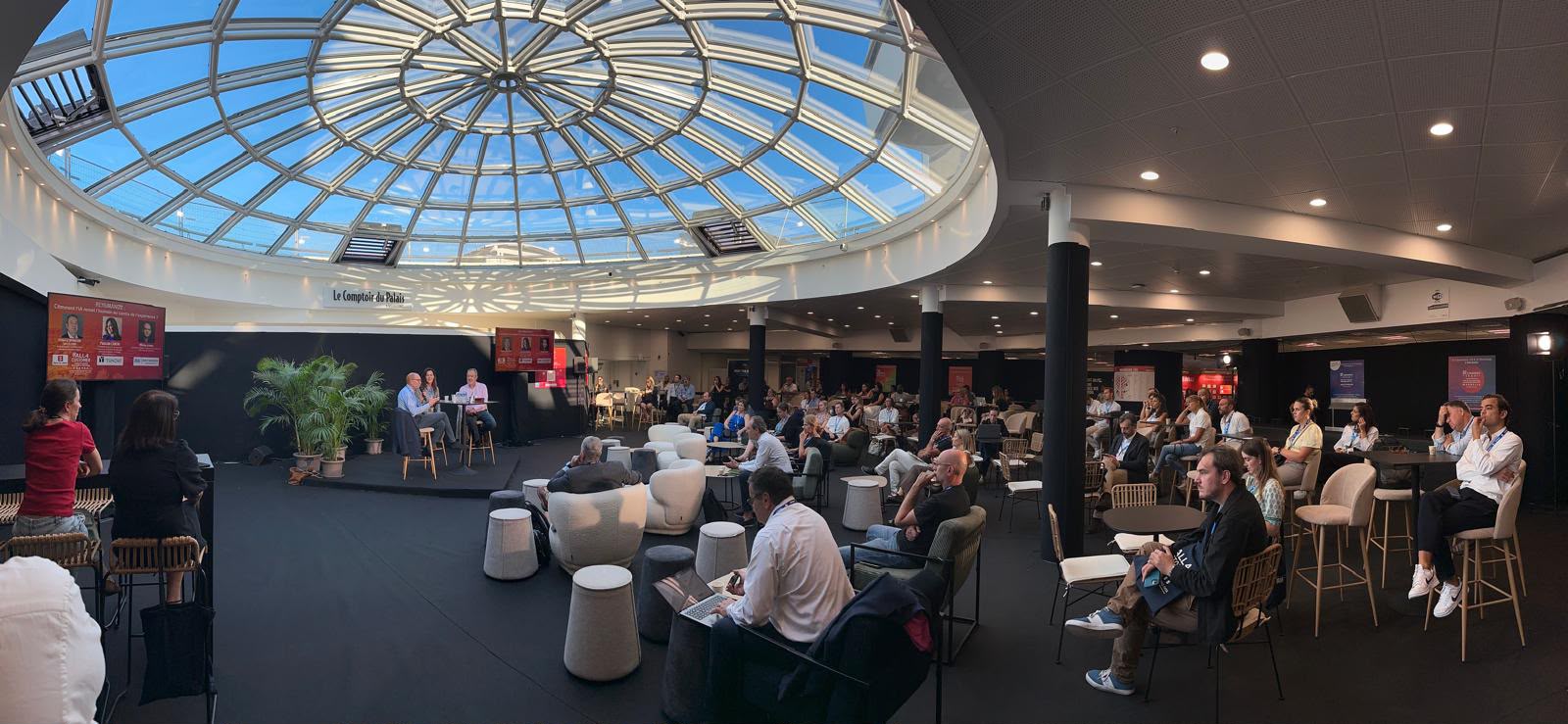
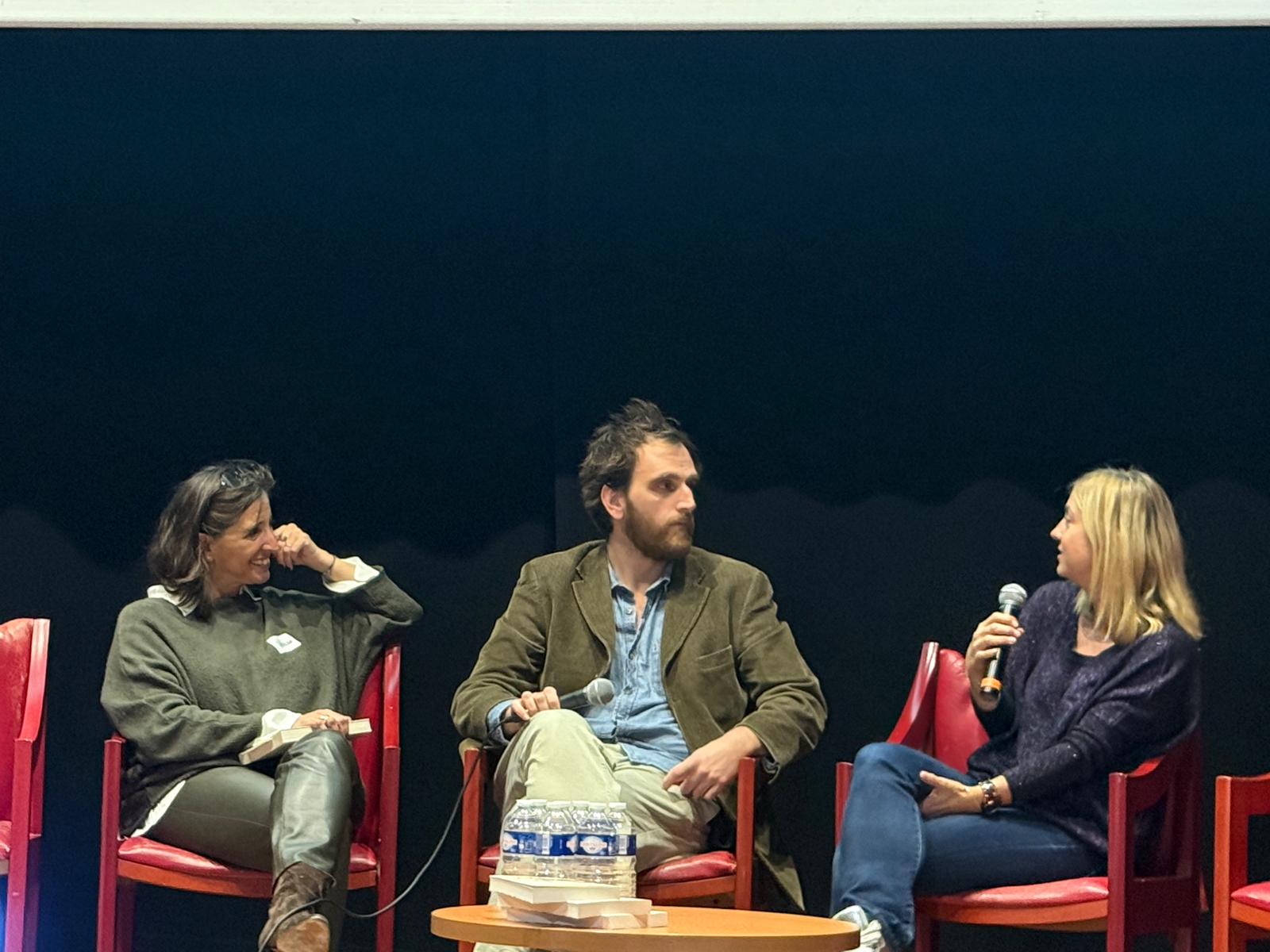
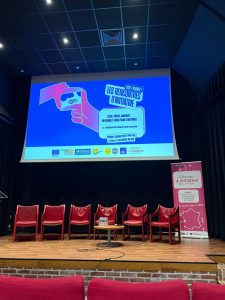
 The room is full, the screen announces the day’s theme: “Daring to Be Bold”. The Initiative Nice Côte d’Azur Meetings open with a major surprise.
Before discussing financing, mentorship or business creation, the floor is given… to literature. And this choice, far from being a mere aesthetic gesture, says much about the Initiative network’s approach: placing humanity at the heart of entrepreneurship.
Sophie Leray: Setting the tone for the day with boldness
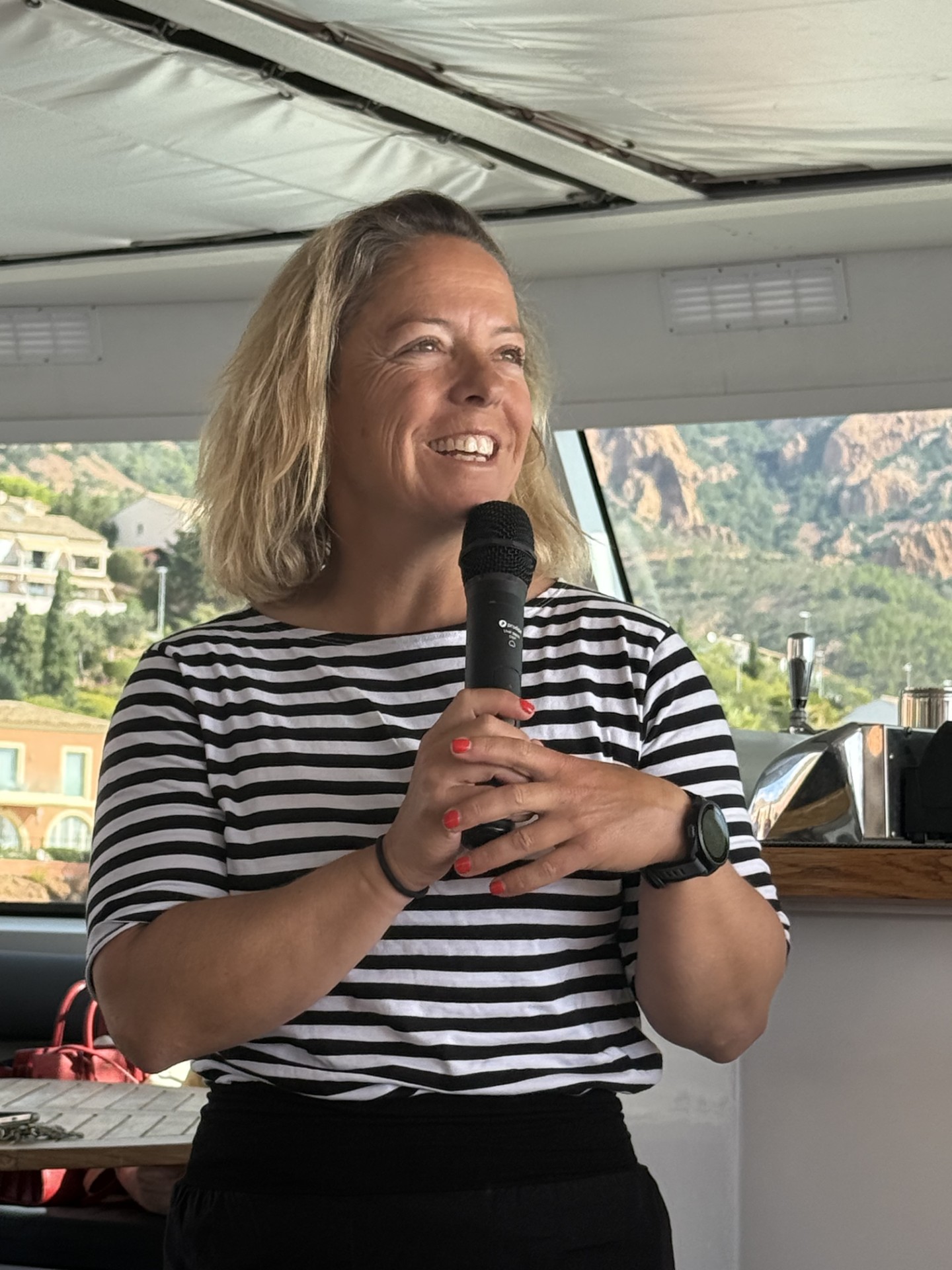
It is Sophie Leray, director of Initiative Nice Côte d’Azur, who opens the panel discussion.
She recalls the network’s mission: to support those who transform an idea into a concrete project, often at a time when confidence wavers. She emphasizes this foundational gesture that runs through all entrepreneurial journeys: taking responsibility for making one’s voice heard, exposing one’s project to others’ scrutiny, moving forward despite fear.
Then, she introduces the two guests who will give this opening an unexpected tone:
- Thibault Daelman, writer, author of L’Entroubli (Le Tripode, 2025),
- Marie Serra, bookseller and owner of the Massena bookstore, privileged observer of readers and their stories.
This first panel discussion will be poetic. It will speak of boldness not as a strategic tool, but as an intimate, physical, existential experience.
Once the introduction is complete, Vanessa Hauret, co-president of Initiative Nice Côte d’Azur, takes over.
She begins by reading aloud a passage from L’Entroubli. A childhood memory. The moment when, in a silent classroom, teenage Thibault is the only one to have completed his writing assignment. The teacher forces him to read. He trembles, sweats, hesitates. Then the sentences escape, carried by a dense, musical language. At the end, people’s gazes change.
This text, Vanessa Hauret chooses to read herself, with gravity. Because it expresses precisely what precedes every business project: that second when one stands up, when one speaks, when one accepts showing something very fragile.
Then she opens the debate, which she will conduct from start to finish with finesse and sensitivity. Through her prompts, she weaves a narrative thread connecting the intimate to entrepreneurship, literature to economic boldness.
The urgency to act: convergences between writing and entrepreneurship
After this reading, the bookseller Marie Serra emphasizes what she feels: an internal urgency. That moment when something asserts itself, breaks free from silence, and pushes one to act.
She explains that every enterprise — literary or economic — is born from the same movement: finding meaning, then committing to it. She also recalls how much the models, words, and stories of others give us permission to imagine our own boldness.
Thibault Daelman then describes his journey: long studies in visual arts, then several years on welfare, writing ten to twelve hours a day, with a rigor he readily compares to that of an entrepreneur at work. Without a contract, without guarantee, without recognition, but with daily discipline.
Vanessa Hauret underscores the parallel: the project leaders supported by Initiative also experience this period when no one is yet waiting for their idea, but when they must act as if it already had a place in the world.
Legitimacy and uniqueness: daring when you don’t come from the “right” place
Marie Serra poses a crucial question: can one dare if one doesn’t feel legitimate?
She evokes the idea that some are born into environments where one becomes “the butcher’s son” or “the writer’s son” almost naturally, while others must conquer this legitimacy step by step.
Thibault Daelman recounts his childhood in public housing. His first memories are of words, not images. He discovers that a word doesn’t reflect reality, but opens a space. Then he meets a French teacher who, in a chaotic classroom, simply utters the word “flower” before reciting Mallarmé. That day, he experiences a shock. Language becomes a parallel world.
Yet, his love of words sets him apart. His brothers mock him: “Stop talking like a bourgeois”. In middle school, they nickname him “the poet”, first derisively, then with a certain respect when he persists in this path.
Vanessa Hauret connects this experience to entrepreneurial realities. Many creators supported by Initiative didn’t grow up in environments where entrepreneurial ambition is valued. They must learn to recognize their own legitimacy even before being validated by a jury or a banker.
Words that liberate: tools of boldness and projection
Marie Serra then recalls the crucial importance of words. Neuroscience shows their impact on our representations, our emotions, our ability to project ourselves.
She insists: perfect synonyms don’t exist. Each word carries a nuance. Saying “try” isn’t saying “undertake”. Saying “project” isn’t saying “business”.
Vanessa Hauret, accustomed to project presentations, confirms this: the way a project leader tells their story has a direct impact on the confidence granted by a committee. Finding the right words is already crossing a symbolic threshold.
Describing a life without judgment: literature as a space of complexity
Thibault Daelman recites from memory a longer excerpt from his book. An illuminated soccer field. Children running. An alcoholic father, massive, strange, almost disturbing. The room is hanging on his voice.
Vanessa recalls that this passage evokes his father, Olivier, a complex figure, neither violent nor brutal, but trapped in his weakness. The mother, too, oscillates between heroism and destructive behaviors.
Thibault Daelman explains that he refuses all judgment. Literature, for him, is not a moral platform. It is a space of perception. A place where human paradoxes are shown without resolving them.
Vanessa Hauret emphasizes that this stance resonates with Initiative’s mission: supporting a creator means welcoming them without reducing them to a difficulty or a lack. It means starting from the complexity of journeys, not from administrative boxes.
Crossing worlds: a dynamic familiar to entrepreneurs
The writer then describes his transition from public housing to more privileged institutions. In the projects, violence is frontal, but solidarity is real. In more bourgeois circles, violence becomes subtle, insidious, social.
From these worlds, he doesn’t choose. He stands “in between”, a fertile space where his literary voice is born.
Vanessa confirms that this positioning is common among creators supported by Initiative: they navigate between different social, economic, cultural universes. They must learn to move between multiple languages, multiple codes, multiple expectations.
Why start with literature?
In closing the panel discussion, Sophie Leray and Vanessa Hauret recall the meaning of this choice.
Opening the Initiative Meetings with poetry is a reminder that every enterprise begins with a personal story. That behind every financial forecast, there is an intimate gesture: that of saying “I want to do this”, despite fear, despite doubts, despite sometimes heavy inheritances.
It’s also a reminder that boldness is not a character trait, but a movement. A giving of voice. A way of accepting one’s uniqueness. A manner of transforming a disconnect into strength.
A question as legacy
Before moving on to the following panel discussions, Vanessa Hauret leaves a question hanging, addressed to all the future entrepreneurs present:
What part of your own story are you willing to put at stake to dare, you too, your own boldness?
A simple question. A starting point.
And perhaps the true engine of all enterprises to come.