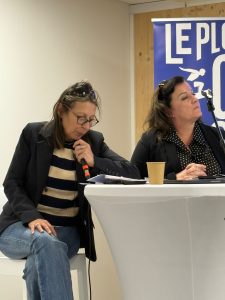
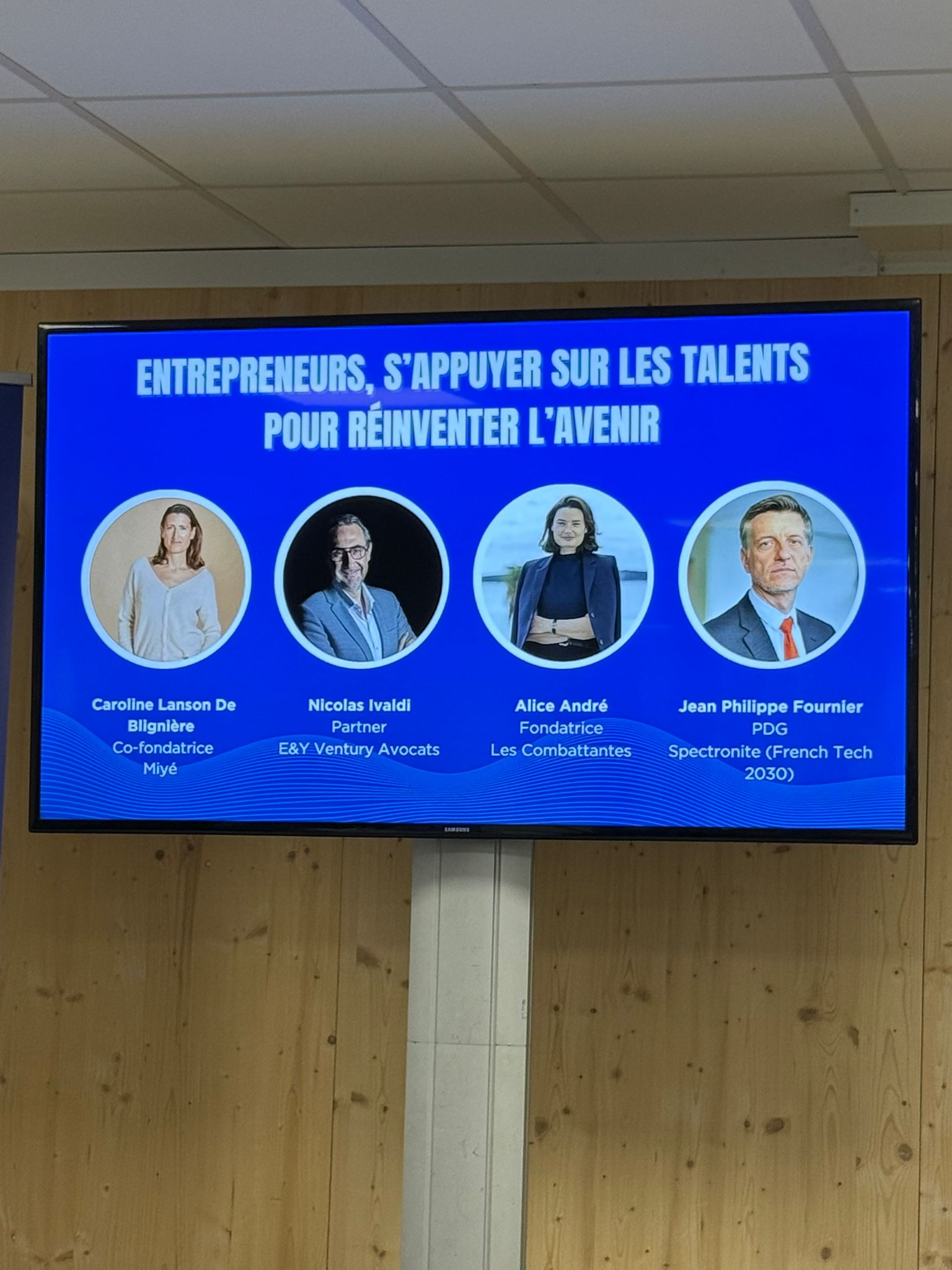
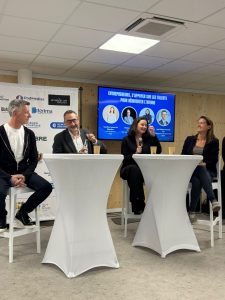
 At the French Tech event in Nice, the panel discussion led by Isabelle Auzias and Karine Wenger placed the question of talent at the heart of entrepreneurial transformation. The title announces the trajectory: to reinvent the future, technical innovation is no longer enough. An organization’s ability to attract, develop, and grow diverse profiles becomes a strategic lever.
The exchanges between Jean-Philippe Fournier (Spectronite), Alice André (Les Combattantes), Caroline Lanson de Blignière (Miyé), and Nicolas Ivaldi (EY Ventury Avocats) reveal the same underlying force: in an uncertain ecosystem, the only truly transformative resource remains human.
Redefining Talent: From Degree to Commitment Capacity
Jean-Philippe Fournier opens the discussion with a clear statement: innovation matters, but the team matters more. Spectronite helps countries with low fiber coverage—Nigeria, South Africa, Mexico, Brazil—improve their 4G and 5G networks. A demanding technological activity, but carried by a small and highly committed workforce.
For him, evaluating talent relies on three simple dimensions: what you have, what you know, who you are. The first criterion—the degree and the school’s brand—appears as the least relevant. Some groups in France still prioritize academic credentials. Spectronite does the opposite. Here, the logic is pragmatic: the degree predicts neither the ability to learn nor genuine motivation. The second criterion—what you know—remains important. An engineer must possess a technical foundation. But Jean-Philippe Fournier refuses to make it the exclusive determinant. The third criterion—who you are—becomes decisive. The example he gives is revealing: a Brazilian intern, a six-year gap in her CV, no direct connection to telecommunications. Nothing that fits traditional recruitment standards. But exceptional motivation. A capacity to project herself forward. An energy that’s hard to fake.
This vision opens a central question for entrepreneurs: what, in a career path, truly matters?
Jean-Philippe Fournier recalls an often-overlooked truth: a PhD is not just a sign of competence. It’s proof of the ability to persist for three years in a specialized field, alone, facing complexity. A demonstration of discipline rather than an intellectual badge. This capacity for perseverance distinguishes profiles capable of contributing to an innovation project. It reflects a dynamic conception of talent: it’s not a stock of knowledge, but a relationship with effort. In an environment where technical cycles constantly renew themselves, seeking perfect alignment between a position and a CV is an illusion. The only relevant question becomes: can this person learn, pivot, handle uncertainty, and keep moving forward?
When asked how talent reinvents the future, Jean-Philippe Fournier offers a nuanced answer. The company has a written vision, a defined direction. But the path remains open. In a team of six people representing five nationalities, each member brings a different interpretation of this vision. The trajectory is stable. The route, however, is redrawn through contact with individuals. This idea challenges entrepreneurial leadership: how do you reconcile strategic intent with human plasticity?
Spectronite relies on cultural diversity as a source of unexpected solutions. The future is not just a goal; it becomes a co-creation. The example of the young Brazilian intern returns as a recurring thread. She comes from business management, loves mathematics, wants to train in data. Jean-Philippe Fournier doesn’t just evaluate her current skills but her potential learning speed. In a context where technologies constantly evolve, this speed becomes an essential marker.
This “career intelligence”—the ability to reinvent oneself—becomes a strategic criterion. It raises a crucial question: how do you identify, during an interview, a person’s ability to scale?
 Alice André: The Battle for Female Presence in Innovation
Alice André shifts the debate to essential ground: women’s place in strategic economic sectors. She begins with a striking figure: only 4 women lead CAC 40 companies.
The obstacles are multiple: maternity, self-confidence, perimenopause, managerial archetypes, sociocultural reproduction mechanisms.
She recalls a quantified reality: 48% of female entrepreneurs don’t pay themselves a salary. And among those who do, the average salary is around 700 euros per month.
This vicious circle weakens female entrepreneurship: economic dependence, family overload, slowed development, premature closure.
The arrival of AI accentuates this gap. At Adopt AI at the Grand Palais, she observes a very clear dominance: “white men aged 30 to 50.”
The question takes on a collective dimension: what happens to society if women don’t fully participate in the data and AI economy?
Alice André recalls an often-ignored phenomenon: for ten years, mathematics was no longer mandatory in high school. This gap hit girls particularly hard, as they drop out earlier than boys. Result: a massive obstacle to entry into strategic fields—finance, engineering, digital.
The consequence is structural: difficulty accessing decision-making positions. This gap directly challenges France’s ability to build an inclusive economy in the most promising sectors.
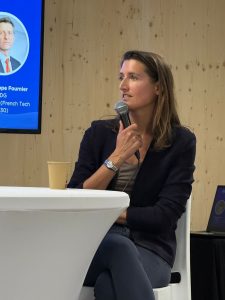 Caroline Lanson de Blignière: Raising Funds, Challenging Archetypes
Caroline Lanson de Blignière, co-founder of Miyé, addresses the topic of financing.
She hasn’t personally experienced discrimination during her fundraising, but she observes the phenomenon systemically: as soon as a founding team includes a woman, fundraising rates drop by more than 50%.
A massive bias emerges: finance spontaneously doubts women’s financial skills, even when they graduate from business schools.
Investors rarely state their bias. They unconsciously apply old patterns, often masculine, sometimes reproduced by… women themselves, as shown by the example of the Axa executive. Caroline Lanson de Blignière also reminds us that diversity must work both ways. Miyé, a brand focused on female hormonal health, chose to integrate men into key positions.
This logic raises the question: how do you build a team that doesn’t reproduce the divisions of the sector it wants to transform?
Nicolas Ivaldi: The Team, a Startup’s Only Tangible Asset
The intervention by Nicolas Ivaldi, a startup financing specialist, closes the panel with an unambiguous observation.
A startup has no finished product, no profitability, no track record. The business plan is “by definition wrong.”
The only real, tangible, assessable asset: the team.
He explains the evolution of the investor profession. For a long time, audits were vertical: legal, financial, intellectual property. Result: no impact on startup mortality. Today, investors have understood that the first cause of failure is disagreement between partners. Funds now send HR experts, often psychologists, to evaluate: emotional stability, compatibility with the entrepreneurial posture, team synergy. It’s not about evaluating a personality in general, but an aptitude for “controlled madness”: enough risk-taking to invent, not enough to crash.
One of startups’ common mistakes is distributing capital too early, unable to offer attractive salaries. According to Nicolas Ivaldi, this logic creates as many problems as it solves. Initial partnerships are rarely stable. Capital must reward proof, not intentions. It must validate a path traveled, not a CV. Loyalty can’t be bought. It’s built on the quality of relationships, clarity of promises, balance of the founding trio.
This perspective raises the question: how do you combine operational agility with human stability?
Reinventing the Future Through Collective Intelligence
This panel reveals a shared conviction: the future of companies depends on the quality of talent they can attract and reveal. Degrees reassure. Skills reassure. But it’s the personalities, unpredictable trajectories, different cultures, heterogeneous ambitions that create organizational wealth. Reinventing the future is not just about technology. It’s about people.
The final question remains open: which organizations will be capable, tomorrow, of transforming talent diversity into a sustainable strategic driver?