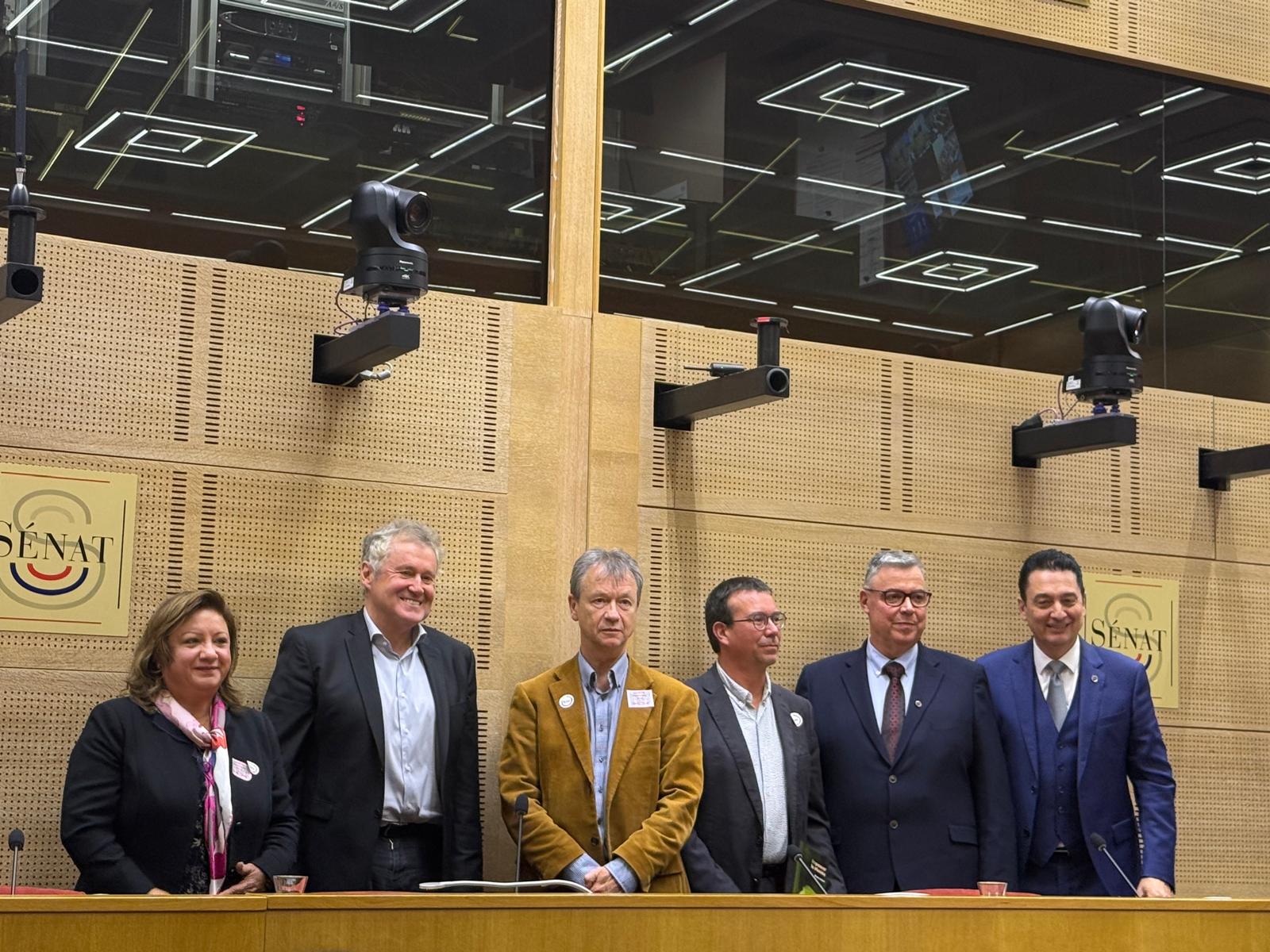
Paris, Senate — Following an initial roundtable dedicated to the role of artificial intelligence in sustainable resource management, the Forum of the French-Speaking Business Group (GPF) continued its work with a second panel focused on the circular economy and green technologies. This theme was addressed as an essential step in economic transformation, no longer as a utopia but as a vital necessity.
This session brought together four speakers from complementary fields:
- Néjia Gharbi, Chief Executive Officer of the Caisse des Dépôts et Consignations,
- Nicolas Imbert, Director of Green Cross France & Territories,
- Thierry Blandinières, Chief Executive Officer of the InVivo Group,
- Jacques Bouvy, founder of a startup converting diesel engines to hydrogen.
Through their exchanges, a common conviction emerged: to achieve ecological transition, the Francophone world must mobilize all stakeholders—businesses, financial institutions, governments, startups, and citizens—to break down silos and build truly sustainable models.
A New Stage in Transition: From Turbulence to Action
From the introduction, the moderator set the framework. According to him, the past 30 years have seen SMEs navigate “turbulent zones” and implement continuous improvement processes. But a threshold has now been reached. An additional step must be taken, where the circular economy and green technologies are no longer experimental but require collective action.
“Moving from a linear model—produce, consume, discard—to a circular model where resources are reused, recycled, and valorized is now an obligation,” he stated. However, despite the existence of concrete solutions, their adoption remains fragmented, too often confined to isolated initiatives. The real question then becomes: how can these projects be transformed into systemic levers capable of fundamentally changing our economies?
Néjia Gharbi: Financing the Future with a Long-Term Approach
The first intervention came from Néjia Gharbi, Chief Executive Officer of the Caisse des Dépôts et Consignations (CDC). She emphasized the crucial role of financial institutions in accelerating transitions.
“In their DNA, deposit institutions serve the general interest. They invest, but not just anywhere: they invest sustainably,” she explained. For her, it’s not only about supporting profitable projects but about reducing climate risks and securing long-term investments for the benefit of future generations.
CDCs, widely present in French-speaking countries, finance both infrastructure and green projects, positioning themselves as catalysts for structural initiatives. “We must reduce the risks of regression, because investing in the short term at the expense of sustainability would be a strategic mistake,” Gharbi insisted.
Thinking About and Repairing Territories
The second speaker, Nicolas Imbert, an engineer by training and former director of environmental NGOs, repositioned the debate within a territorial and citizen perspective. Author of a book titled Repenser la planète au nom de la Nacophonie (with a deliberate “a” to emphasize the idea of “repairing”), he stressed that territorial resilience must be at the heart of transitions.
“The degradation of our environment endangers our way of life,” he reminded, citing the European Environment Agency’s annual report published that very morning. But he also wanted to convey an optimistic message: “The good news is that together we have pathways to solutions.”
Imbert illustrated his point with a concrete example: the transformation of the Dunkirk region. A former industrial basin marked by dependence on coal and steel, it has gradually reinvented itself by focusing on the green economy, ecological data centers, sports and leisure, and even digital arts. “It’s this capacity to co-construct models adapted to the territory, rather than imposing a one-size-fits-all solution, that ensures resilience,” he concluded.
Agriculture as a Solution and Lever for Sovereignty
With Thierry Blandinières, Chief Executive Officer of the InVivo group, the debate shifted toward the strategic role of agriculture. For him, far from being a problem, agriculture can and must be part of the solution.
“The challenge is clear: how can a baguette be 100% carbon neutral?” he asked. The answer lies in a systemic approach covering the entire value chain, “from field to plate”: seeds, agricultural practices, processing, distribution, to the final product.
He emphasized the importance of precision agriculture, enabled by artificial intelligence and data management. Mapping plots, optimizing water and input use, securing farmers’ incomes: these are all levers for reconciling productivity and sustainability.
“We must reassure farmers, give them reliable and predictive tools. Otherwise, they won’t engage in the transition,” he stressed. According to him, regenerative agriculture, biodiversity, and new crop rotations must become the pillars of ecological and economic recovery.
Finally, Blandinières raised a major tension: that between global competitiveness and environmental requirements. “Cereal prices are global. If our products respect the environment but become too expensive, they’ll be swept away by imports,” he warned. The key lies in an alliance between innovation, financing, and regulation to guarantee agriculture that is simultaneously competitive, sustainable, and sovereign.
Low-Tech Innovation for Decarbonization
The final speaker, Jacques Bouvy, founder of a startup specializing in converting diesel engines to hydrogen, illustrated a low-tech innovation approach.
“We’re five people in our startup. It’s hard to change the world on our own,” he acknowledged humbly. But the solution he proposes is simple and radical: transforming existing diesel engines into hybrid engines running on hydrogen, with no loss of power, no pollution, and at a much lower cost than current technologies.
Supported by the Burgundy region, this project illustrates a pragmatic approach: “taking the old and making it new.” For Bouvy, the circular economy shouldn’t only concern materials or waste but also the use and transformation of existing infrastructure.
However, he denounced a recurring pitfall: “Large corporations capture most public funding and bury disruptive innovations to prevent them from disrupting their models.” For him, success depends on a model where each stakeholder—startups, local workshops, large corporations—finds their economic interest.
Four Perspectives, One Shared Finding
Throughout the exchanges, four complementary dimensions emerged:
- Sustainable finance (Gharbi), which must secure long-term investments;
- Territorial resilience (Imbert), custom-built with citizens and SMEs;
- Precision agriculture (Blandinières), which can combine sovereignty, competitiveness, and sustainability;
- Low-tech industrial innovation (Bouvy), capable of transforming the existing rather than relying solely on futuristic technologies.
These approaches, while different, converge toward the same requirement: that of systemic change, simultaneously mobilizing businesses, governments, investors, and citizens.
Francophone Economy at a Crossroads
This panel also highlighted the Francophone dimension of the transition. Whether regarding financing, agriculture, or innovation, all speakers emphasized that solutions cannot be solely national.
“The emerging economies of the Maghreb and North Africa, in full transformation, may be a step ahead of Europe in building a resilience economy,” observed Nicolas Imbert. For his part, Thierry Blandinières reminded that the coalition to be built must be global, as food and climate challenges know no borders.
Finally, the GPF announced the launch of a digital platform dedicated to the circular economy, called Circule Circule, designed to connect French-speaking SMEs, startups, and investors. It aims to facilitate asset exchange, resource pooling, and create economic bridges between Francophone countries.
From Discourse to Action
This second panel of the GPF Forum confirmed what many suspected: the circular economy and green technologies are no longer optional. They constitute a condition for economic, ecological, and social survival.
The panelists, each in their own way, demonstrated that solutions already exist—in finance, agriculture, industry, and territories. But their success depends on the ability to break down silos and build coherent ecosystems.
As Jacques Bouvy summarized, “on a finite planet, wanting to grow alone infinitely makes no sense.” The Francophone world now has the opportunity to embody this alternative vision, where innovation and sustainability go hand in hand.