Interview by Pascale Caron
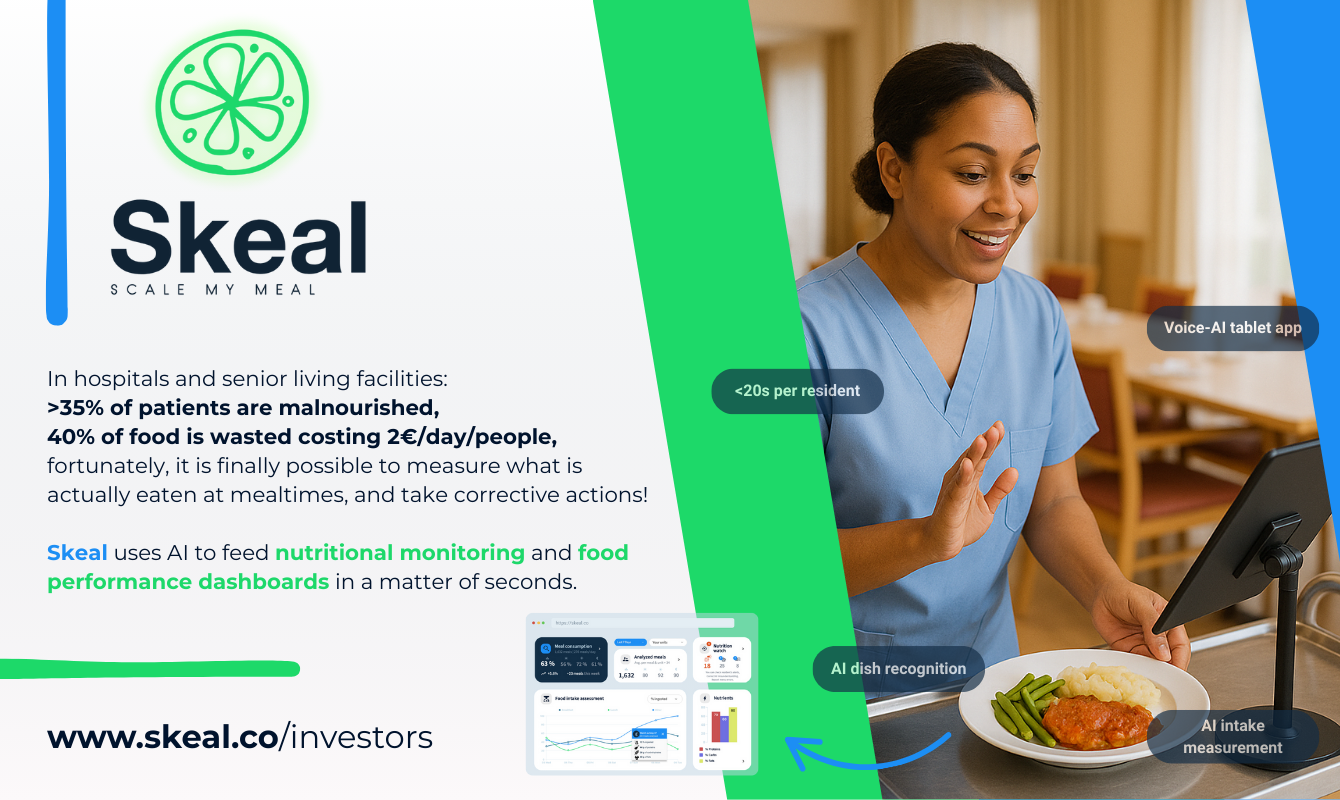
In Monaco, a young startup incubated at MonacoTech and hosted on Monaco Cloud aims to revolutionize a field that is often overlooked yet crucial: nutrition for patients and the elderly. Skeal, co-founded by Charles Juhel, has set itself the mission of accurately measuring what individuals actually consume, in order to improve their health and reduce food waste.
 Charles Juhel, a former commercial director in the digital sector, discovered the subject during a clinical research project conducted with the Dijon University Hospital in 2017. The problem was clear: elderly patients suffer from malnutrition, often worsened by hospital stays. Since manual records kept by caregivers were incomplete and imprecise, the idea was born to use artificial intelligence to automate the measurement of food intake.
His two sisters, both doctors engaged in nutrition research, reinforced this conviction. The observation was confirmed during his exchanges in Japan, a country facing an aging population and pressing needs in nutritional monitoring.
The technology developed by Skeal relies on computer vision and large language models. Specifically, tablets mounted on stands photograph plates before and after meals. The AI identifies the dishes, measures the portions consumed, and establishes individual tracking of nutritional intake.
 This system requires no heavy equipment. A simple tablet or smartphone is sufficient. The challenge is to integrate into the daily routines of caregivers and hospitality staff without complicating their tasks. “The key is to make the solution simple and motivating for teams,” insists Charles Juhel.
Trials and Field Feedback
Since 2024, Skeal has conducted several pilot trials, particularly at the CHPG in Monaco and in nursing homes in Nice. These tests validated the robustness of the model and adapted the tool to real field constraints.
 Integration with hospital information systems and the nutritional evaluation of menus (via the CIQUAL and GEMRCN databases) strengthen the platform’s effectiveness. The collaboration with dietitian Aline Victor, a specialist in geriatric nutrition, adds valuable clinical expertise and prepares the arrival of an automated recommendation engine.
Health, Economy, and Sustainability
The potential is immense. The “senior living” sector represents a colossal market estimated at several trillion dollars. Yet catering constitutes the second or third largest expense item there, with average food waste of 35 to 40%. Skeal proposes to tackle this problem at its root: precisely understand what residents eat, identify problematic recipes, and generate real-time alerts.
The economic dimension is obvious. Each poorly consumed meal represents a direct cost for facilities and a health risk for patients. Skeal’s tool would not only reduce waste but also improve food satisfaction and medical monitoring.
An Adapted Business Model
Skeal has chosen a “pay-per-use” model: facilities purchase “tokens” for analyzed meals, with tiered pricing based on volume. This system ensures a clear return on investment: savings achieved on food waste far exceed the cost of the solution.
A Fundraising Round in Preparation
Self-financed until now, the company is entering an acceleration phase. An initial round of €250,000 is underway to transform pilots into commercial deployments, before a Series A planned for 2026 estimated at €3 million.
The ambitions are international. Discussions are underway in the United States and the Middle East with potential distributors. Skeal is banking on speed of execution and product reliability to convince markets where opportunities are considerable but competition fierce.
A Research Project with CNRS
Skeal’s future is also oriented toward new experimental fields. A partnership with CNRS is in preparation to test the solution in collective canteens. The objective: accurately measure students’ actual consumption and identify sources of waste. This collaboration opens a broader perspective: beyond hospitals and nursing homes, Skeal’s AI could become a key tool for optimizing school and collective catering. It would contribute to both public health, raising awareness among younger generations, and more sustainable management of food resources.
An Integrated Vision of Nutrition
Beyond technology, Skeal is part of a comprehensive reflection on clinical nutrition. With its partners, the company envisions creating an ecosystem combining food data, dietary recommendations, and industrial innovations in medicalized nutrition.
The objective is clear: transform a still artisanal practice into data-driven management, for the benefit of patients, caregivers, and society.