With the NEO platform, the Council of Europe is deploying a sovereign, inclusive and operational artificial intelligence strategy, designed by and for business units.
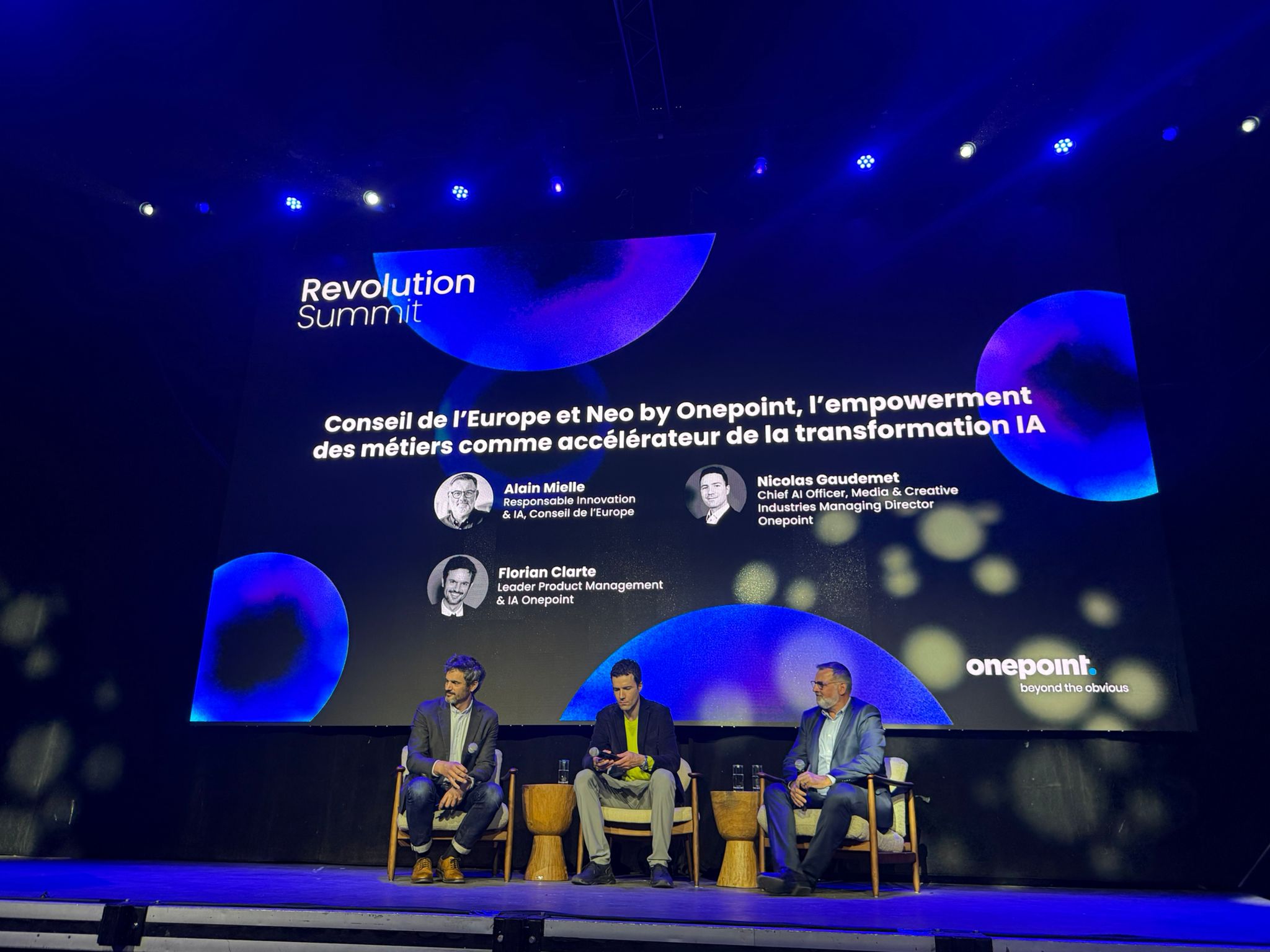
During the Revolution Summit organized by Onepoint at the Palais de Tokyo, we witnessed a demonstration of generative AI in the service of human, pragmatic and sovereign transformation. The Council of Europe, represented by Alain Miel, Head of AI Innovation, presented its pioneering approach around the NEO platform, developed with the support of Onepoint. Far from mere announcements, the narrative was one of structured, governed, controlled deployment—but above all, co-constructed with business units.
A demanding institutional context
Established in 1949, the Council of Europe now brings together 46 member states. A pan-European institution dedicated to defending human rights, democracy and the rule of law, its activities span a vast territory—from Iceland to Azerbaijan. Composed of 3,500 staff members, the majority of whom are lawyers, it faces a constant requirement: to guarantee the sovereignty, ethics and compliance of the digital tools it deploys.
The rise of shadow AI as a trigger
From 2022 onwards, with the emergence of ChatGPT, the proliferation of uncontrolled use cases (shadow AI) within the institution alerted innovation managers. Rather than prohibiting or slowing down, the decision was made to embrace it: a cross-disciplinary working group was formed, with business representatives in each entity. The objective: to collectively identify use cases that could drive transformation.
A deliberate business-first approach
Five major themes quickly emerged: multilingual transcription, report summarization, thematic extraction, graphic visualization and data monitoring. To address these needs, the Council of Europe implemented an agile method centered on co-constructed workshops, bringing together AI experts, change managers and business users.
The strength of the ambassador network
The success of this acculturation largely relies on the “ambassador” model—pioneering users tasked with testing tools, evangelizing their colleagues, and providing feedback from the field. This network plays a crucial role in the adoption of AI across the organization.
The NEO platform: a sovereign technological building block
Developed with Onepoint, the NEO platform is deployed in a secure environment on the Council of Europe’s infrastructure. It processes audio files, extracts multilingual transcriptions using frugal models, generates summaries, themes, timelines, and automates report creation.
Tangible operational gains
With over 3,000 hours of transcription processed in three months, the platform has proven its robustness. Entire processes—such as meeting note-taking, press release drafting or parliamentary report processing—are accelerated and made more reliable. For staff members, this is an opportunity to focus on value-added tasks.
A dynamic glossary fed by business units
The issue of multilingual acronyms, so sensitive in an international context, was anticipated through the implementation of a dynamic glossary, built by the business units themselves. This repository is integrated into a RAG (Retrieval-Augmented Generation) system to ensure accuracy and consistency of content.
Strong and ethical governance
This approach is part of clear governance, led by management and supported by the AI convention adopted by the Council of Europe. Beyond the requirements of the European AI Act, this convention sets standards for ethics, transparency, non-discrimination and integrity—essential for an institution founded on human rights.
A multi-model approach to ensure autonomy
The Council of Europe has chosen a multi-platform strategy, with specialized frugal models and deliberate technological agnosticism. The objective: to avoid any dependency, preserve sovereignty, and select models based on use cases, with local instances for sensitive data.
Use cases tailored to specific functions
Nicolas Gaudemet, Chief AI Officer at Onepoint, presented the use cases deployed through NEO. Automated financial analysis, persona and business model creation, legal contract processing, technical code documentation, client meeting preparation, automated HR support, analysis of responses to calls for tender… So many concrete examples, in production, field-tested.
A strong link between business units and AI agents
What makes these use cases relevant is their business grounding. Prompts are co-written with users, models are trained on contextualized corpora, agents are developed in a low-code studio to be manageable by non-technical profiles. The human/agent pairing is at the heart of the architecture.
A replicable model at European scale
The approach presented at the Revolution Summit offers an answer to the question many organizations are asking themselves: how to integrate generative AI without sacrificing sovereignty, ethics or operational efficiency? The Council of Europe’s approach, based on technological plurality, shared governance and business empowerment, deserves to be observed, adapted and transposed.