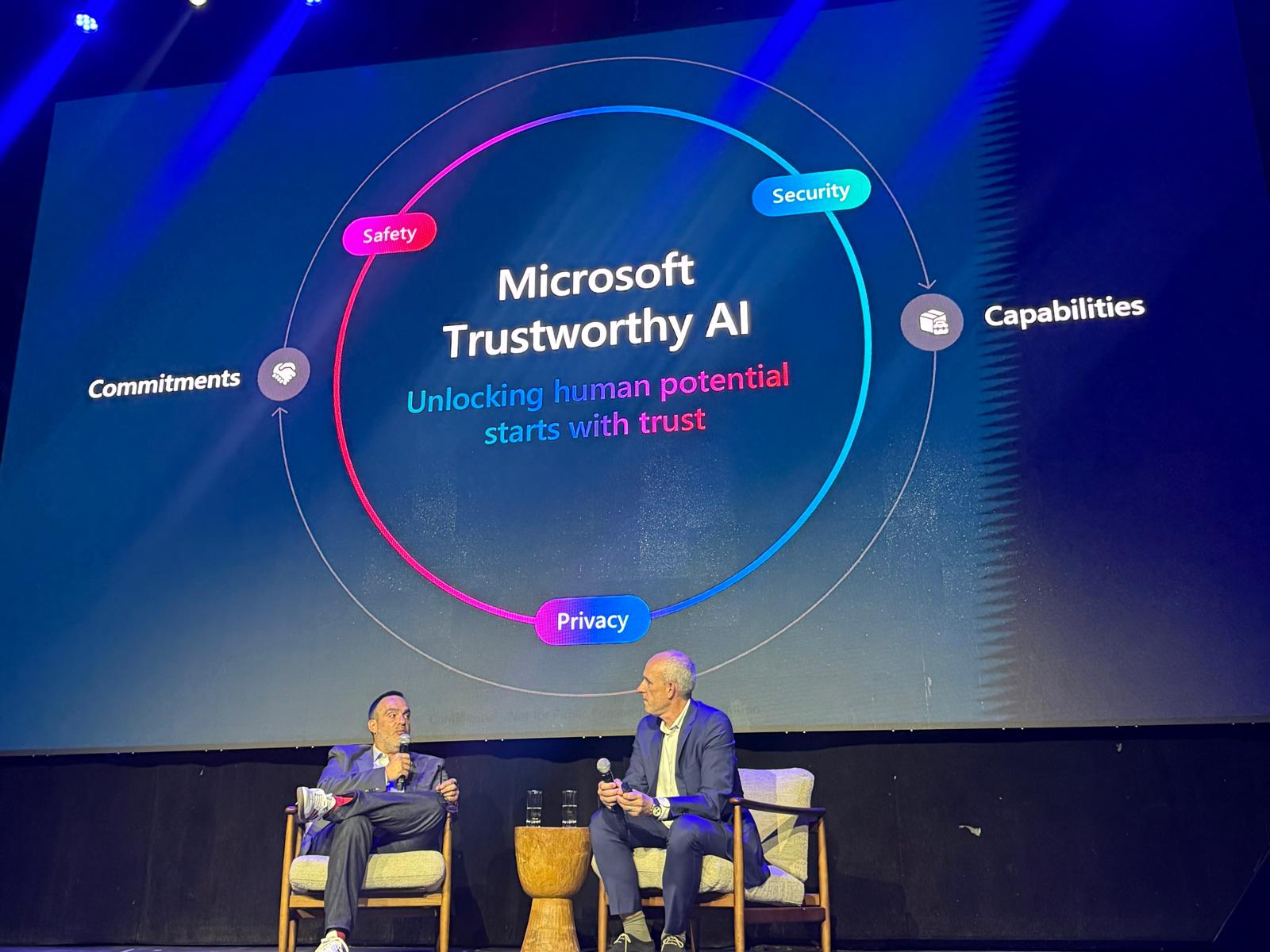
Paris, Palais de Tokyo, Revolution Summit. Xavier Perret, Director of Azure Cloud Business at Microsoft France, and François Binder, Partner Data & AI at Onepoint, shared a clear vision, backed by concrete demonstrations, on the rise of AI agents. These are autonomous intelligences capable of executing, planning, and sometimes even collaborating to accomplish complex tasks.
From ChatGPT to Agents: A Paradigm Shift
From the introduction, François Binder recalls the milestones reached over the past two years. In 2023, the discovery of ChatGPT disrupted professional practices. In 2024, the first agent tools began to emerge. In 2025, the challenge is now to industrialize.
Xavier Perret clarifies what we mean by agent: an AI to which we delegate a task, under human supervision. Unlike simple conversational chatbots, agents are designed to execute processes, interact with other tools, and even with other agents.
Four Strategic Impact Areas
Microsoft structures agent usage around four major axes:
- Enhancing employee productivity, via Copilot for Microsoft 365 or GitHub Copilot.
- Reinventing the customer experience, through intelligent conversational assistants.
- Transforming business processes, as illustrated by a supply chain demo.
- Opening up to innovation, with startups and open source tools such as AutoGen or CrewAI.
An Agent to Unsubscribe from Newsletters: A Pragmatic Demonstration
The personal example presented by Xavier Perret is striking in its simplicity. In just a few hours, he designed an agent tasked with detecting unwanted emails and automatically unsubscribing from unsolicited newsletters. The script uses a browser agent that reads, clicks, and navigates unsubscribe pages autonomously.
This case illustrates an essential point: agents are accessible to any developer, or even any advanced user. The goal: to free up time for higher value-added tasks.
Agents, Copilots, Orchestrators: Towards a Modular Architecture
François Binder and Xavier Perret emphasize the evolution of agentic architecture. An agent is no longer just a conversational interface. It becomes an orchestrator capable of activating other specialized agents.
This modularity relies on three pillars:
- Knowledge: a contextualized database or document repository.
- Skills: operational capabilities (reading documents, querying CRM, generating responses, etc.).
- Autonomy: the desired level of delegation, supervision, or human intervention.
Client Case: Invoice Management at Dow
The first concrete case concerns Dow, a chemical company processing over 4,000 invoices per day. An agent, deployed in Microsoft Teams via Copilot Studio, automatically scans billing discrepancies, detects anomalies, proposes analysis reports, and enables accelerated processing.
The benefit? Simple, low-cost automation, for a massive cumulative gain. This type of agent, almost declarative, requires neither complex orchestration nor advanced reasoning models.
Advanced Reasoning: GPT-4 vs O1
The session continues with a compelling comparison between two models: GPT-4 and O1 (OpenAI). The case presented: analyzing the causes of a customer’s dissatisfaction in a retail scenario. Result:
- GPT-4 provides a correct but generic answer.
- O1, equipped with advanced reasoning capabilities, contextualizes the grievances, proposes a targeted strategy, and generates a customized customer response.
This demonstration shows that certain models are now capable of orchestration, planning, and high-level agentic collaboration.
Advanced Case: Supply Chain Orchestrated by Agents
The highlight of the conference is the demonstration of a supply chain process entirely driven by an agent orchestrator.
Starting from a multi-product order, a main agent activates several specialized agents (stock search, product substitution, transportation cost evaluation, margin verification) to formulate a complete logistics proposal.
The orchestration is dynamic: if an anomaly is detected (e.g., inconsistent price), the agent modifies the plan in real time, calls other agents if necessary, then submits the final decision to a human. This is the principle of Human in the loop, fundamental in critical scenarios.
Towards Organizational AI: Each Agent as a Colleague
In this vision, each agent becomes a semi-autonomous digital entity, endowed with a business role, a level of autonomy, an interaction history, and a security perimeter.
This raises new questions: who manages the agents? What access do we grant them? Should they appear in the functional organization chart? How do we trace their decisions?
We are entering the emerging field of organizational AI, where governance becomes as critical as technological innovation.
The Security Challenge: Jailbreaking, Hallucinations, and Governance
Xavier Perret then addresses cybersecurity and reliability issues. He shows a jailbreak simulation: a malicious user injects a hidden command in an email destined for an agent. If the latter is not properly secured, it could disclose sensitive information.
Microsoft already offers solutions like Kunchil, a tool capable of detecting these attempts and alerting the user. The message is clear: the more autonomous the agent, the more its monitoring must be reinforced.
Sovereignty and Data: Microsoft’s European Commitments
On the matter of digital sovereignty, Microsoft reiterates its commitments:
- Data and metadata remain hosted in Europe.
- Access is reserved for employees based in the EU.
- AI-specific infrastructures are under construction in France.
- Open source is actively supported via GitHub and projects like Phi-3.
These commitments aim to reassure European companies about the compatibility between performance, compliance, and innovation.
Six Structural Trends for the Future
François Binder concludes with six key trends to watch:
- Advanced reasoning models (O1, O3…).
- Data mastery as the foundation of agentic AI.
- Multimodal capabilities, particularly voice integration.
- The rise of use-case-centric approaches, with process-oriented projects.
- The governance of agents within the organization.
- Interoperability between open source and industrial solutions (Autogen, Swarm, CrewAI…).
A Revolution Taking Root in Practice
At the end of this conference, one certainty emerges: the agentic revolution is no longer theoretical. It is gradually settling into organizations, in stages, often at the periphery, sometimes at the heart of critical processes.
But for it to deliver on its promises, it must be governed. It is there, at the intersection of technology, governance, security, and business strategy, that transformation is now unfolding.