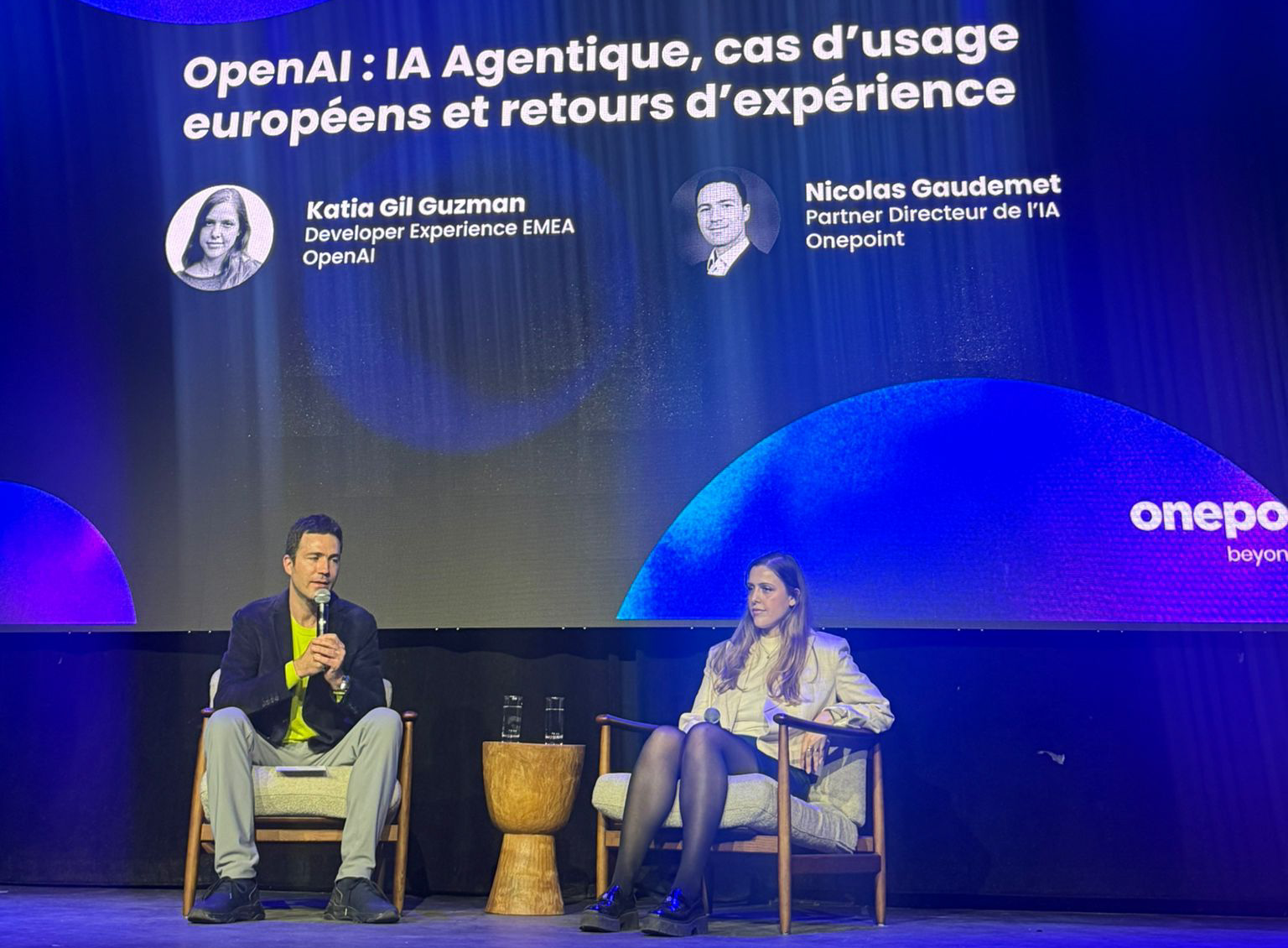
On May 14, 2025, in Paris, OpenAI and Onepoint at the Revolution Summit opened a strategic window on agentic artificial intelligence in Europe. Katia Gilles-Gouzman, Head of Developer Experience EMEA at OpenAI, and Nicolas Gaudemet, AI Partner at Onepoint, shared their combined vision of a future where intelligent agents become the new digital collaborators. A rich, concrete, clear-sighted exchange, both technological and geopolitical.
A Consolidated European Presence
OpenAI is firmly establishing itself in Europe. After London, Katia Gilles-Gouzman witnessed the opening of offices in Dublin, Brussels, Paris, Zurich, and soon Munich. This physical presence enables constant dialogue with companies, developers, and institutions. A territorialized approach, running counter to standardized models, to address the specific expectations of European players.
The Developer Experience team plays a fundamental role in the OpenAI ecosystem. Documentation, onboarding resources, demonstrations, user feedback: it orchestrates the end-to-end developer experience. It also carries the voice of the technical community to product engineers in San Francisco. The goal is to adapt tools to ground realities, accelerate use cases, and build truly useful AI.
A Controlled Avalanche of Innovations
Innovation at OpenAI is continuous. In recent months, several structural innovations have arrived:
- The Agent SDK: a toolkit for creating custom agents integrating tools and business logic.
- The Responsive API: to simplify the development of conversational agents and access functions like web or document search.
- A new range of models: GPT-4.1, Mini, Nano – optimized according to use cases (cost, speed, power).
- Multimodal integration with GPT-Image-1: image generation from text, with fine-grained context understanding.
- New audio models: transcription and voice synthesis approaching realism.
This segmentation allows companies to better calibrate their uses: powerful models for complex tasks, lightweight models for targeted functions. A gain in performance, costs, and efficiency.
For OpenAI, 2025 is “the year of agents.” An agent, in their definition, is an AI capable of acting on behalf of the user, with a set of tools, instructions, and guardrails. Two agents have already been launched:
- Operator: performs actions on web interfaces (bookings, purchases, forms, etc.).
- Deep Research: compiles 10 to 15-page reports from extensive online research.
A third agent, still confidential, is under development. These agents no longer simply inform: they execute, pilot, assist. A conceptual and productive shift.
Use Cases in Europe
Europe is keeping pace. Several companies have integrated OpenAI’s tools:
- Pigment (France) automates strategic planning using intelligent agents.
- Photoroom (France) leverages GPT-Image to visually enhance product photos.
- Astmona (culture/museums) creates conversational agents on proprietary documentary collections.
- Mirakl (marketplaces) optimizes the integration and classification of supplier catalogs.
- Clara (Sweden) has automated a large part of its customer service, pioneering multi-agent orchestration.
Each company adapts the models to its data, business, and pace. AI is no longer an option; it’s becoming a structural lever.
Sovereignty, Security, Trust
The question of sovereignty is central in Europe. OpenAI responds with transparency: no enterprise client data is used to train models. “Zero data retention” options exist for APIs. Security complies with the most stringent standards, enabling collaboration with sensitive players like Sanofi or BBVA.
On the model security side, OpenAI rigorously evaluates robustness and risks. GPT-4o, the recently launched model, is the first to pass a new security standard. The agentic approach is thus accompanied by technical, contractual, and ethical guardrails.
Efficient AI: Toward Algorithmic Sobriety
Facing environmental challenges, OpenAI incorporates an energy efficiency strategy. The Mini and Nano models consume fewer resources. Automatic routing systems choose the optimal model according to query complexity, avoiding mobilizing an oversized LLM for a simple task.
GPT-4o, for example, enables complex reasoning with a reduced footprint. The objective: combine power, performance, and frugality.
Impact on Developers
Developers are the first users, the first integrators, the first ambassadors. OpenAI invests in tools tailored to their expectations (via the Agent SDK, the Responsive API) and in education. The goal is clear: make agent creation accessible, even without deep learning expertise.
OpenAI also focuses on diversity. Katia Gilles-Gouzman emphasizes the need to attract more women to AI. Low-code AI, simplified environments, and visual pedagogy are promising levers to democratize access to coding, starting from childhood.
Dialogical, Contextual, Useful AI
Through its agents, OpenAI doesn’t seek to replace humans, but to assist them. It’s a use-oriented, adaptive, explainable AI, centered on context. With GPT-4o, the ability to “reason aloud” (chain-of-thought) sheds light on the model’s logic. This improves trust while facilitating the detection of ambiguities. In the future, agents may even flag a poorly formulated prompt or ask clarifying questions before acting.
Public-Private Cooperation
AI also progresses through institutional alliances. OpenAI collaborates with research organizations such as EHESS, the Max Planck Institute, or ESCP Business School. Academic dialogue remains fundamental to establishing the methodological, ethical, and social foundations of European AI. Companies find a basis of legitimacy there.
A Technological and Strategic Turning Point
What the conference highlighted is the convergence between technological maturity and strategic alignment. Europe, often cautious, is entering a more active phase. The agent is no longer a laboratory concept: it’s integrated into CRMs, e-commerce platforms, HR solutions, cultural interfaces. The business model follows.
This paradigm shift also requires new data governance, skills development, and continuous reflection on usage.