Revolution Summit, May 2025
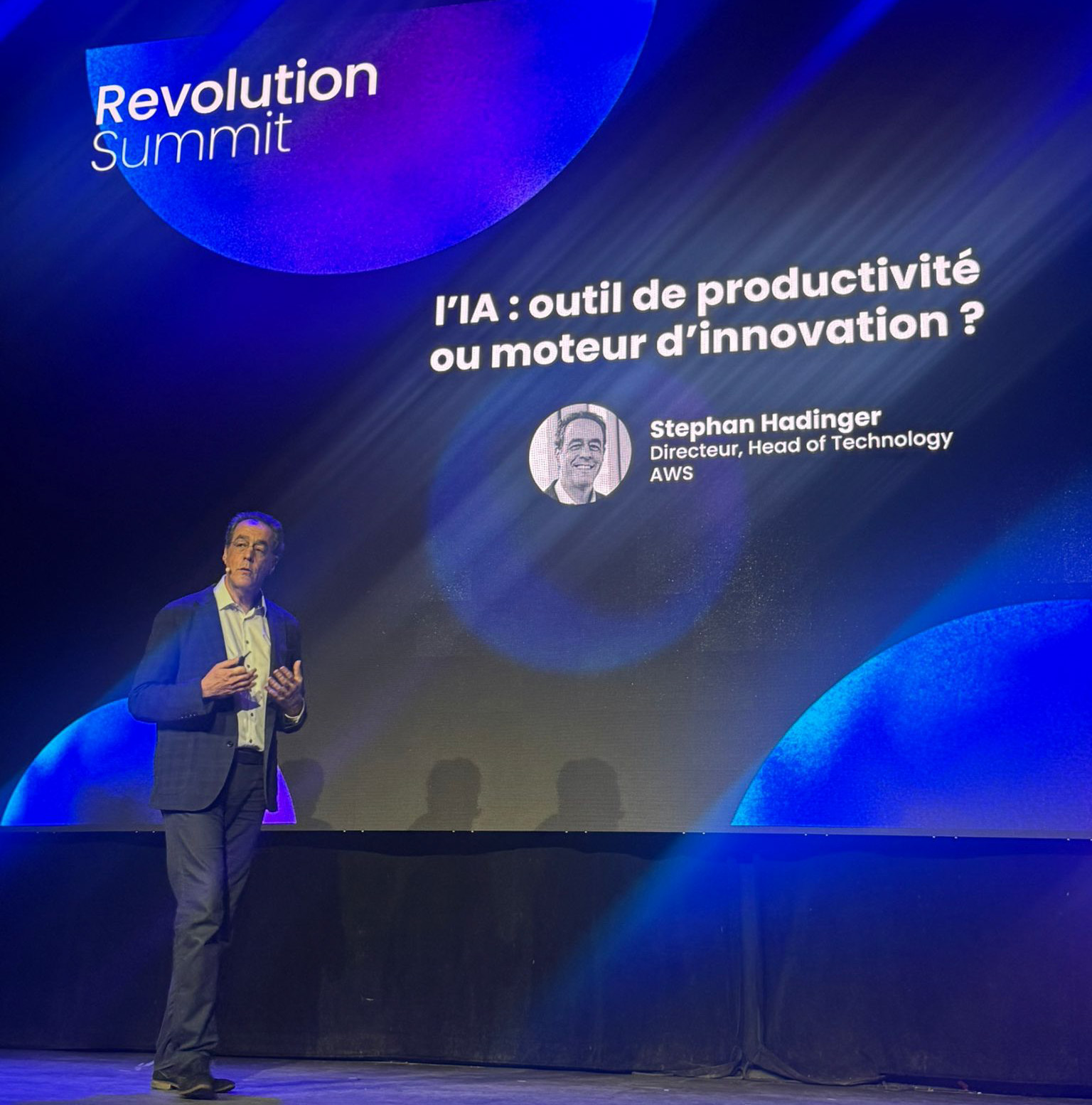
On the Revolution Summit 2025 stage, Stephan Hadinger, Director and Head of Technology at AWS, opened a strategic session by posing a fundamental question: “Is AI a productivity tool or an innovation driver?” A question that resonates strongly in digital ecosystems where generative AI is emerging as the catalyst for a dual transformation: operational and creative.
With thirteen years at AWS under his belt, Hadinger delivers an evolving vision of use cases. From pioneering startups to maturing French Tech companies and CAC 40 blue-chip corporations, all are confronted with the need to innovate quickly, powerfully… and securely.
The Genesis of AWS: From Internal Agility to a Global Innovation Platform
Amazon Web Services (AWS) was born from an internal imperative: making Amazon’s teams more agile. This quest for agility, test-and-learn, and experimentation still structures AWS cloud’s DNA today, now an innovation tool shared by over 100,000 AI customers worldwide.
AWS isn’t just infrastructure. It’s a three-tier architecture: hardware infrastructure (data centers, chips), development tools (Amazon Bedrock, Amazon SageMaker), and ready-to-use services (Amazon Q, Amazon Q Developer). A modular structure that enables varied use cases, from prototype to scale deployment.
Infrastructure and Sustainability: ARM Chips Serving Green AI
AWS has been investing in its own processors for several years. Graviton (ARM) and Trainium/Premium2 deliver significant gains: +60% speed and -40% costs (source: Anthropic). These in-house designed chips enable AWS to offer greener, faster, and more economical AI—an essential combination facing generative AI’s exponential energy consumption.
This efficiency comes with an open model. AWS doesn’t impose a single proprietary model, but offers a multi-LLM marketplace: Mistral, Anthropic (Claude), Meta, Cohere, and others. A “wholesaler” stance that guarantees freedom of choice and portability.
Data as the Sine Qua Non Condition of Generative AI
“No data, no AI. Bad data, bad AI.” This maxim, quoted by Hadinger, recalls a structural truth: generative AI can only function with connected, contextualized, quality data.
Through concrete cases, AWS demonstrates that AI projects are primarily data transformation projects. The example of Safran, supported by Onepoint, illustrates this complexity: the same order amount can appear differently depending on business perspectives. AI doesn’t correct data, it inherits it. Deep work on governance policies and truth models is therefore necessary.
Security and Sovereignty: A Non-Negotiable Issue
At AWS, security is design principle #1. Led every Friday by AWS’s global CEO, the security review is a strategic ritual. AWS cloud was the first to obtain ISO/IEC 42001 certification dedicated to generative AI. Recognition aimed at reassuring European companies about compliance, transparency, and data protection.
Use Cases: When AI Becomes an Invisible Production Force
Two client cases illustrate generative AI’s productive dimension:
- Veolia with its CGPP assistant, used by over 53,000 employees. The goal? Avoid shadow IT by offering a secure and supervised alternative to ChatGPT. Cost per user: less than €1.80/month. Result: obvious ROI, massive adoption, assured security.
- Fox Intelligence (Nielsen IQ): from e-commerce order emails, their AI reads, extracts, and structures data at large scale. Scaling from 100,000 to 1 million emails analyzed daily, while opening 14 new countries thanks to the Mistral model’s multilingual understanding.
In both cases, AI isn’t visible, but it operates deeply. Invisible, yet decisive.
Agents, Protocols and Multi-Model Architecture: Heading Toward Agentic AI
A revolution is emerging: that of AI agents. AWS is betting on interoperability through MCP (Model Capability Protocol), developed by Anthropic and already adopted by OpenAI, Google, and AWS. This protocol allows an AI agent to discover, understand, and use business application APIs.
The next step: multi-agent systems. The architecture relies on a central model (supervisor) that delegates unit tasks to specialized agents. Objective: avoid exorbitant costs linked to using a single LLM for simple tasks, and streamline adaptive workflows.
A new paradigm is emerging: after deterministic agents (hard-coded workflows), then autonomous ones (agents capable of adapting), we’re moving toward systems mimicking a complete team, with coordination, specialization, and self-adjustment.
Toward Disruptive Innovation: Stephan Hadinger’s Call to Decision-Makers
In a powerful conference moment, Hadinger challenges companies: “How does generative AI enable you to create services you couldn’t imagine before?” Few hands go up. Proof that there’s still ground to cover. He cites a striking example: automatic summarization of customer reviews on Amazon.fr. This service, at virtually zero cost, has a major impact on conversion rates. Value isn’t in raw technology, but in its subtle integration into customer experience.
2028 Projections: AI Autonomy in Sight
According to Gartner, by 2028:
- 33% of enterprise software applications will integrate AI.
- 15% of daily workplace decisions will be made autonomously by AI systems.
For AWS, 2025 is a pivotal year. It’s no longer about proving AI works, but creating products, services, and business models based on it.
A Dual Agenda to Activate Urgently
AWS’s conference at Revolution Summit 2025 left no ambiguity: productivity and innovation aren’t two opposing AI goals, but two levers to activate simultaneously. Short-term, individual efficiency gains are undeniable. Medium-term, companies not investing in product innovation risk finding themselves sidelined.
The message is clear: 2025 is the year to start seriously. Test, iterate, industrialize, but above all… innovate.