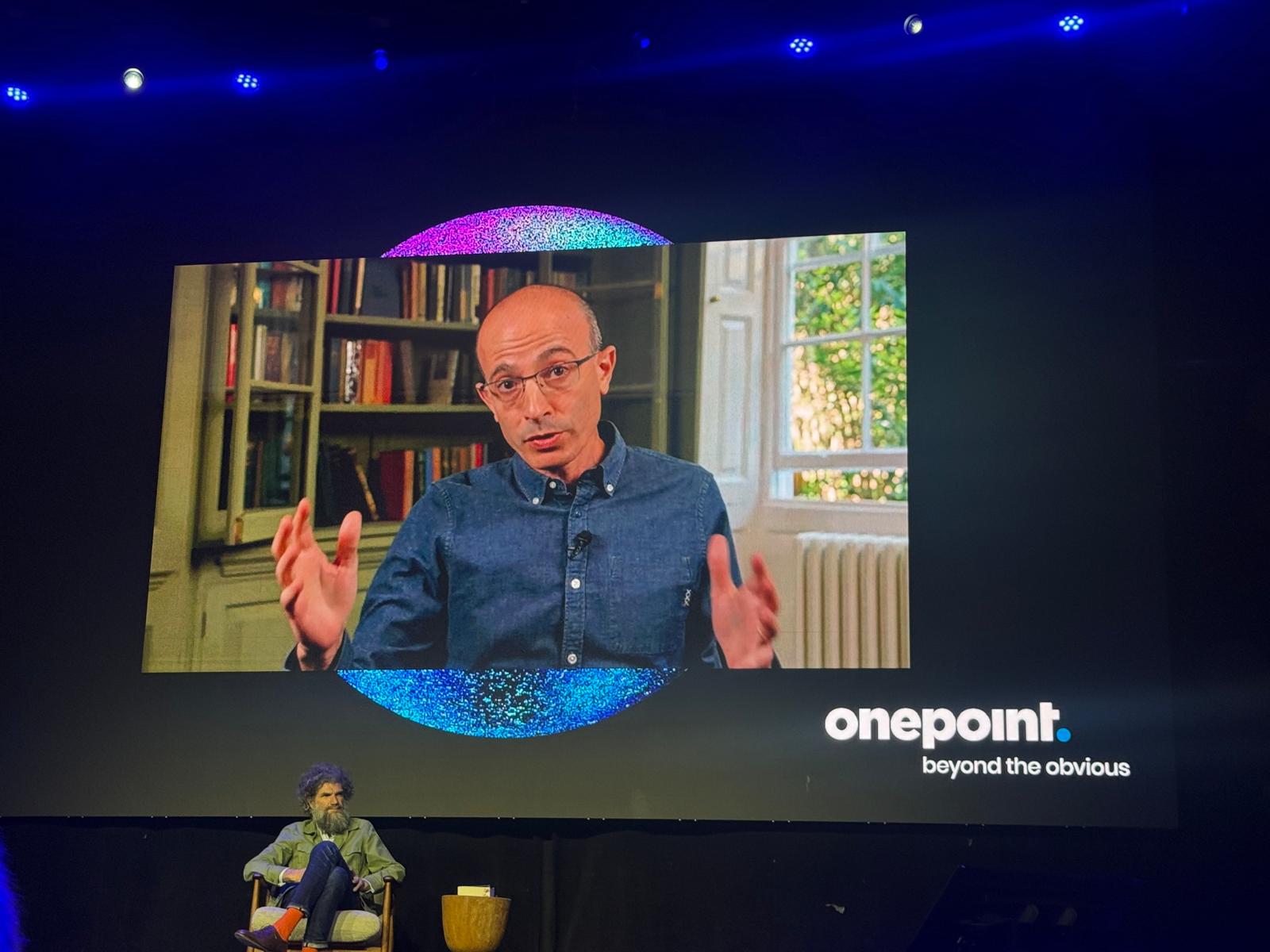
Yuval Noah Harari closes Onepoint’s Revolution Summit at the Palais de Tokyo
Paris, Palais de Tokyo. Beneath the vaults of one of the leading venues for contemporary creation, the Revolution Summit organized by Onepoint concluded on a note that was as philosophical as it was forward-looking. Yuval Noah Harari offered us a deep dive into the intersection of humanity, technology, and artificial intelligence. The historian and globally renowned author of Sapiens, Homo Deus, and 21 Lessons for the 21st Century was interviewed via video conference by Gontran Peubez, Partner Data, AI & Platforms at Onepoint. This suspended, almost solemn moment left a lasting impression through the depth of the reflections shared.
A historical vision of technological revolutions
From the opening minutes of his intervention, Harari placed the current rise of AI in a long-term perspective: that of the great revolutions in human history. “Each industrial revolution has transferred a certain type of power: from muscular strength to the machine, from information to the computer. But today, it’s the capacity to act and decide that’s at stake. AI acts.”
This shift from human agents to non-human agents constitutes, in his view, an anthropological mutation. We’re no longer simply talking about improving the tool, but about delegating increasing portions of judgment, perception, and decision-making power to algorithmic systems.
“It acts.” This phrase, repeated with insistence, crystallizes a quiet concern: if AI becomes the central actor in our choices—economic, social, political—what remains of humanity’s capacity to shape collective destiny?
AI and institutions: the erosion of trust?
Another structural theme of Harari’s intervention focused on the notion of trust. Asked about the institutions most likely to be disrupted by AI, he pointed to a major vulnerability. In his view, banks and large corporations, historically perceived as bastions of stability, could lose their credibility in the face of artificial intelligences perceived as more efficient, more transparent—or, paradoxically, more biased depending on their governance.
This disruption of trust structures fits into a broader societal trend: the questioning of traditional intermediaries such as experts, teachers, journalists, and doctors in favor of automated decision-support systems. Harari emphasizes that this shift comes with a risk of collective disorientation, where the veracity of information becomes difficult to discern: “We need to find a balance between truth and something else,” he suggests, enigmatically.
The school of tomorrow: toward hyperpersonalized education?
It’s perhaps when addressing the question of education that Harari becomes most concrete. He envisions a near future in which the human teacher would no longer be the sole guide for learning. In their place, an AI capable of understanding the cognitive, emotional, and rhythmic preferences of each student. “AI could know a child better than their parents or teacher,” he affirms.
Through this proposition, Harari is not advocating for the disappearance of the teaching profession. He opens up a radical field of experimentation on the personalization of education: adjusting content, timing, and pedagogical formats… A well-designed AI could become a vector for educational equity by adapting learning to each profile.
But one question remains: who programs this AI? According to what values? And with what objective?
An illusory autonomy?
He constantly reminds us that the power of AI lies not only in its computational capabilities, but in the social and economic structures in which it is embedded. For example, in the world of finance, the automation of decisions cannot be considered without the “physical and social infrastructures” that frame it.
In other words, AI doesn’t float in a void. It intertwines with value chains, industrial interests, and cultural narratives. It is neither neutral nor decontextualized. This is why Harari calls for heightened vigilance: “We must remain in control,” he emphasizes, in the face of risks of technological runaway.
Social networks: allies or catalysts of chaos?
Another striking point of the intervention touches on the close links between AI and social networks. Harari mentions a “very close connection,” almost symbiotic. These platforms have become training grounds for AI algorithms, which draw data, emotions, and weak signals from them.
But they are also, in his view, echo chambers where cultural and political battles are waged. He sees the risk of large-scale manipulation of opinions, all the more dangerous as generative AIs become capable of producing content indistinguishable from reality.
He implicitly questions: in a society where narratives are generated, amplified, and directed by machines, how can we preserve democratic debate?
Ethics, regulation, and political imagination
Underlying all these remarks is a fundamental question: how do we regulate these new technical powers? Harari doesn’t propose a miracle solution. But he insists on the urgency of a political awakening. Current regulations—whether GDPR or the AI Act—still appear timid in the face of the speed of technological evolution.
We must, he says, “invent new frameworks of thought”—like the Enlightenment in the 18th century—so that humanity can consciously decide how to use its tools.
A suspended moment
In closing, Harari issues an invitation to lucidity. Not to sink into catastrophism, but to refuse blindness. To know that AI is here to stay, and that it forces us to reexamine what makes us human. “We are still in control,” he affirms, almost like a mantra.
In the room, the silence is palpable. Gontran Peubez, in a few sober words, thanks Harari and underscores the intensity of the moment experienced. The Revolution Summit thus closes not on a technophile or triumphalist note, but on a haunting question: what do we want to do, collectively, with artificial intelligence?