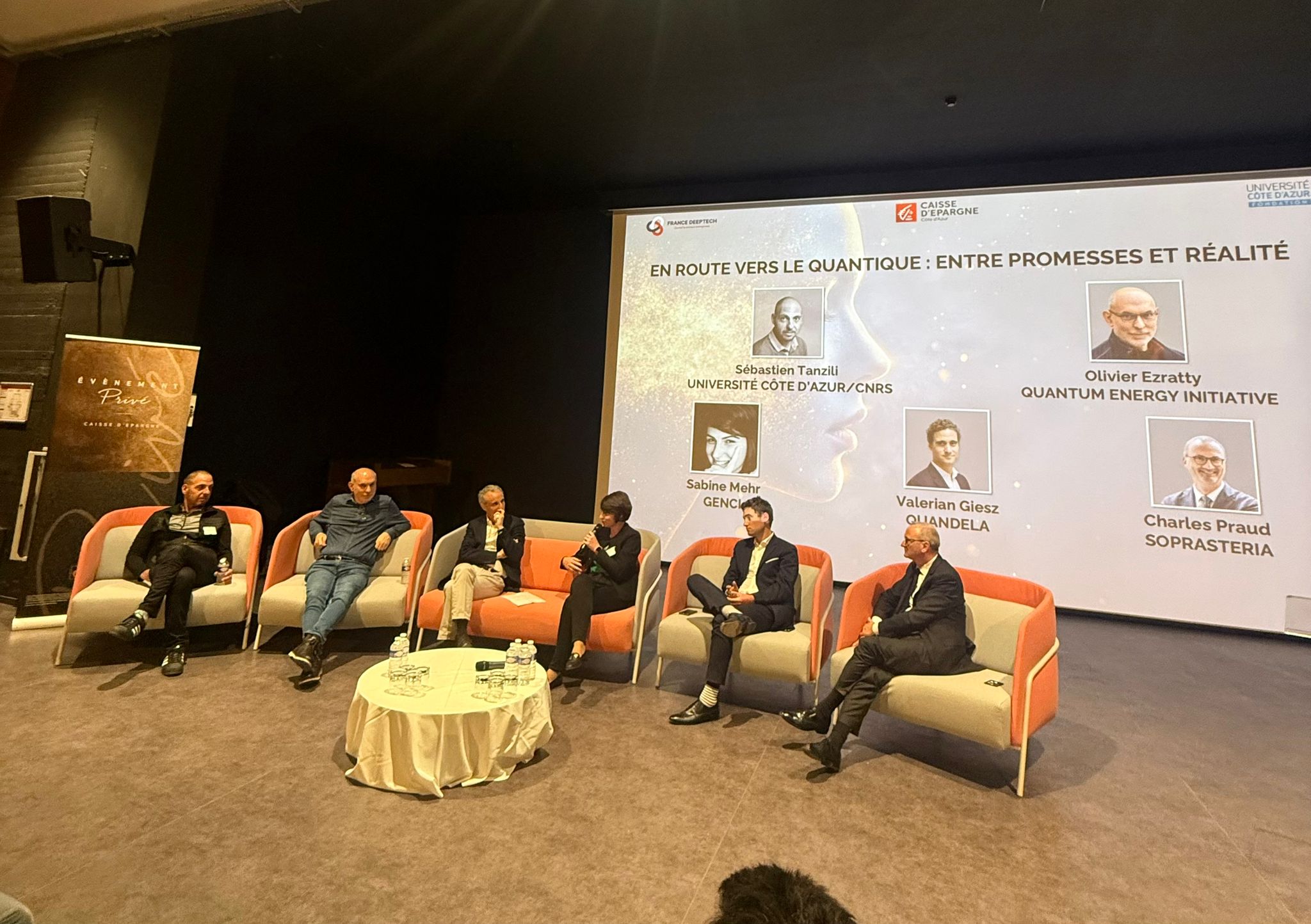
On May 6, 2025, in the inspiring setting of Villa Arson in Nice, we attended an evening dedicated to quantum sciences and technologies. Organized in partnership with Caisse d’Épargne Côte d’Azur, Université Côte d’Azur Foundation, and France Deeptech, this ambitious conference brought together fundamental research, technological entrepreneurship, and industrial perspectives.
In this historically significant venue—recently listed as a historical monument—which embodies both artistic avant-garde and educational experimentation, quantum science found an unexpected yet eminently relevant platform for expression. For if quantum physics disrupts classical paradigms, it also calls for a reconfiguration of relationships between disciplines, between public and private actors, between intuition and rigor. The evening unfolded in two parts. First, presentations by four doctoral students as part of the “My Thesis in 180 Seconds” competition. Then a high-level panel discussion titled “On the road to quantum: between promises and reality,” bringing together researchers, entrepreneurs, and public decision-makers. All orchestrated with unifying energy by Michel de Lempdes, president of France Deeptech, a master of ceremonies as pedagogical as he was bold.
From the introduction, the director of Villa Arson emphasized the importance of this venue in knowledge transmission and contemporary creation. A place of research, experimentation, and confrontation of ideas, Villa Arson positions itself as an incubator of cross-perspectives, a ground for hybridization between arts, sciences, and society. By hosting this conference on quantum technologies, it confirms its role as a bridge between academic worlds and real-world transformations. Sylvain Antoniotti, vice-president of Université Côte d’Azur, then spoke to situate the event within the broader context of a university focused on major contemporary challenges. UCA, labeled Initiative of Excellence, intends to play a structural role in the French and European innovation ecosystem, particularly in deeptech and quantum technologies, which are redrawing the boundaries of scientific possibility.
Then came the young researchers’ turn. The “My Thesis in 180 Seconds” challenge featured four exceptional doctoral students, capable of transforming scientific complexity into captivating narratives. A performance both intellectual and theatrical.
The first speaker used the Super Mario universe to illustrate the transition from medicinal chemistry to three-dimensionality. Where classical molecules are still conceived in 2D, she develops an innovative method for synthesizing complex 3D structures using a gold-based catalyst. A “molecular revolution” aimed at expanding chemical libraries to design tomorrow’s medicines. Through the playful metaphor of the golden mushroom, she made highly promising pharmaceutical research accessible.
The second thesis took the audience underwater. The objective: to replace acoustic waves, which disturb marine life, with light waves in underwater communications. The doctoral student designs micro-LEDs emitting in the ultraviolet range, using aluminum-enriched gallium nitride. One of the major challenges lies in the fragility of these structures, which the researcher attempts to stabilize through bio-inspired architectures. An issue at the crossroads of engineering, ecology, and optics.
The third candidate offered a dive into solar electrolysis. Her ambition: to produce green hydrogen from semiconductor nanowires composed of indium, gallium, and nitrogen. These wires, when exposed to light similar to sunlight, generate an electric field capable of splitting water molecules. A promising technology, still in its maturation phase, but already carrying a renewed energy vision.
Finally, the fourth presentation shifted attention toward the cosmos. Focusing on Betelgeuse, a giant star at the end of its life, the doctoral student develops very high-resolution optical interferometry techniques, exploiting optical fibers to simulate a giant telescope. By connecting two distant instruments, she seeks to create a virtual telescope the size of a continent. A revolution in observational astrophysics, and another step toward a refined understanding of stellar cycles.
Each of these presentations, though thematically different, testified to the same movement: that of science in transition, the necessity to broaden methodological and conceptual frameworks, to project beyond established paradigms.
The second part of the evening was devoted to a panel discussion, whose title—”On the road to quantum: between promises and reality”—immediately set the framework for a balanced dialogue. Around Michel de Lempdes, six speakers from research and industry offered a lucid panorama of current issues in quantum technologies.
Sébastien Tanzilli, CNRS research director and co-leader of a program within the national quantum strategy, traced the foundations of quantum information: superposition, entanglement, qubit encoding. He emphasized the sector’s technological pillars—computing, simulation, communication, metrology—while highlighting persistent challenges: qubit decoherence, error correction, architecture stabilization.
Olivier Ezratty, independent consultant and co-founder of the Quantum Energy Initiative, provided a synthetic and comparative view of different technical approaches: photons, trapped ions, superconductors, neutral atoms. Each of these technologies presents specific properties, costs, scaling perspectives, and varying levels of maturity. Ezratty also warned against fads and hasty extrapolations: while quantum potential is real, its timeline will be long, its integration progressive.
Sabine Maire, from GENCI (Grand Équipement National de Calcul Intensif), presented public procurement policy regarding quantum. Within the HQI program framework, GENCI invests in quantum computer prototypes integrated into computing centers, aiming to test their robustness and coupling with classical supercomputers. France, a pioneer in this field at the European level, is thus exploring the conditions for large-scale hybrid computing.
Valérian Giesz, co-founder of the start-up Quandela, testified to French industrial dynamism. Specializing in photonic quantum computers, Quandela already offers cloud-accessible machines and works in partnership with major industrial groups, from energy to mobility. Giesz defended a pragmatic innovation model, articulating academic research and use cases, with an obsession: making quantum accessible to end users, developers, and businesses.
Charles Praud, quantum development director at SopraSteria, highlighted the strategic role of digital services companies. In the near future, IT architectures will necessarily be heterogeneous: CPUs, GPUs, and quantum processors will coexist within integrated infrastructures. IT service companies, through their ability to assemble these technological building blocks and adapt software to business needs, will play a key role in democratizing quantum.
Throughout the exchanges, several cross-cutting themes emerged. First, the importance of reasoned hybridization between classical and quantum computing: the quantum computer will not replace the classical one; it will provide support for specific tasks. Next, the crucial question of use cases: while certain applications such as molecule simulation seem promising in the short term, others (such as combinatorial optimization or post-quantum cryptography) still require major technological advances.
One of the discussion’s salient points was the tension between technological promise and economic reality. Ezratty recalled that certain economic projections (up to $1 trillion in value created by 2040) are more storytelling than rigorous analysis. He advocated for an approach based on return on investment (ROI), evaluating infrastructure costs, performance, but also the environmental impact of proposed solutions.
Finally, all emphasized the importance of training and breaking down skill silos. Quantum cannot be deployed without new engineering, bringing together physicists, computer scientists, systems engineers, developers, and industry experts. The future of this technology depends as much on its theoretical advances as on its ability to integrate into existing industrial processes.
Quandela’s example is emblematic in this regard. Starting from a fundamental physics laboratory, the company now brings together diverse profiles—physicists, engineers, computer scientists—to produce a “full stack” computer intended for real use. Its strategy rests on accessibility (cloud access), collaboration (with industry and computing centers), and internationalization. The fact that it won a European tender in a competitive market validates the quality of its approach.
Beyond technological performance, it was an ecosystem question that prevailed throughout the evening. The speakers unanimously confirmed that France, and more broadly Europe, has a robust scientific foundation, a dynamic entrepreneurial pool, and a structuring public framework. But the competitive advantage will only be maintained if funding continues, if training intensifies, and if collaborations between academic and industrial actors multiply.
In closing, Michel de Lempdes recalled the societal challenge of this transition: not to repeat past mistakes. “With the internet, microprocessors, GAFA, Europe often played second fiddle. This time, we have a window of opportunity. It’s up to us to seize it collectively.”
In the chiaroscuro of Villa Arson’s amphitheater, one thing appeared with clarity: quantum is no longer a matter of science fiction. It is becoming a strategic, industrial, ethical issue. And in this silent but decisive transformation, France is advancing its pieces with rare lucidity.