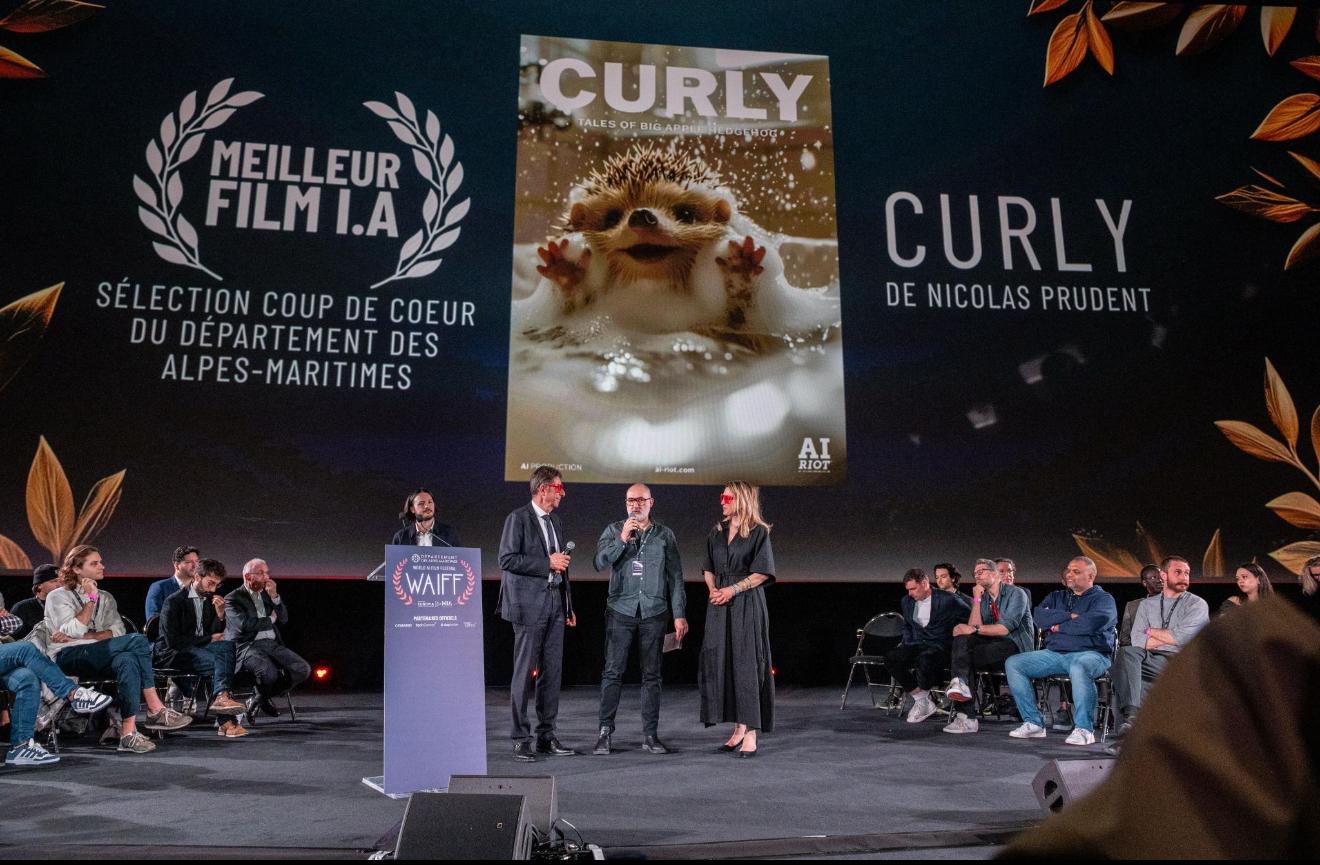
On April 11, the “Pathé Gare du Sud” cinema in Nice hosted the opening night of the very first edition of the World AI Film Festival (WAIFF). This unprecedented event stood at the crossroads of the 7th art and artificial intelligence. In the presence of numerous personalities from the film world, this evening marked the launch of a promising international gathering where technology and creation meet.
For this event, an exceptional jury was assembled, presided over by screenwriter and director Thomas Bidegain. Alongside him, major figures from cinema and audiovisual: Claude Lelouch (honorary president), Julie Gayet, Alexia Laroche-Joubert, Jean-David Blanc, Simon Bouisson, Anna Apter, Astou Sedy Diouf, Gilles Guerraz, Marianne Carpentier, and Éric Libiot.
Three Highlights for a Memorable Opening Night
• A fictional trial of AI in cinema, brilliantly staged, opened the evening. A true moment of collective reflection, it questioned the place of artificial intelligence in artistic creation processes, between technological innovation and ethical issues.
• A selection of unreleased films, chosen from more than 1,500 submissions from 80 countries, was then screened, demonstrating the diversity of forms and imaginaries carried by this new generation of filmmakers.
• The evening concluded with the presentation of 11 official awards, recognizing bold projects that explore new forms of writing and storytelling in the AI era.
A Court to Judge Art: Fiction in Service of Public Debate
Instead of a classic screening or red carpet, it’s a fictional trial that opens the evening. A performance halfway between judicial theater, social satire, and reflection on the right to creation. In the dock: ECHO, a (fictional) blockbuster film entirely generated by artificial intelligence. No actors, no technicians, no filming. Yet, 18 million cinema admissions.
Can we still call this “cinema”? Is AI a tool or an author? Through this fictional case, an entire dimension of the future of the 7th art is summoned to the court of public opinion.
The idea of the fictional trial is simple but powerful: to stage a real controversy in a structured dramatic format, with magistrates, lawyers, witnesses, and pleadings. The audience plays the role of the jury, called upon to reflect on a central question: can a work created without humans claim the status of a film? And above all, can it be screened in French cinemas, which are subject to demanding legislation regarding film production?
Two charges are brought against ECHO:
- Circumventing French production rules, particularly obligations related to public funding, national creation quotas, and the presence of identified professionals (directors, technicians, actors).
- Distortion of the very definition of a film, defined by law as the fruit of collective work, of a human creative effort framed by cultural and legal conventions.
Beneath its parodic airs, the exercise reveals genuine tensions currently running through the film industry, from the economic impact of AI to the question of artistic legitimacy.
Charlie Fabre: The Defendant Who Claims a Revolution
It’s a moving and angry monologue that Charlie Fabre, the fictional director of ECHO, delivers at the opening of the trial. He doesn’t defend himself: he claims. Marginalized in his youth, unable to integrate into group dynamics in film schools, he discovers in AI an absolute creative partner. “I was God in sweatpants, alone on the ship’s deck, braving the waves of imagination.”
His plea is an ode to the democratization of art: “With AI, you no longer need to be a Lelouch or a Sédoux. You can all become Charlie Fabres.”
But behind the humor, a muted anger surfaces: that of a creator rejected by traditional circuits, who finds in technology a social and artistic revenge. “What you’re hearing is the echo of a humanity we’d ended up forgetting,” he asserts, in a finale with prophetic overtones. For him, ECHO doesn’t betray cinema. It liberates it from its constraints. It returns it to those whom the industry had excluded.
The Prosecution: A Fierce Defense of the Collective
Faced with this romantic vision of cinema liberated by machine, the prosecution presents an implacable argument based on law, culture, and ethics.
Me Latrappe, lawyer for the CNC, reminds us that ECHO, however spectacular it may be, meets none of the required criteria to be screened in French cinemas. “This film has no right to exist, because it circumvents all national production obligations. It doesn’t pay anyone, doesn’t contribute, doesn’t participate in any ecosystem.”
The tone hardens with prosecutor Bougrine, who speaks of “a silent massacre”: “300,000 entertainment industry workers, deleted with a click.” She attacks head-on: ECHO would be a cold, empty product, devoid of flesh, doubt, imperfection, therefore incapable of generating a work of the mind. “It’s not a film, it’s an algorithm mimicking emotion.”
And she adds, in a plea that oscillates between provocation and social drama: “AI doesn’t just kill jobs. It kills dreams.”
Defense Arguments: Between Humor, Provocation, and Utopia
But the defense hasn’t said its last word. In a perfectly rehearsed duo, Me Gravellin-Rodriguez and Me Sagnier reverse the perspective. For them, the trial of ECHO is merely a symptom: that of a sclerotic industry panicking at the arrival of a new player.
Gravellin attacks on the grounds of creative freedom: “We want to censor a film because it didn’t generate strikes, star tantrums, or budget overruns. Since when is suffering an artistic criterion?” And he concludes: “It’s not cinema that’s in danger. It’s the monopoly of those who control it.”
Me Sagnier, in a theatrical plea punctuated with musical humor, drives the point home: “Echo isn’t a film. It’s worse: it’s cinema.” For him, creation doesn’t depend on the method of production, but on emotional impact. “It’s not who creates that matters. It’s why we believe in it.”
He even dares to satirize: “You want human cinema? You have Camping Paradis. I want films that dare.”
A Fiction That Reveals Very Real Fractures
Beyond entertainment, the fictional trial of ECHO touches a raw nerve. The revealed tensions are very real. On one side, film professionals, worried about their jobs, their status, their recognition. On the other, a generation of creators who see in AI a historic chance to overturn barriers to creative access.
The central question isn’t only legal. It’s anthropological. ECHO forces us to redefine what a work is, a creation, a film. At what point does a told story cease to be cinema? When it’s produced by a machine? Or when it no longer evokes human emotion?
What is certain is that the audience—the fictional jury of this hearing—left divided. Fascinated. And often moved. Because behind the farce, an anxiety: what if AI could really do better than us?
At the close of this first World AI Film Festival, the question posed at the opening remains: is AI the future or the end of cinema?
The trial of ECHO doesn’t provide a definitive answer. But it sets the terms of a debate that must be confronted. On one side, a technology capable of simulating style, narrative, emotions. On the other, an industry that defines itself by its human collectives, its conflicts, its slowness… but also its magic.
What if the future of cinema lay neither in substitution nor in resistance, but in collaboration? An augmented cinema, not replaced. An art that would integrate AI as a new camera, a new brush, without ever renouncing the essential: the human soul.
The final word went to Claude Lelouch, honorary president of the festival, who announced the verdict—deliberately nuanced—as a call for reconciliation. “Cinema needs new technologies,” he affirmed, before specifying: “AI is the rational. Creation is the irrational. The challenge interests me. It will save me time for a 52nd film.”
The verdict was thus a middle-ground deliberation. No condemnation, no triumphant acquittal. But an implicit recognition: AI is here, and it will transform cinema. It’s up to us to decide how.
Here is the 2025 WAIFF Award Winners
Department’s Favorite Award
Curly — directed by Nicolas Prudent
Best Series Bible Award
• 1st prize: White Mask—Serge Hayat
• 2nd prize: SK8 — Philippe Rouin
• 3rd prize: Et n’être qu’un homme — Olivier Bouffard
Best Film Shot on Smartphone Award
Lost in Space — Timothée Falcon & Gabriel Jouve
Best Feature Film Synopsis Award
• 1st prize: Minuit — Hannah Reveille & Jules Kensley
• 2nd prize: Mr Kaplan — Amaury Hayat
• 3rd prize: À ciel ouvert — Guillaume Miquel
Best AI-Generated Film Award
• 1st prize: The Russian Sleep Experiment—Nicolas Pomet
• 2nd prize: L’espace tombe sur la terre — Nicolas Russeil
• 3rd prize: Thiaroye 44 — Hussein Dumbel Sow, Laura Bui and Papa Oumar Diagne