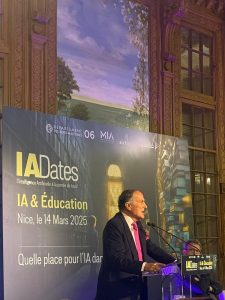
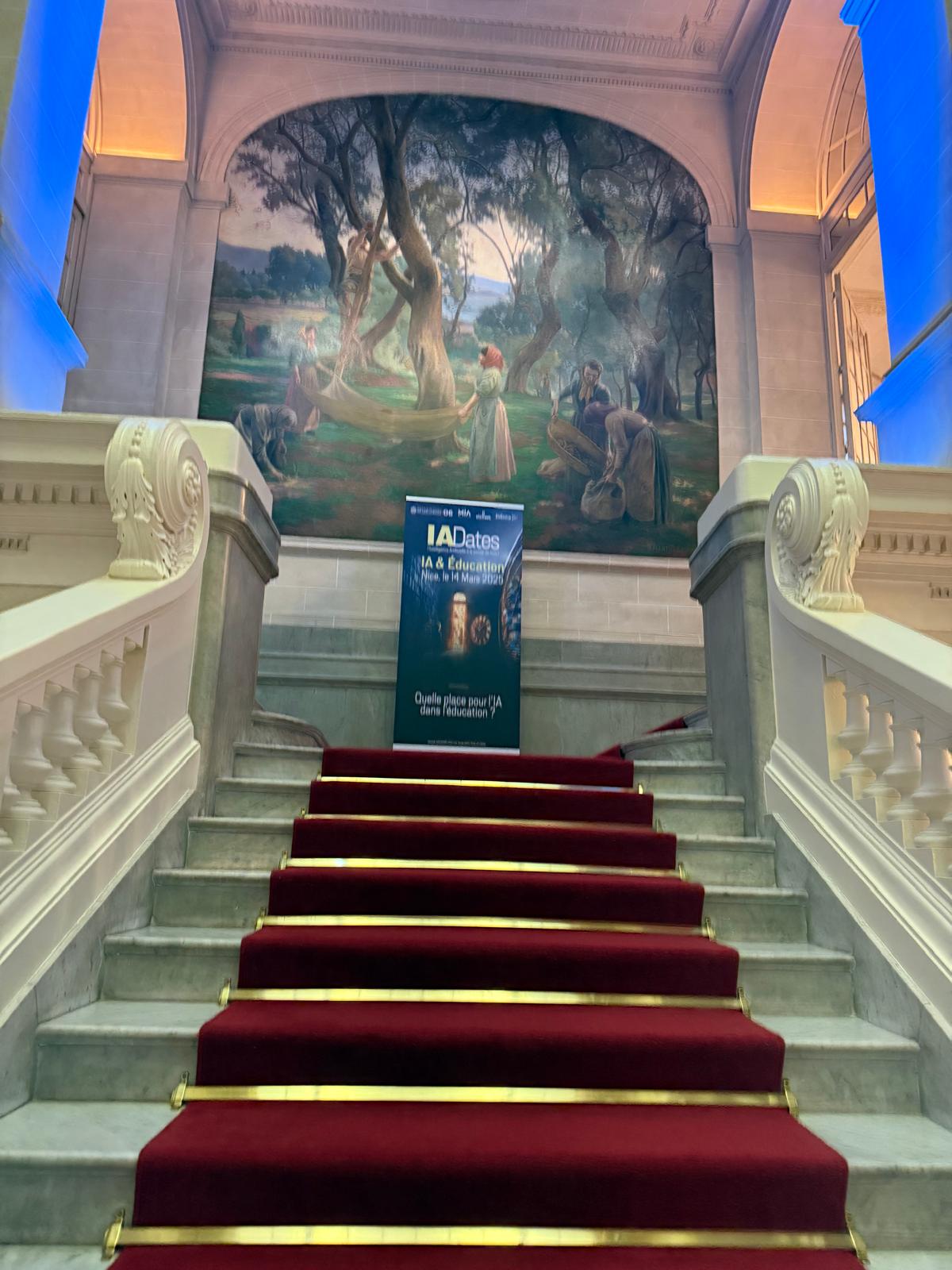
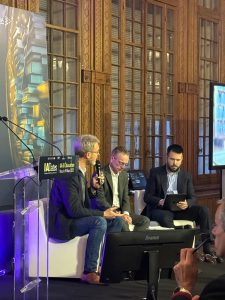
 At the IA Dates: AI and Education event on March 14, several experts gathered to debate the implications of AI on the French education system. Among them, Erwan Paitel, General Inspector of Education, Sports and Research, and Jean-Marc Huart, former Director General of School Education and future rector. They provided insights into the impact of AI technologies on teaching and learning.
Artificial intelligence: a revolution for education
AI does not represent a simple technological evolution in education; it represents a fundamental upheaval in the role of teachers and learning methods. According to Erwan Paitel, the arrival of generative AI such as ChatGPT or Perplexity marks a major breakthrough. For the first time, technology is no longer content to provide passive tools like the calculator or word processor that were criticized in their time, but actively produces content.
This raises a key question: how can this innovation be integrated into the education system while preserving the quality and equity of teaching? Jean-Marc Huart recalls that the digital transition in education has taken place in several phases, from the first typewriters to interactive whiteboards. But generative AI requires a much faster and deeper change. Now, teachers and students must navigate a world where information is not only accessible, but also generated automatically.
The evolution of the teaching profession in the age of AI
The introduction of AI in the classroom is changing the teacher’s role. Far from replacing teachers, AI could become an effective teaching assistant. According to the speakers, three major transformations of the profession are emerging:
- The integration of AI into teaching practices
Teachers must train in AI not only to use it in their classes, but also to learn how to analyze and supervise its use by students. Initiatives such as the Canopé network’s “Teaching with AI” program aim to support this transition.
- An evolution of assessment methods
The widespread adoption of generative AI raises questions about the relevance of homework and traditional assessments. If a student can write an essay in seconds using an AI model, how can fair and relevant assessment be guaranteed? Should continuous assessment be rethought?
- A need for acculturation and continuous training
With 850,000 teachers in France, bringing everyone up to speed on AI is a major challenge. Training exists, but it must be adapted to teachers’ time constraints and the rapid evolution of technologies.
AI should not be perceived as a threat to the teaching profession, but as an opportunity to rethink the transmission of knowledge. For Jean-Marc Huart, it is about “transforming fear into opportunity” and helping teachers see AI as a pedagogical lever rather than an obstacle.
AI education: a necessity for students
AI is not only a teaching tool; it is also becoming a subject of learning in itself. It is crucial that students develop a critical digital culture in order to understand how these technologies work, identify algorithmic biases and use these tools ethically and responsibly.
Two dimensions are essential:
- Training students in the technical basics of AI: understanding the principles of algorithms, machine learning and statistics is becoming as important as learning computer programming.
- Developing a critical mindset toward AI-generated content: as Paitel explains, 90% of the training data for generative AI models is in English, which can lead to cultural biases. It is essential that students learn to question the information provided by these technologies.
In this context, AI education is not only about science and digital technology: it also extends to the humanities, philosophy and economics. AI influences our understanding of the world and our relationship to knowledge, and students must be equipped to evolve in this changing environment.
AI as a tool for personalized learning
One of the great challenges of education is the personalization of teaching. AI can play a key role in adapting educational content to the pace and needs of each student.
Tools like Adaptive Maths, Algore and Plume make it possible to individualize learning paths by offering exercises and explanations adapted to students’ weaknesses and strengths. For students with special needs (dyslexia, autism, attention disorders), AI opens up new perspectives by facilitating accessibility and offering adapted teaching materials.
Jean-Marc Huart also points out that AI could reduce educational inequalities by offering personalized support to all students, regardless of their socio-economic background. However, this advancement must not lead to a digital divide where only the best-equipped schools benefit from the most effective tools.
Integrating AI into education: what challenges must be overcome?
Despite its promises, integrating AI into education raises several challenges:
- Ensuring equity in access to AI tools
Today, some districts benefit from pilot experiments such as the Digital Educational Territories, but to extend these technologies throughout the country, substantial investments will be necessary.
- Training teachers and supporting change
Establishing exchange communities among teachers can facilitate the adoption of these tools and encourage gradual adoption.
- Ensuring ethical and responsible use of AI
AI should not replace the teacher, but serve as a learning aid, with safeguards to prevent abuses (plagiarism, dependence on AI tools, information manipulation).
We are at a decisive turning point for education
AI is profoundly transforming education, both in teaching methods and learning modes. Rather than a threat, it represents a unique opportunity to personalize pathways, improve pedagogy and develop students’ critical thinking. However, its integration should not be left to chance. It is imperative to support teachers, guarantee equitable access to tools and regulate the use of AI so that it remains a learning lever and not a substitute for human thinking. Education cannot ignore AI. The question is not whether it should be integrated, but how it should be, to build an education system that is more inclusive, more effective and adapted to the challenges of the 21st century.
When we talk about education, I can’t help but think that the mission goes far beyond teachers and students: we will also need to train the entire French population so that no one is left behind…