
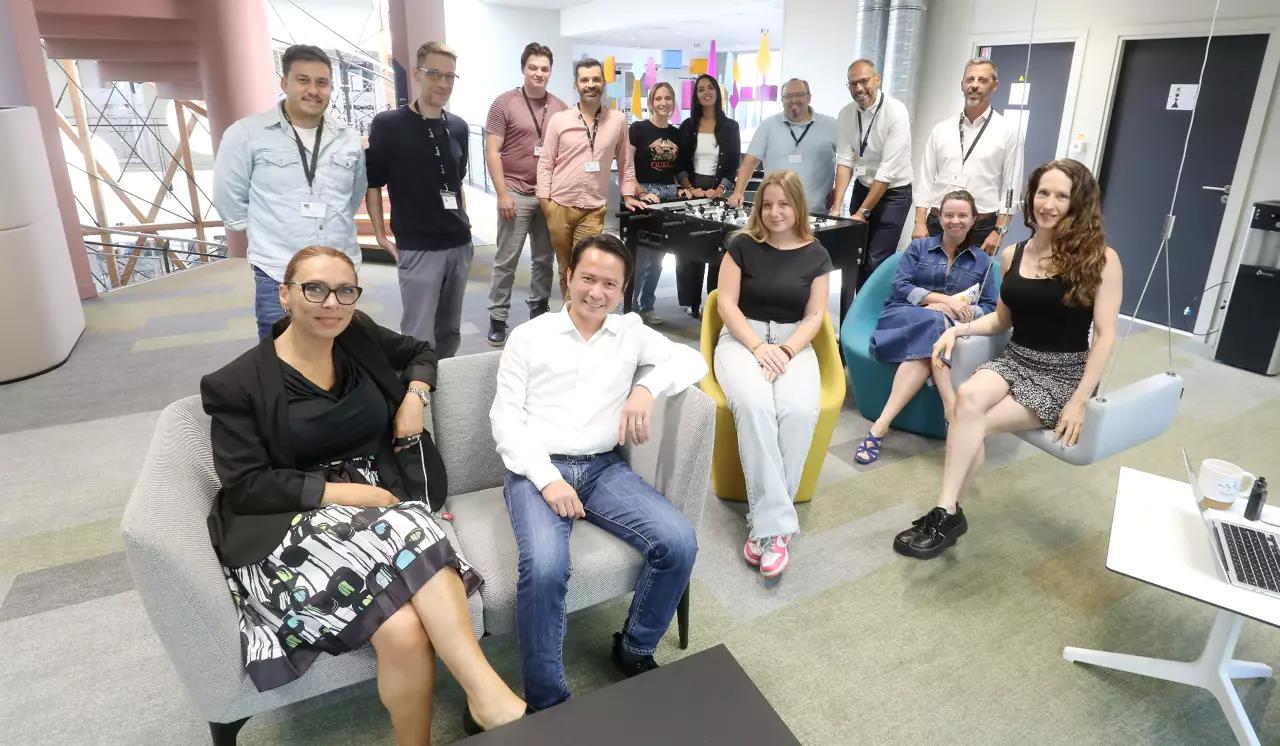
As part of the EntrepreneurIA project, where we explore the integration of AI in businesses through concrete testimonials, we had the opportunity to speak with Arnaud Pinte. This interview highlights the AI solutions developed by iPepper, which provide tangible responses to current entrepreneurial challenges.
iPepper, a Catalyst for AI Innovation
Founded on a hybrid model between consulting and software solution development, iPepper relies on a community of experts in data and artificial intelligence to support its clients in their digital transition. Present in several French regions and Morocco, the company positions itself as an accelerator of digital transformation, combining technological approach and human collective intelligence.
iPepper’s ambition is based on a simple principle: putting AI at the service of operational efficiency while ensuring ethical, sovereign responses adapted to clients’ specific needs. From financial reconciliation to HR optimization, through automated report generation, the applications of their solutions are multiple and impactful.
Use Cases: AI as a Lever for Business Optimization
Throughout our discussion, Arnaud Pinte presented several concrete cases of AI implementation, illustrating how iPepper transforms business challenges into growth opportunities.
Financial Reconciliation with the FinRec Platform
One of iPepper’s flagship solutions concerns the automation of financial reconciliation for business travel agencies. Faced with managing thousands of invoices per day, errors and anomalies are frequent (double billing, omissions, data loss). The FinRec platform implemented by iPepper has achieved a 99% matching rate, significantly reducing manual processing time and generating substantial savings.
Automated Dashboard Generation with Report Companion
The Report Companion chatbot illustrates another facet of iPepper’s expertise: making data analysis accessible to everyone through AI. This solution, deployed particularly in the real estate sector, allows companies to generate dashboards in natural language, without specific technical skills. The result? Faster and more informed decision-making.
Accelerating Skills Assessments with MyTalents
In the human resources field, MyTalents is a platform that revolutionizes skills management. Until now, writing a skills assessment summary required long hours of analyzing CVs, tests, and motivations. Thanks to a generative AI engine developed by iPepper, this process is now automated. MyTalents reduces processing time from 40 hours to just 1 to 5 hours, while ensuring optimal quality.
A Data Marketplace for Advertising Agencies
With Evorra, iPepper has also entered the marketing and advertising domain by developing a data marketplace for agencies. This platform allows advertisers to select targeted audiences that comply with privacy regulations, thus optimizing advertising campaign performance. The time saved in campaign preparation is significant: from 5 to 10 days to just one day.
Recruitment Optimization with Xtreme Profiler
Finally, the Xtreme Profiler project addresses HR teams facing the complexity of profile sourcing. Thanks to an AI-powered skills scoring and matching module, the time spent identifying relevant candidates is reduced by 30 to 60%, thus facilitating internal mobility and recruitment.
Ethical and Sovereign AI: iPepper’s Winning Bet
Beyond technological performance, iPepper stands out through a responsible approach to AI. The company takes pride in developing sovereign solutions that respect current regulations (GDPR, data privacy). Their commitment is also reflected in a strong policy regarding diversity, inclusion, and employee well-being.
This philosophy is essential for Arnaud Pinte: “AI should not be a black box imposed on businesses, but a transparent and understandable tool that improves their daily operations without stripping them of their expertise.”
Here are Arnaud Pinte’s main recommendations for entrepreneurs who want to integrate artificial intelligence:
Don’t wait to experiment with AI: “Many hesitate to invest in AI for fear of cost or lack of internal skills. You need to test quickly, even with Proof of Concept (POC).” Arnaud encourages them to start small, with targeted tests on a specific need.
Choose sovereign and secure AI: “The question of data protection is key. We always recommend opting for sovereign solutions hosted in controlled environments, like OVH or internally, rather than on public clouds.” AI should not compromise the confidentiality of the company’s strategic information.
Integrate AI as a complementary tool, not a substitution:
“AI is not meant to replace teams, but to save them time on repetitive tasks with no added value.” He emphasizes the importance of training employees so they use AI proactively and intelligently.
Measure ROI: “We shouldn’t talk about AI in abstract terms. You need to prove a clear return on investment, with measurable gains in productivity, cost reduction, or customer service improvement.” AI must be designed to integrate sustainably into the organization, not just as a one-time project.
Adapt AI to your sector and business needs: “Each company has its specificities. You shouldn’t copy large corporations, but appropriate AI according to your market’s constraints and opportunities.” SMEs and mid-sized companies should focus on concrete use cases rather than seeking generic solutions.
Accept a learning phase: “Implementing AI is not instantaneous. There’s an adjustment, training, and continuous improvement phase. The important thing is to have an iterative approach.” AI must be fed with relevant data to reach its full potential.
Don’t underestimate resistance to change: “AI adoption can be hindered by fear or skepticism from teams. It’s crucial to involve employees from the start and show them how AI can improve their work.” AI must be a lever for engagement, not a source of fear.
Rely on experts to succeed in implementation: “AI cannot be improvised. You need to surround yourself with specialists capable of supporting deployment and ensuring follow-up.” Entrepreneurs can collaborate with technology partners to avoid costly mistakes.