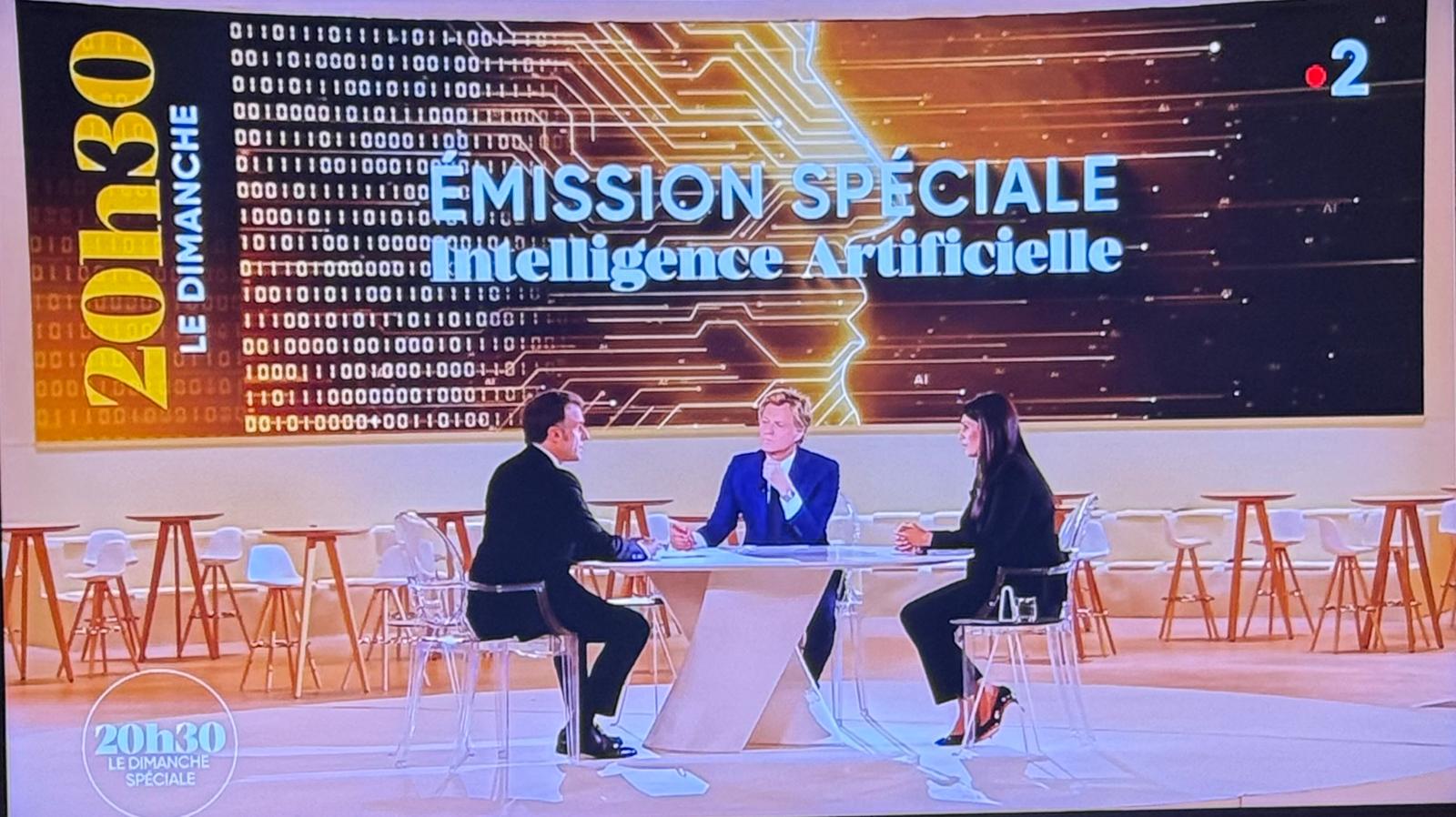
Artificial intelligence (AI) is at once a revolution, a hope, and a challenge. On the eve of the global AI summit, Emmanuel Macron granted an exclusive interview to present the French vision in the face of the global technological race led by the United States and China. Alongside Indian journalist Palki Sharma, he addressed major issues: innovation, ethics, regulation, and technological sovereignty.
109 billion euros to position France as an AI leader
The flagship announcement of this interview: an investment plan of 109 billion euros to accelerate AI development in France. This historic amount aims to:
• Build state-of-the-art data centers to support the computing capabilities essential to AI.
• Finance startups and innovative players like Mistral AI, in order to compete with American and Chinese giants.
• Train 100,000 talents per year to meet the growing needs of the industry.
• Develop more ethical and sustainable AI, with reduced energy consumption.
This funding will come from various players: the United Arab Emirates, American and Canadian investment funds, as well as major French companies like Iliad, Orange, and Thales.
Technological sovereignty at the heart of concerns
Faced with the dominance of American and Chinese Big Tech, Emmanuel Macron emphasizes the need for European sovereignty in AI. For him, France must not only be a key player, but also ensure that its innovations remain independent.
“We want to work with the United States and China, but we don’t want to depend on anyone.”
This requires accelerated development of data centers in France, allowing companies not to be dependent on foreign infrastructure.
AI in the service of health and society
Beyond economic competition, AI represents an opportunity to improve key sectors, particularly healthcare. Emmanuel Macron highlighted medical advances thanks to AI:
• Early cancer detection: thanks to machine learning technologies, diagnoses are faster and more accurate.
• Digital twins: these virtual replicas allow testing treatments without applying them directly to patients.
• Smart exoskeletons: French innovations, such as those from Wonderhawk, help people with disabilities regain mobility.
AI thus becomes a powerful ally in the medical field, while requiring strict regulation to avoid excesses.
Regulating AI: between innovation and regulation
Artificial intelligence raises numerous concerns:
• Impact on employment and transformation of the labor market.
• Disinformation and deepfakes threatening democracy.
• Issues related to intellectual property and copyright.
The president emphasizes the need for global regulation, involving governments and businesses. For him, technology platforms must assume their share of responsibility and clearly indicate when content is generated by AI. “We must require players to signal when a creation comes from artificial intelligence.” France thus wishes to play a driving role in regulating AI, while promoting its development.
France and India: a strategic alliance on AI
The Paris AI summit is co-chaired by India, a key player with its one and a half billion inhabitants and its booming technology industry. Emmanuel Macron and Prime Minister Narendra Modi wish to establish a lasting partnership in several areas:
• Talent training: India trains more than one million engineers per year, offering a valuable pool for technological collaborations.
• Development of sovereign AI: reducing dependence on the United States and China.
• Energy and sustainable datacenters: integrating a more ecological approach to AI.
This Indo-French alliance could open a third way in the global race for artificial intelligence.
Towards a future where France counts in global AI
President Macron’s interview marks a decisive step for France and Europe. With 109 billion euros invested, a stated willingness to regulate, and a strategic alliance with India, France aims to become an essential player in global AI. “We are entering a new era of progress. France and Europe will be there.”
The Paris AI summit will be a key moment to measure the impact of these announcements and define the future of artificial intelligence in a rapidly changing world.