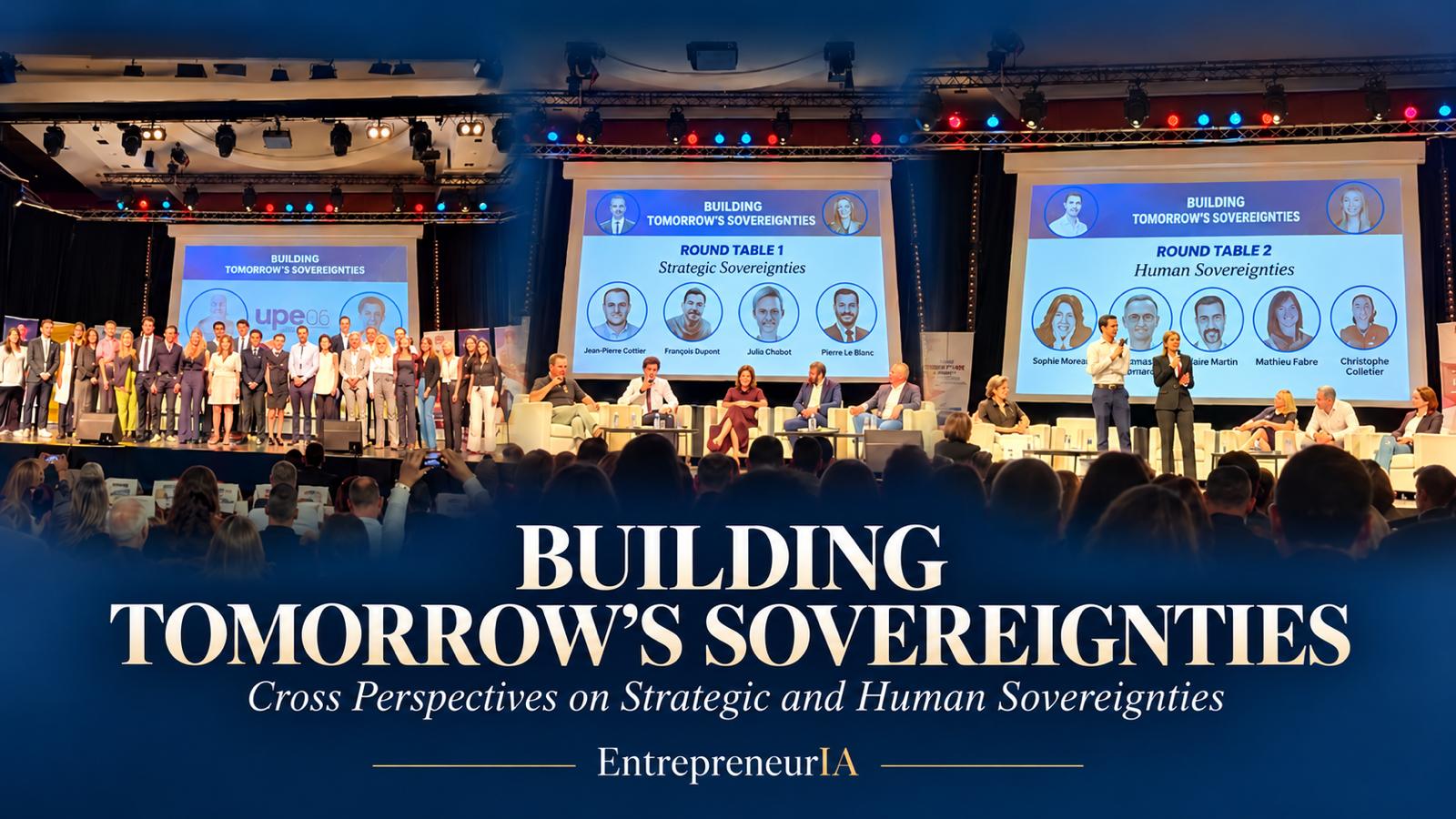
In Cagnes-sur-Mer, the Institut des Solutions Sud brought together fourteen networks around strategic and human sovereignty. An evening hosted by Marielle Walicki for Pierre Gattaz, designed as a laboratory for territorial cooperation and intergenerational transmission.
Cagnes-sur-Mer, October 13, 2026
How can we build tomorrow’s sovereignty without breaking down the silos between economic, professional, and community networks and generations? This was the premise of the evening organized at TERRAZUR by the Institut des Solutions Sud. More than a conference, the event aimed to create a common space between communities that usually work within their own ecosystems.
At the heart of this dynamic was Marielle Walicki. She carries this Institut des Solutions Sud project for Pierre Gattaz and chose to make inter-network cooperation the very method of the evening. The program combined two round tables, speeches from partner networks, partnership signings, and a networking session designed to generate concrete collaborations.
The ambition was clear: not to reduce sovereignty to a geopolitical abstraction. Producing, feeding ourselves, protecting data, providing healthcare, accessing energy, financing innovation, and retaining talent are now closely linked issues. They all point to the same question: what capacities must we have to remain masters of our decisions?
Fourteen networks, one territorial question
The uniqueness of the evening lies first in the diversity of the networks brought together. Around the Institut des Solutions Sud were the Collectif Energia, ANDRH Côte d’Azur, CJD, Clinique Juridique Côte d’Azur, DCF Côte d’Azur, and DFCG Côte d’Azur. Les Femmes Cheffes d’Entreprises, La French Tech Côte d’Azur Région Sud, Jeune Chambre Économique Nice Côte d’Azur, Kefi Business Club, Les Premières Sud, Skål International Côte d’Azur, and UPE06 completed this collective mobilization.
This coalition was not merely institutional. Marielle Walicki had asked network leaders to come accompanied by young members, students, or professionals. They were the ones who presented the organizations, often in their own words and from their own experience. The exercise immediately gave the subject another depth: a territory cannot be sovereign if it doesn’t know how to transmit its skills, responsibilities, networks, and capacity for action.
Collectif Energia emphasized the strength of entrepreneurial mutual aid and co-development. ANDRH focused on the role of human resources. CJD on leadership training. The Clinique Juridique on access to law. DCF on promoting commercial professions. DFCG on the link between students and financial functions. Les Femmes Cheffes d’Entreprises and Les Premières Sud on women’s place in the economy. La French Tech on the innovation ecosystem. JCE on learning through action. Kefi on business relationships. Skål on tourism and international openness. UPE06 on the economic representation of the territory.
Sovereignty is not the absence of dependencies. It is the capacity to know which ones we can accept and which ones we must imperatively control.
Sovereignty no longer means autarky
The first round table, devoted to strategic sovereignty, examined four particularly sensitive areas: food, digital, energy, and health. A common point quickly emerged. Being sovereign does not mean producing everything oneself. Rather, it means understanding one’s dependencies, identifying those that become critical, and retaining enough levers to act when the environment deteriorates.
This reading directly concerns leaders. An organization can function perfectly while having already lost part of its decision-making freedom. It may depend on a technology supplier, a platform, an energy resource, external financing, or a rare skill. As long as the ecosystem remains stable, the dependency is almost invisible. Crisis reveals it.
Agriculture: sovereignty through added value
Adrien Gannac, from Maison Gannac, illustrated this logic through the Menton lemon. The company relies on an integrated model combining production, processing, and distribution. This diversification strengthens resilience: when one of the businesses is weakened by a climate, economic, or logistical crisis, the others help maintain activity.
In the Alpes-Maritimes, land constraints often make it impossible to compete by volume with large agricultural regions. The answer then lies in valorization: protected geographical indication, local processing, quality, and know-how. Three particularly strong vulnerabilities remain, however: labor, water, and land. They show that territorial food sovereignty requires collective trade-offs on the use of scarce resources.
Digital: dependency hides in the technological chain
Jean-Charles Chemin, president and co-founder of Legapass, shifted the reflection toward digital sovereignty. For regulated professions, the question is particularly sensitive. Lawyers, notaries, accountants, or judicial officers work with protected data and significant compliance obligations.
His observation highlights a frequently underestimated difficulty: locating a server in France is not enough to guarantee effective sovereignty. One must also examine the nationality of suppliers, the extraterritorial legislation to which they are subject, payment solutions, operating systems, software, and the actual circulation of data.
Technological sovereignty is also at stake in financing. Europe’s lag in investment capacity, particularly in artificial intelligence, risks increasing future dependence. For companies, choosing a French or European supplier when a credible alternative exists therefore becomes a strategic decision as much as a technical choice.
Energy: the infrastructure of all other sovereignties
Salah Ajraoui, an engineer who has worked on the French nuclear fleet and international projects, recalled that energy cannot be considered a simple bill. It conditions mobility, industry, digital, data centers, artificial intelligence, agriculture, and most modern infrastructures.
Energy sovereignty must therefore be considered across the entire value chain: technologies, production capacities, supplies, skills, maintenance, and uses. Having energy is not enough. One must also know how to direct it toward productive and efficient uses. This reflection brings together industrial sovereignty and ecological transition: producing locally with highly decarbonized electricity can reduce both certain industrial dependencies and the carbon footprint of value chains.
Health: retaining brains as much as infrastructure
Julie Oudin, director of care at Centre Antoine Lacassagne, offered another reading. Some pharmaceutical dependencies are now deeply internationalized. The question therefore becomes less about relocating everything than identifying the capacities that remain essential to master. Research, medical skills, and cooperation between institutions and universities are among them.
Her intervention also showed how sovereignty can depend on very concrete factors. An institution can be recognized, innovative, and attractive, but lose professionals because they cannot find housing in the territory. Housing, mobility, parking, and quality of work life then become issues of skills retention. Health sovereignty is also built outside the hospital.
The second frontier: remaining sovereign in the face of the machine
The second round table, devoted to human sovereignty, shifted the debate toward a more fundamental question. How can we preserve the individual’s capacity to think, choose, and decide in an environment increasingly mediated by digital technologies and artificial intelligence?
Laurence Vanin emphasized the need to regain the capacity to think for oneself and maintain critical distance from passions, opinions, and manipulated information.
In an environment saturated with content, intellectual sovereignty becomes a strategic skill.
Armand Bourgeois addressed the same issue from the digital perspective:
artificial intelligence must remain a tool and not become the device that decides in place of the user.
The easier automatic responses become to access, the more necessary it becomes to strengthen verification, contextualization, and judgment capacities.
Jérôme Baer framed the risk differently. According to him, we are not necessarily threatened with being replaced by machines.
The danger would rather be losing part of our humanity by entrusting them with what should remain human work.
Relationship, discernment, responsibility, and the capacity to give meaning cannot be reduced to optimization functions.
The issue is no longer just protecting our data or infrastructure. It is also knowing what we choose not to delegate to the machine.
Transmission as the invisible infrastructure of sovereignty
The presence of young people throughout the evening takes on its full meaning here. Several of them implicitly rejected the idea that youth would only be the future. They reminded us that it is already an actor in the present, provided it is given access to spaces of decision-making, learning, and engagement. This intergenerational approach directly aligns with the logic of Marielle Walicki and the Institut des Solutions Sud. Building sovereignty does not only involve major technological or industrial investments. It also requires creating networks capable of communicating, identifying their complementarities, and transmitting the capacity to act early enough.
Behind the fourteen associations and networks brought together thus appears an often underestimated infrastructure: the territory’s relational capital. Companies do not innovate alone. Talents do not develop alone. Projects do not spontaneously find their financing, partners, or markets. Sovereignty is also a matter of cooperation.
From sovereignty as protection to sovereignty as capacity
The main lesson of the evening is probably this shift. For a long time, sovereignty was thought of mainly as protection: protecting borders, companies, technologies, data, or resources. Current transformations require adopting a more dynamic conception.
Sovereignty becomes a capacity: the capacity to produce, finance, understand technologies, retain skills, manage a crisis, cooperate, and ultimately decide.
For leaders, this evolution profoundly changes the question. It is no longer enough to ask: what does my organization depend on? One must ask: among all my dependencies, which ones could tomorrow limit my capacity to decide?
This is probably where any serious sovereignty strategy begins.