In Monaco, the MonacoTech incubator supports innovative startups that place AI at the heart of their strategy. Altores and Maliz.ai, two young Monegasque ventures, are developing AI solutions designed to optimize business processes. They tackle the automation of repetitive tasks, customer interaction management, and workflow optimization.
Through this interview, we dive into the world of these two companies and explore their vision, challenges, and impact on Monaco’s entrepreneurial ecosystem. They will participate in the event organized by Monaco Women in Finance and Monacotech for Digital Women’s Day on April 17, 2025.
 Altores: Virtual Employees to Automate Business Operations
Founded 18 months ago by Louis and his partner, Altores aims to elevate user and employee experience through AI. The company designs advanced chatbots and custom solutions that enable businesses to automate their internal processes. The goal? Free up time for teams and optimize productivity.
“We develop chatbots for customer support, employee onboarding, and the automation of repetitive tasks.” – Louis, co-founder of Altores
One of AI’s major challenges is data management. Many companies question the use of American solutions and the need for sovereign hosting of sensitive information. Altores has chosen a hybrid model: using OpenAI technologies when relevant, while ensuring data sovereignty for use cases requiring enhanced security.
“Our solutions are tailored to client needs. For some companies, it’s essential to keep their data in-house. We adapt according to their requirements and budget.” – Louis.
Today, Altores deploys its solutions with several renowned clients. The company is in the contracting phase with other businesses, highlighting the growing adoption of its automation tools.
 But how can you stand out in such a competitive market?
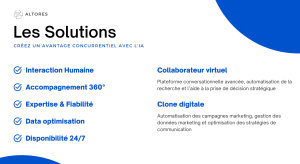
“Conversational AI is a foundation, but we go further. We develop virtual employees capable of automating more complex business tasks. For example, I personally test our solution on LinkedIn: my ‘digital employee’ generates content and suggests post ideas.” – Louis
One of Altores’ major ambitions is to integrate AI with enterprise CRMs, which contain strategic data and enable information structuring for optimized decision-making.
But where is this data stored? The question of digital sovereignty is central. “We’re seeking the best open-source model to guarantee data confidentiality. Currently, we use OpenAI to test our solution internally, but we’re simultaneously developing an alternative that preserves companies’ data.” – Louis
 Maliz.ai: Sovereign and Secure AI for Businesses
Like Altores, Maliz.ai specializes in developing conversational solutions and enterprise chatbots. Their distinctive feature? A focus on data sovereignty and infrastructure security.
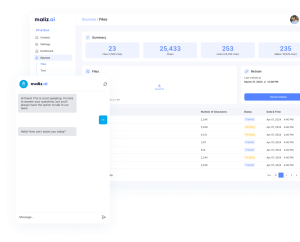
“Our solution enables companies to index and efficiently leverage their data through high-performing and secure AI models. We’ve integrated open-source LLMs, like Mistral, to ensure complete data control.” – Andréa, co-founder of Maliz.ai
The challenge is twofold: offering effective and customizable tools while ensuring maximum security. Maliz.ai primarily targets large enterprises, which are particularly sensitive to data confidentiality issues.
“Our biggest clients request on-premise solutions (hosted internally) to maintain complete control over their information. We’ve developed an infrastructure enabling seamless integration with companies’ existing systems.” – Andréa
To optimize data management, Maliz.ai has developed RAG (Retrieval-Augmented Generation) technology, enabling intelligent indexing and information utilization. The goal? Avoid the errors of generalist AIs by providing contextualized and precise answers.
Strategic Challenges: Sovereign AI and Energy Optimization
AI development also raises questions about its environmental impact. The infrastructure required for model training consumes enormous amounts of energy and water. “AI’s environmental impact is a key issue. We must use the right models, with the right size, and avoid unnecessary computations. Adopting Small Language Models (SLMs), which are more specialized and less energy-intensive, is one solution.” – Andréa
Vertical models adapted to specific business needs appear to be the future, as explained by Luc Julia, co-creator of Siri, whom we had the opportunity to interview: “Ultimately, generalist LLMs will lose relevance. The cost per query is too high relative to the actual energy cost.” This vision is shared by the founders of Maliz.ai and Altores, who are developing solutions tailored to specific use cases, thereby reducing energy consumption while improving result relevance.
Training and Supporting Companies in AI Adoption
One of the main challenges for companies today is AI adoption. Maliz.ai and Altores support their clients in structuring their data and integrating AI tools.
“Many companies don’t know how to integrate AI into their processes. It’s essential to raise awareness and show them how these technologies can improve their productivity.” – Louis
Education and training are therefore crucial challenges. To facilitate AI adoption, it is recommended to:
- Start with simple use cases to demonstrate added value.
- Train employees so they don’t perceive AI as a threat, but as a lever for excellence.
- Structure data upfront to optimize model performance.
- Engage experts for effective implementation.
Encouraging Women to Enter AI Professions
Finally, the artificial intelligence sector remains predominantly male. How can we encourage more women to join this rapidly expanding industry?
“Don’t be afraid to take the leap! AI careers aren’t reserved for men. We need diverse talent to enrich approaches and foster innovation.” – Andréa
New generations have access to more accessible tools, particularly through no-code platforms and simplified interfaces, thus opening the door to a wider audience.
Monaco, a Growing Technology Hub
Thanks to MonacoTech and the Principality’s support, startups like Altores and Maliz.ai are shaping the future of AI in Europe. Their innovations enable companies to gain competitiveness while ensuring data sovereignty and security.
AI is more than just a tool: it’s a strategic lever redefining how we work. For entrepreneurs, the challenge is clear: adapt now or risk being left behind.