
ENTREPRENEURIA | Analysis
This morning, at breakfast, the radio decided to answer my questions
This morning at breakfast, I had a rather rare experience: the radio was answering almost exactly the questions I had been asking myself for several weeks. This is unusual enough to be worth noting.
Should we really start worrying about artificial intelligence, or are we witnessing a new season of the grand technological series where every advance must necessarily herald either paradise or the disappearance of humanity?
The heads of major labs regularly explain to us that they are building extraordinary machines. Then, sometimes in the same interview, that they could become extraordinarily dangerous. It must be acknowledged that the situation is rather ironic.
We are investing dizzying sums in a technology whose designers simultaneously ask us to measure the existential risks. We are developing agents capable of accomplishing more and more tasks, while wondering what will become of our jobs. We are developing humanoid robots for factories at a time when Europe is aging and certain sectors are already struggling to recruit. And we are producing considerable quantities of artificial content while wondering how to preserve the quality of data that will feed the next generations of models.
In other words, my breakfast was becoming interesting.
“Is it Terminator or is it really a plausible scenario?”
Terminator. Here we go again.
Since artificial intelligence left the laboratories to enter our businesses, our phones and our conversations, we have struggled to imagine its future with nuance. Between the office assistant and the extermination of the human species, intermediate scenarios seem almost to have disappeared.
It is precisely for this reason that the debate I was listening to this morning interested me. Because quite quickly, it stopped talking about Terminator.
David Djaïz questions the alarmist discourse of major AI labs. Jean-Louis Constanza, co-founder of Wandercraft, responds from a much more tangible universe: that of exoskeletons, humanoid robots, factories and labor shortages.
Then the discussion drifts toward subjects that seem to me much more interesting today for entrepreneurs. Why are those who most accelerate the race to AI sometimes those who ask us to be wary of it? Will robots really eliminate jobs or will they arrive precisely when we run out of workers? What happens to the Internet when machines produce a growing share of the content they will then use? And what does the sovereignty of a company still mean when part of its operational intelligence depends on models it does not own and does not control?
In a few minutes, we had gone from Terminator to demography, from the end of humanity to labor shortages, from general intelligence to business continuity. It is much less spectacular. But probably much more important.
“Fear marketing”: when those who build AI ask us to fear it
“I think there is a lot of fear marketing in all this.”
David Djaïz begins by turning the question around. Why are the leaders of labs accelerating the race to AI also among those who most insist on its dangers? He does not deny the risk. He proposes to look at the same time at the interests surrounding the discourse on risk.
His first track is economic. The technological frontier has become extraordinarily expensive: computing, data centers, semiconductors, energy and talent. The more access to this frontier requires capital, the fewer can still participate in the race.
His second track is that of regulatory capture. In essence: we have built the most powerful systems, so we are best placed to explain to governments how dangerous they can be. And since these systems are dangerous, market access requirements can become considerable.
The paradox becomes quite clear quite quickly. Regulation can protect society. It can also strengthen actors who already have the means to comply with it. Both effects can coexist.
“If we are not in the cockpit of the plane, the plane will crash.”
Djaïz finally evokes the influence of intellectual currents very attentive to existential risks and the long term. Here again, the analysis deserves better than caricature. An alert can be sincere, scientifically argued and, simultaneously, serve the competitive position of whoever issues it. The International AI Safety Report 2026, directed by Yoshua Bengio with more than a hundred experts, helps precisely to get out of this simplistic opposition. It distinguishes already observable harms from more uncertain scenarios of loss of control and notes rapid but highly uneven progress in capabilities.
From fear of AI to the industrial reality of robotics
After the billions, loss of control and the possible disappearance of humanity, Jean-Louis Constanza brutally brings the conversation back to earth. Literally. His company must make people walk who no longer walk and teach robots to evolve in industrial environments without putting humans in danger.
“For four years, we have heard this phrase every six months.”
Constanza greets with distance the recurring announcements of imminent general intelligence or catastrophic tipping point. His skepticism, however, is not a denial of risk.
“AI and robots are extraordinarily powerful tools for the future, as trains were, as planes were.”
The analogy can be debated. Software AI spreads faster than a plane and its uses are much less circumscribed. But Constanza points to something right: a dangerous technology does not become acceptable because it ceases to be dangerous. It becomes so because engineering, standards, controls and responsibilities progress with it.
“We must remain optimistic, we must be careful.”
This caution takes concrete form at Wandercraft. In August 2026, the company announced FDA authorization of its Eve personal exoskeleton for certain adults with spinal cord injuries. Here, technology does not replace anyone. It seeks to restore a physical capacity.
Loss of control: what scientists say, and what they don’t say
The program nevertheless recalls the warnings of Yoshua Bengio and Geoffrey Hinton. They cannot be dismissed on the grounds that catastrophic scenarios make good headlines.
The 2026 international report, however, brings an essential clarification: current systems do not yet possess all the robust capabilities necessary for an extreme loss of control scenario. They nevertheless show early signs of relevant capabilities: more autonomy, planning, tool use, detection of certain evaluation situations and search for loopholes in test protocols. And above all, experts do not agree on the probability of the most serious scenarios. Some consider them very unlikely. Others believe that the uncertainty itself justifies precautionary measures. It is less spectacular than an announced date for the end of the world, but intellectually much more solid: we do not know.
For a company, the immediate risk is moreover more mundane. An agent with excessive rights. A bad answer automatically transformed into action. A decision that no one checks anymore because the system works correctly most of the time. Agentic AI does not only change performance. It changes the potential cost of error.
Exponentials, water lilies and our taste for impossible dates
“The problem is exponential laws.”
David Djaïz uses the classic image of the water lily that doubles its surface area every day in a pond. The metaphor works because we do indeed have difficulty reasoning in the face of compound progressions. It becomes more fragile if transformed into a physical law of artificial intelligence. There is no single quantity called “intelligence” or “power” that doubles neatly every six months. Evaluations rather show extremely rapid progress in certain areas, notably mathematics, programming and certain scientific tasks, associated with persistent weaknesses in others. The best systems can solve a sophisticated problem and then stumble on a surprisingly simple step.
This heterogeneity explains part of our difficulty in talking about AI. We simultaneously observe performances that would have seemed impossible a few years ago and errors that brutally remind us that we are not facing digital human intelligence.
What if the real problem was much less cinematic?
“I think the main risk is today, we don’t see it.”
This is probably when the program becomes most interesting. David Djaïz abandons the spectacular scenario of the machine turning against humanity and looks at what is already changing before our eyes: the information space.
“For one human click, you will have 1,000 robot clicks.”
The ratio is an image, not a statistic. But the question it poses is real. What happens to the Internet when artificial agents produce, read, comment, recommend and republish content on a scale with no comparison to human activity?
“The risk is that we will be literally buried under a deluge of content manufactured by robots.”
Here is a scenario that has the bad taste of being less photogenic than Terminator, but which could be much closer.
In 2024, a study published in Nature by Ilia Shumailov and co-authors highlighted a risk linked to the repeated use of AI-generated content to train new models. By learning from content generated by other AIs, models can gradually lose the richness and diversity of data from reality. Researchers describe this phenomenon as “model collapse.” In other words, if AIs end up learning mainly from content produced by other AIs, they risk gradually moving away from the complexity of the real world. This does not mean that all synthetic data is toxic. Well designed, it can on the contrary be useful. But it changes the economic value of provenance.
If producing content becomes almost free, content will not necessarily be the scarce resource. Scarcity could become the data we know comes from reality: an interview, an industrial experience, an authentic customer return, a field observation, tacit knowledge, a database whose provenance is documented.
We have spent twenty years accumulating information. We could spend the coming years trying to prove which still deserves our trust.
We were afraid robots would take our jobs. What if we ran out of humans?
The debate then shifts to robotics. And another paradox appears.
“For many years, robots will mainly focus on arduous jobs.”
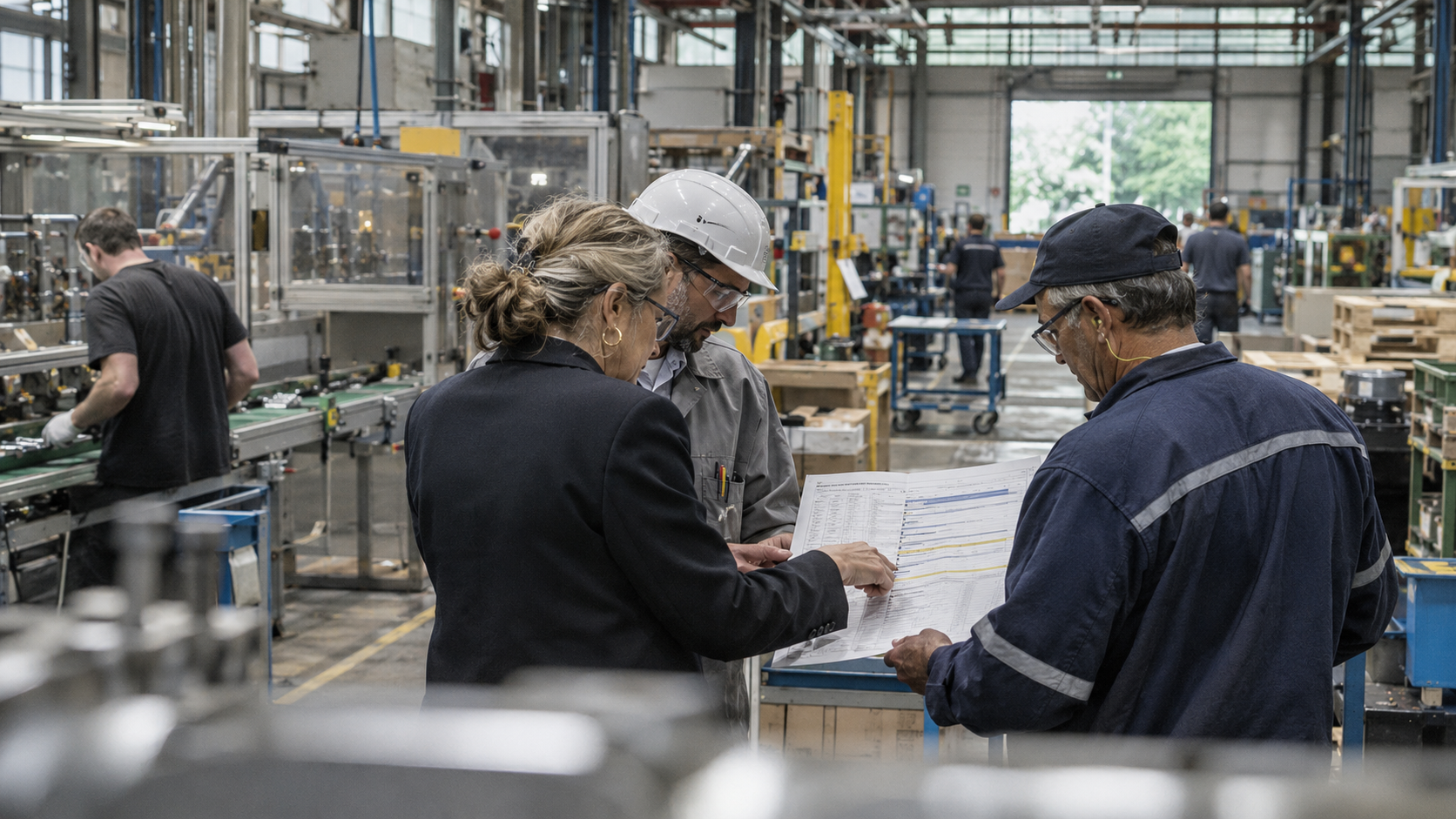
Wandercraft is working with Renault Group on Calvin, a humanoid robot intended for industry. Renault plans about ten robots in position at the end of 2026, then 350 in its French and Spanish factories by the end of 2027. The first targeted tasks concern notably heavy loads, cutting parts and repetitive gestures.
For years, we have wondered what we would do when robots took our jobs. Constanza comes to explain to us that we may soon need them because we are no longer numerous enough, or no longer numerous enough to want to occupy some of these jobs.
“We are entering the demographic wall quite slowly on a human scale, but very quickly on a historical scale.”
Jean-Louis Constanza’s formula is strong, but it reflects a now well-documented demographic evolution. In OECD countries, the number of people aged 65 and over relative to the working-age population rose from 19% in 1980 to 31% in 2023. According to the organization’s projections, this ratio could reach 52% in 2060. Behind these figures emerges a profound transformation of the labor market: fewer workers to support an aging population, but also recruitment difficulties likely to intensify in certain sectors. OECD work published in 2026 specifically studies the possibility that AI could mitigate some of the economic constraints of aging. The authors see real productivity potential, but certainly not an automatic solution: training, labor reallocation, innovation and entrepreneurial dynamism remain essential.
We must therefore beware of the too comfortable scenario according to which robots would only do tasks that no one wants. A versatile technology changes use as it becomes better and less expensive. Some jobs will be transformed, some will disappear, others will appear.
But the reverse is also true: reasoning only in terms of job destruction ignores sectors where automation could become a condition for maintaining production.
On employment, the most serious answer remains: we don’t know
“The answer is that there is no answer.”
This phrase by David Djaïz is probably more useful than many spectacular projections.
Economists can measure task exposure, build scenarios, observe employer intentions and monitor early effects on certain professions. They cannot yet establish with certainty the final balance of this transformation.
The 2026 international report also notes the disagreement among economists. The observed aggregate effects remain limited, while some signals suggest stronger exposure of early-career workers in some cognitive occupations.
The problem is that we too often reason in terms of stock of jobs when the difficulty will probably be the transition. A position created in five years does not immediately compensate for the one that disappears today. A robotics engineer is not the natural continuation of an automated administrative job.
And a more discreet question appears: how does one become an expert if AI performs the junior tasks through which one used to learn one’s profession? The immediate productivity gain can create a long-term skills debt.
AI, new strategic infrastructure for companies
“AI is an infrastructure.”
This phrase by David Djaïz shifts the subject again. If AI becomes a cognitive infrastructure integrated into the company’s critical processes, choosing a model no longer quite resembles choosing office software.
Djaïz takes the example of banks and insurance. Imagine that a growing part of risk analysis, scoring, document processing or fraud detection relies on systems provided from abroad. What happens if access conditions change? If a service becomes unavailable? If a regulatory conflict appears? If the supplier modifies the model?
The scenario of a European economy brutally stopped by an American button is deliberately pushed. But the technological dependence is real. Sovereignty does not necessarily mean developing a French model for each use. It means knowing what one depends on and keeping options.
For a company, the questions become concrete: which processes rely on which model? Where does the data go? What is the exit cost? Can we change suppliers? Is there a degraded mode? Who would still know how to do the work if the system became unavailable?
Sovereignty then ceases to be only a political debate. It becomes a business continuity issue.
Finally, my coffee had gone cold
At the end of the program, my coffee had gone cold, but the initial question had fortunately changed a lot. I still did not know whether artificial intelligence would one day cause an existential catastrophe. No one seriously knows today. On the other hand, several transformations are already visible enough not to wait for Terminator. AI is beginning to modify the value of information. It is shifting the boundary between automation and expertise. It meets a demographic shock that changes the economic meaning of robotization. It creates new technological dependencies. And, with agents and robots, it is beginning to connect three previously relatively separate universes: knowledge, decision and action.
A hallucination in a chatbot produces bad information. The same error in an agent with permissions can produce a bad action. In a robot, it can produce a physical event. The more action capacity increases, the more governance ceases to be an abstract subject. The question “should we fear AI?” therefore seems to me less and less interesting. Fear is not a strategy. Enthusiasm is not either.
For entrepreneurs and leaders, the questions are now more demanding. What do we want to automate? What skills must we preserve? What human data will have particular value tomorrow? Which suppliers do we accept to depend on? And what decisions do we want to continue to understand sufficiently to assume responsibility for them?
In a world where synthetic production becomes abundant, part of the value could paradoxically shift toward what remains rare: real experience, trust, judgment, field knowledge and human responsibility.
Artificial intelligence creates capability. Organizations create value.
But their competitive advantage may also depend on what they will have had the intelligence not to delegate.