
ENTREPRENEURIA | IN-DEPTH ARTICLE
By Pascale Caron | November 28, 2026
Artificial intelligence is spreading through companies, but its economic effects remain uneven. Why do individual productivity gains not necessarily translate into collective performance? The results of the EntrepreneurIA 2026 Barometer, academic research and industrial feedback invite us to shift the debate towards processes, expertise and management decisions.
The productivity paradox
Two companies can use the same artificial intelligence model and obtain very different economic results. One reduces its production times, develops new services or improves its margin. The other accumulates experiments, multiplies subscriptions and struggles to demonstrate what these investments have changed. The difference does not necessarily lie in the quality of the algorithms, but in the way each organization mobilizes their capabilities.
Through more than a hundred interviews conducted as part of EntrepreneurIA with Dr. Yves-Marie Le Bay, this question has gradually emerged. Discussions often begin with technologies and lead to subjects of management, professional expertise, coordination and responsibility. They extend a conviction that now structures my research: artificial intelligence creates a capability. Organizations create value.
This conviction does not deny the importance of technical performance. It invites us to study what happens between a possibility offered by AI and its observable result in the company. This is particularly decisive for mid-sized companies (ETI), which must transform existing activities without compromising their operational continuity. [1]
Massive adoption that does not guarantee performance
The global McKinsey survey published on August 25, 2026, among 1,719 respondents, reveals that 89% report regular use of AI in at least one function of their organization. While 80% report an improvement in their individual productivity, 37% attribute a positive contribution to earnings before interest and taxes (EBIT) to AI. Approximately 6% meet the criteria of “AI high performers,” namely a declared contribution of at least 5% to EBIT and a value deemed significant. These distinct indicators do not allow calculation of a project failure rate. [2]
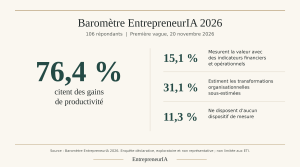 The first data from the EntrepreneurIA 2026 Barometer provide complementary insight. As of November 20, out of 106 usable responses, 81 people (76.4%) cite productivity gains among the benefits obtained. Only 16 (15.1%) report measuring value with both financial and operational indicators. Twelve (11.3%) have no measurement system, and 33 (31.1%) consider that companies underestimate the organizational transformations caused by AI. The survey is exploratory, declarative and not representative; 41 respondents work in technology, digital or professional services. It does not focus exclusively on mid-sized companies and does not allow direct statistical comparison with McKinsey. [3]
These observations align with several research studies. Brynjolfsson, Li and Raymond observe in 2025 an average 15% increase in the number of problems solved per hour in an AI-assisted customer support activity, with heterogeneous effects across employees. Dell’Acqua and his co-authors show that AI can improve performance on certain tasks and deteriorate it on others, even within comparable intellectual work. These experiments establish effects in particular contexts, but do not prove an equivalent progression in overall profitability. [4, 5]
We must therefore distinguish technical capability, its actual use, process modification, value created and value actually captured by the organization. Between these steps, trade-offs are made that adoption statistics do not describe. [6]
Mid-sized companies facing a particular transformation challenge
Mid-sized companies (ETI) occupy a unique position between SMEs and large enterprises. The French statistical definition combines criteria of workforce and financial size. In these structures, the complexity of activities can be significant without the specialized resources available to transform the information system being comparable to those of a large group. [7]
Successive acquisitions, site dispersion, legacy software and diversity of working methods can make data difficult to reconcile. Essential expertise sometimes remains held by a few employees. Resources invested in AI also compete with essential industrial investments. The challenge is therefore not to mechanically apply the architectures of large companies, but to organize transformations proportionate to needs, resources and risks.
This perspective aligns with the work of Mikalef and Gupta on organizational capabilities associated with AI: technology constitutes one resource among others, whose combination with the company’s skills and resources is decisive. It also aligns with the productivity J-curve of Brynjolfsson, Rock and Syverson, which emphasizes the role of intangible investments complementary to general-purpose technologies. The transformation time must be taken into account, without indefinitely excusing the absence of results. [8, 9]
From technical capability to decision: lessons from the field
At Monaco–Monte-Carlo station, the project conducted with Akila illustrates the value of a common repository linking infrastructure, equipment and operational data. XXII’s computer vision contributes to understanding passenger flows. In an article dated October 12, 2026, SNCF Numérique reports an energy saving of 6 to 7% achieved through adjustment of settings, particularly ventilation. The reconciliation between historical plans and actual public areas, 10% smaller than those in the initial plan, also made it possible to renegotiate cleaning contracts. This is not a physical reduction in areas. The value here comes from decisions made possible by knowledge of the building. [10, 11]
In automotive, Inbolt explains how its 3D vision system guides a robot at a tailgate handling station at Stellantis in Detroit. The supplier announces a 30% reduction in cycle time at this station. The improvement in flexibility of an existing machine is interesting for an industrial mid-sized company, provided the effects on the entire chain and integration costs are examined, rather than extrapolating the figure to the factory. [10, 12]
In aquaculture, Samuel Dupont, co-founder of Bioceanor, explained during our interview how models combining expertise in marine biology and environmental data can anticipate water quality degradation. His solution announces predictions of dissolved oxygen levels up to 48 hours in advance. However, a prediction only has economic significance if the operator can adapt their intervention in time. [13, 14]
Industrial research offers another field. In an interview published in April 2026, David Cranfill, chief technology officer at Huntsman, reports an approximately 30% reduction in development time on a first polyurethane insulating foam formulation project with Citrine Informatics. AI helps anticipate performance and select relevant tests; experimental and regulatory validation remains necessary. The declared indicator concerns this project, not the group’s R&D. [15]
The announcement of November 25, 2026 concerning MANE DIGITAL HOUSE, in Barcelona, extends this reasoning. The group specializing in flavors and fragrances wishes to bring together data, AI, product and change management skills to serve its businesses. Its internal assistant MANEGPT already exists; the development of agents is included in a roadmap from 2027. This is an organizational ambition, not yet a demonstrated return on investment. In formulation businesses, the question will notably be to mobilize and transmit accumulated knowledge without impoverishing expert judgment. [16]
Finally, the retailer Worten has combined Lokad’s probabilistic forecasts with optimization of replenishment and allocation decisions. The case study published in January 2025 reports 17.8% fewer stockouts, 7.8% reduction in the value of inventory held in stores and 0.78% additional revenue. These results, communicated by the partners, shed light on the link between forecasting, service level and immobilized capital. [17]
These organizations are not all mid-sized companies in the French statistical sense. However, their experiences provide transferable lessons. Above all, they show that value can result from better use of capital, risk reduction, innovation or quality, and not only from time savings.
Why knowing when to stop a project is a strategic skill
The contrast between two experiences at L-Acoustics, a manufacturer of professional sound systems, is particularly instructive. In a feedback reported on November 19, 2026 by Christophe Auffray, specialized agents feed a B2B prospecting chain: searching for business signals, qualification, enriching files and transfer to CRM. Sales representatives can then exploit the identified opportunities. No quantified ROI is published in this testimony.
In the same company, a project for automatic extraction of about twenty legal and financial fields from complex contracts was interrupted. The control and verification time exceeded that of manual processing, with an additional risk linked to the precision of clauses. The technology quickly produced information whose validation cost too much. [18]
This case invites reasoning about the cost of a verified result: technical resources, integration, training, maintenance, controls, corrections and exception handling. A less expensive or faster tool in execution can produce a higher overall cost. Knowing when to stop a project whose net value is not confirmed is therefore part of good governance, not a renunciation of innovation. [19]
This analysis highlights five recurring errors. Companies prioritize the tool over the problem to be solved, optimize isolated tasks and underestimate issues related to data and risks. They also multiply pilot projects without defining success criteria and too often entrust transformation to the IT department alone. It is up to business units and general management to jointly define objectives and success conditions.
Five principles for understanding value conversion
At the intersection of EntrepreneurIA observations and organizational research, I propose five reading principles. They constitute working hypotheses and analytical benchmarks, not universally validated laws.
The non-additivity of gains reminds us that time saved by several employees does not mechanically translate into collective performance. Organizational conversion designates the transition from new capability to a decision, action and useful result. The systemic constraint emphasizes that an accelerated step can move the bottleneck to a control, validation or another team.
Cognitive dissociation invites us to distinguish information production, its understanding and the quality of judgment exercised. Finally, value governance requires making explicit who carries the transformation, measures its effects and decides on the allocation of freed resources. These principles help identify points where a technically convincing project becomes organizationally fragile. [6, 20, 21]
In a mid-sized company, the question of knowledge deserves particular attention. If an agent uses only documents without integrating practices, exceptions and tacit know-how, it risks producing an impoverished representation of the business. The transformation must also plan how teams continue to learn.
Governing uses without stifling innovation
AXA France offers an example of governed decentralization with NADiA, Nouvelle Ambition Data & IA, launched in 2024. The CostratIA committee, whose existence is reported by Christophe Auffray, associates members of the executive committee with project arbitrations. A mid-sized company can draw inspiration from this with a lighter system: a management sponsor, business leaders and a joint review of results, costs and risks. [18, 22]
Shadow AI, that is, the use of AI tools outside the authorized framework, also shows that rules must respond to real needs. BPCE has developed its secure portal MAiA; Orange has designed Live Intelligence and supported its deployment with training. These initiatives illustrate a controlled adoption strategy, without themselves constituting proof of Shadow AI reduction. [23, 24, 25]
The European framework also requires qualifying uses and responsibilities according to the AI Act. The obligations to control AI and the prohibitions of certain practices have been in effect since February 2025; the regulation is generally applicable since August 2026, with exceptions. According to the European Commission, the AI Omnibus has postponed certain obligations relating to high-risk systems to December 2027 or August 2028. Compliance depends on the system, the company’s role and its use. It must be integrated into the framework, like data protection and cybersecurity. [26]
VALEUR: a decision grid before investment
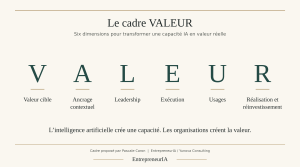
To translate these lessons into decisions, I have developed the VALEUR framework, presented in my EntrepreneurIA work. It allows examining the conditions for transforming a capability into a result and identifying what remains to be demonstrated. It is neither a certification nor a scientifically validated maturity score. [6]
V, Valeur cible (target value): define the indicator to be improved, whether it concerns margin, deadline, risk, quality, customer experience or innovation capacity.
A, Ancrage contextuel (contextual anchoring): identify the data, rules, business knowledge, systems and access rights that are essential.
L, Leadership: designate the person responsible for the result, specify the trade-offs and limits of delegation to AI.
E, Exécution (execution): review the end-to-end process, transfers between teams, bottlenecks and controls.
U, Usages (uses): support adoption, preserve skills and capitalize on errors and learning.
R, Réalisation et réinvestissement (realization and reinvestment): verify the net benefits obtained and decide on the use of freed capabilities.
This grid can be translated into three complementary works. The AS-IS describes the actual functioning, constraints and baseline indicators. The TO-BE designs the target functioning, new responsibilities and the expected contribution of AI. The RFP (request for proposal to consult suppliers) formalizes the requirements necessary for selecting a solution when it is justified. The order matters: choosing the technology partner before defining the need risks engaging the organization in a transformation dictated by the tool.
The manager can then conduct a limited experiment, measure the complete result before and after, document costs and adverse effects, then choose to deploy, redirect or stop. When possible, a comparison group or period improves interpretation. A potential time saving should not be counted twice or equated with cash savings without actual cost change.
Five questions for managers
- What economic or operational problem justifies our investment in AI?
- What complete process must be transformed, beyond the automated task?
- What data and knowledge constitute our competitive advantage?
- Who is responsible for value creation and risk control?
- What results will allow us to decide to continue, redirect or stop the project?
The real challenge for mid-sized companies is not only to have high-performing technologies. It is to maintain the ability to choose what they want to transform, mobilize their expertise and verify the results of their decisions. A company’s maturity is not measured by the number of agents it deploys, but by its ability to convert their contributions into useful and sustainable results.
Artificial intelligence creates a capability. Organizations create value.
Sources and references
[1] Pascale Caron, AI creates a capability. Why organizations create value (EntrepreneurIA, Yunova Consulting).
https://yunovaconsulting.com/ia-cree-une-capacite-pourquoi-les-organisations-creent-la-valeur/
[2] McKinsey, The State of AI in 2026: On the Road to ROI, August 25, 2026.
https://www.mckinsey.com/capabilities/quantumblack/our-insights/the-state-of-ai
[3] EntrepreneurIA 2026 Barometer, export from November 20, 2026, 106 responses. Calculations from raw responses. Exploratory survey; file not public.
[4] Brynjolfsson, E., Li, D. and Raymond, L. R. (2025). Generative AI at Work. Quarterly Journal of Economics.
https://doi.org/10.1093/qje/qjae044
[5] Dell’Acqua et al. (2026). Navigating the Jagged Technological Frontier: Field Experimental Evidence of the Effects of Artificial Intelligence on Knowledge Worker Productivity and Quality. Organization Science.
https://doi.org/10.1287/orsc.2025.21838
[6] Pascale Caron, The great AI paradox: productivity increases, but where does the value go? (EntrepreneurIA, Yunova Consulting). Presentation of the VALEUR framework.
https://yunovaconsulting.com/le-grand-paradoxe-de-lia-la-productivite-augmente-mais-ou-passe-la-valeur/
[7] Insee, statistical definition of company category.
https://www.insee.fr/fr/metadonnees/definition/c1057
[8] Mikalef, P. and Gupta, M. (2021). Artificial intelligence capability: Conceptualization, measurement calibration, and empirical study on its impact on organizational creativity and firm performance. Information & Management.
https://doi.org/10.1016/j.im.2021.103434
[9] Brynjolfsson, E., Rock, D. and Syverson, C. (2021). The Productivity J-Curve: How Intangibles Complement General Purpose Technologies. American Economic Journal: Macroeconomics.
https://doi.org/10.1257/mac.20180386
[10] Pascale Caron, Industrial AI, far beyond chatbots: five entrepreneurs’ experiences (EntrepreneurIA, Yunova Consulting, November 5, 2026).
https://yunovaconsulting.com/lia-industrielle-bien-au-dela-des-chatbots-cinq-experiences-dentrepreneurs/
[11] SNCF Numérique, Monaco station makes the winning bet on digital twin, October 12, 2026.
https://numerique.sncf.com/actualites/la-gare-de-monaco-fait-le-pari-gagnant-du-jumeau-numerique/
[12] Inbolt, 30% Cycle Time Reduction in Automotive Pick & Place, Stellantis case study.
https://www.inbolt.com/resources/customer-stories/30-cycle-time-reduction-in-automotive-pick-place/
[13] Pascale Caron, Bioceanor: How artificial intelligence improves water quality, interview with Samuel Dupont (EntrepreneurIA, Yunova Consulting, October 24, 2024).
https://yunovaconsulting.com/bioceanor-comment-lintelligence-artificielle-ameliore-la-qualite-de-leau/
[14] Bioceanor, AquaFORECAST, solution documentation.
https://bioceanor.com/aquaforecast/
[15] AZoMaterials, Driving Innovation with AI: How Huntsman Accelerates Materials Development with Citrine Informatics, interview with David Cranfill, April 22, 2026.
https://www.azom.com/article.aspx?ArticleID=25176
[16] Les Petites Affiches, MANE opens a new chapter in perfumery in the age of artificial intelligence, November 25, 2026.
https://www.petitesaffiches.fr/actualites%2C069/economie%2C045/mane-ouvre-un-nouveau-chapitre-de%2C47963.html
[17] Lokad and Worten, Optimizing Omnichannel Retail at Worten, case study, January 2025.
https://www.lokad.com/images/solutions/lokad-worten-case-study.pdf
[18] Christophe Auffray, Governance, AI Mesh and token budget: the keys of Axa France, L-Acoustics and Paris-Saclay on Agentic AI, Secrets de Data, November 19, 2026.
https://secretsdedata.substack.com/p/gouvernance-ai-mesh-et-budget-tokens
[19] Pascale Caron, Beyond the token price: the new economics of AI (EntrepreneurIA, Yunova Consulting).
https://yunovaconsulting.com/apres-le-prix-du-token-la-nouvelle-economie-de-lia/
[20] Pascale Caron, AI simplifies tasks. But does it really simplify the company? (EntrepreneurIA, Yunova Consulting).
https://yunovaconsulting.com/lia-simplifie-les-taches-mais-simplifie-t-elle-vraiment-lentreprise/
[21] Pascale Caron, AI accelerates answers: should we also accelerate decision-making? (EntrepreneurIA, Yunova Consulting).
https://yunovaconsulting.com/lia-accelere-les-reponses-mais-faut-il-accelerer-la-decision/
[22] AXA, 2025 Integrated Report, Innovating with confidence, interview with Chafika Chettaoui.
https://www.axa.com/fr/a-propos-d-axa/rapport-integre-2025-innover-en-confiance
[23] Groupe BPCE, AI strategy and MAiA portal.
https://www.groupebpce.com/le-groupe/innovation/la-strategie-ia-du-groupe-bpce/
[24] Orange, AI at Orange, institutional presentation of Live Intelligence.
https://www.orange.com/fr/notre-groupe/notre-demarche-dinnovation/lia-dorange
[25] Pascale Caron, AI at Orange: an internal revolution and strategic support for companies, interview with Thomas Peyrot Des Gachons (EntrepreneurIA, Yunova Consulting, March 17, 2025).
https://yunovaconsulting.com/lia-chez-orange-une-revolution-interne-et-un-accompagnement-strategique-pour-les-entreprises/
[26] European Commission, AI Act, updated application schedule after the AI Omnibus.
https://digital-strategy.ec.europa.eu/en/policies/regulatory-framework-ai