Christophe Barraud warns of a global economy entering a phase of structural fragility
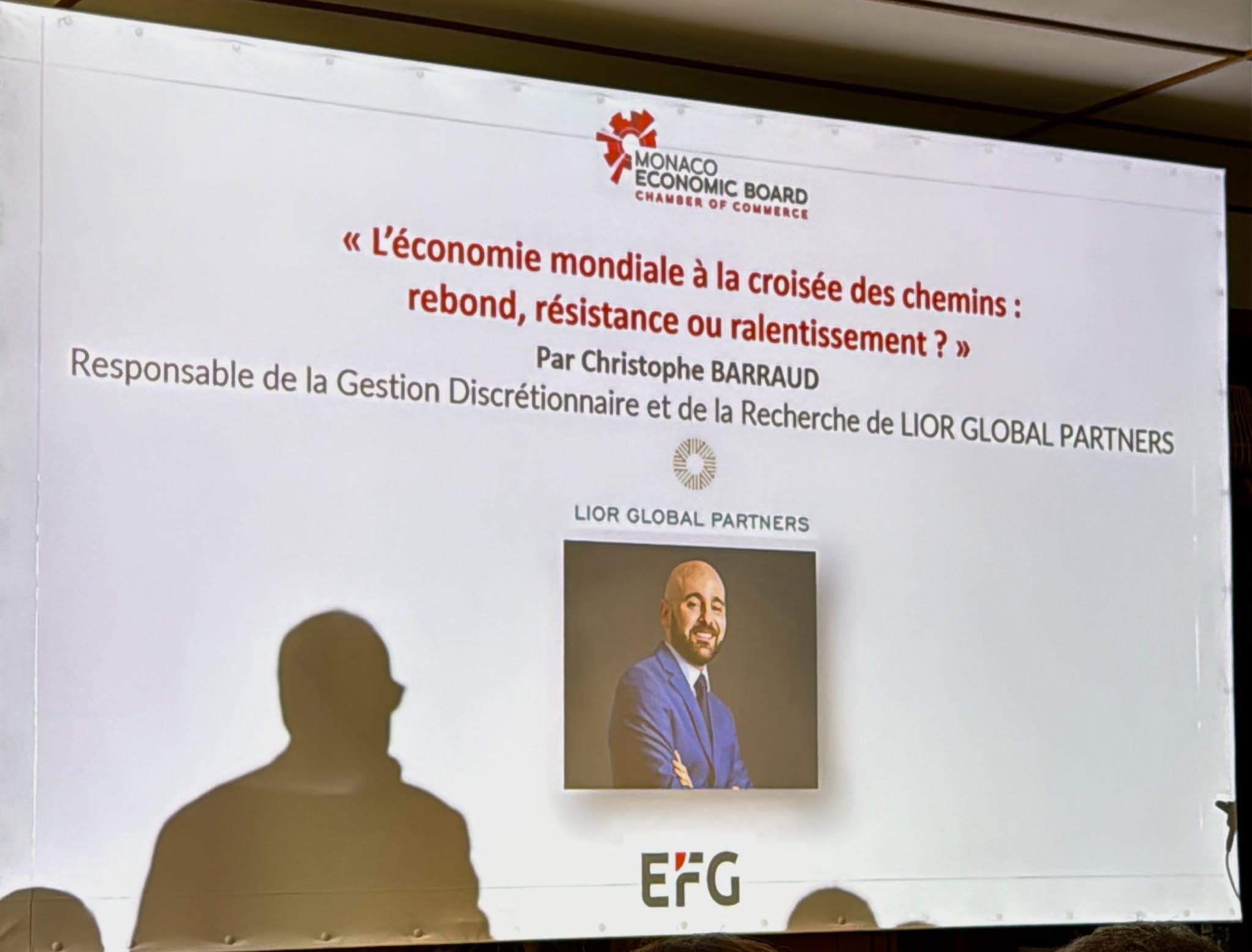
In Monaco, for the Monaco Economic Board, economist Christophe Barraud, Head of Discretionary Management and Research at LIOR Global Partners, presented a nuanced yet concerning assessment of the global economic situation. Titled “The global economy at a crossroads: rebound, resilience or slowdown?”, his conference explored the tensions currently affecting the United States, Europe and global markets.
Behind the apparent resilience of certain economies, Christophe Barraud sees a much more unstable environment emerging, marked by persistent inflationary risks, growing geopolitical tensions, tightening financial conditions and a progressive fragmentation of global trade.
The United States is holding up, but the balance is becoming fragile
For Christophe Barraud, the central scenario remains an American slowdown without immediate recession. The US economy retains several supporting drivers: household consumption, a still robust labour market, massive public investments and the rise of spending related to artificial intelligence.
“The American economy continues to rest on several solid pillars,” he explains, whilst emphasising that this solidity is becoming more vulnerable to external shocks.
The speaker reminds us that markets still anticipate a relatively contained recession risk by 2026. However, this outlook relies on assumptions of geopolitical stability and progressive disinflation that could quickly be called into question.
According to Christophe Barraud, the American economy is now entering a more delicate phase where the slightest energy, logistical or trade disruption can trigger chain reactions in the markets.
Less visible inflation, but still present
One of the central messages of the conference concerns the current nature of inflation. Christophe Barraud believes that inflation has not disappeared. It is simply changing form.
Whilst key indicators show a progressive moderation of inflation, Christophe Barraud emphasises that several factors continue to exert upward pressure on prices. Geopolitical tensions, rising energy costs, persistent disruptions to global supply chains, increases in fertiliser prices and climate variations affecting certain agricultural production maintain an inflationary environment whose effects could be prolonged.
The slides presented notably show a sharp rise in fertiliser prices as well as tensions in certain Asian trade data, used as leading indicators of global exchanges. “Inflationary pressures remain mainly exogenous,” emphasises Christophe Barraud. According to him, the danger lies less in demand overheating than in the multiplication of supply shocks.
American rents remain a structural problem
A significant part of the presentation is devoted to the American property market.
Christophe Barraud insists on the still very rigid nature of rents in the United States. Cross-referenced data between the Zillow, Apartment List and CPI Shelter indices show a significant gap between leading signals and official Federal Reserve statistics.
“The measures used by the Fed react with a lag,” he explains.
In other words, disinflation exists, but its transmission to official indicators remains slow. This situation considerably complicates monetary policy decisions.
A Fed forced to be cautious
In this context, Christophe Barraud believes that the US Federal Reserve will remain cautious for longer than markets anticipate. Even though markets anticipate a monetary easing cycle in 2026, Christophe Barraud believes that caution remains advisable. Inflation remains above central bank targets, whilst geopolitical uncertainties, persistent commodity volatility and the risk of new trade tensions continue to fuel a particularly unstable economic environment.
The Fed must therefore choose between two dangers: maintaining high rates for too long and breaking growth or easing too early and relaunching inflation.
This equation constitutes, according to him, one of the major macroeconomic challenges of the coming years.
Europe facing a stagflation risk
The second part of the conference adopts a much more pessimistic tone concerning the eurozone. Christophe Barraud explicitly mentions a “stagflation” risk, that is to say a combination of weak growth and persistent inflation.
“Europe faces a much more uncomfortable macroeconomic configuration,” he explains.
Several indicators presented during the conference testify to a progressive slowdown in the European economy. Business surveys show a decline in PMIs, whilst the business climate is deteriorating in several countries. Added to this are a weakening of industrial activity, greater caution by companies in their investment decisions and a weakening of employment prospects.
German data appears particularly worrying. The IFO index as well as business confidence indicators show continuous erosion over several months.
Germany at the heart of European concerns
For Christophe Barraud, Germany today crystallises part of Europe’s economic vulnerabilities. The country must simultaneously face the consequences of its energy dependence, the slowdown of its industrial apparatus, its strong exposure to fluctuations in global trade as well as administrative constraints that hinder the implementation of major investment programmes announced in recent years.
The speaker is cautious about the real impact of the new German fiscal stimulus. “The amounts announced are significant, but the speed of execution remains a major issue,” he observes. According to him, bureaucratic delays and structural constraints could severely limit the effectiveness of stimulus plans.
Energy tensions return to the forefront
Christophe Barraud also devotes several slides to European energy risks. He emphasises that tensions in the Middle East and the potential rise in oil prices could quickly revive inflationary pressures. A particularly striking graph shows the rapid decline in commercial jet fuel stocks in several European countries.
“The services and tourism sector is becoming particularly vulnerable to a lasting rise in energy costs,” he warns.
The possible consequences are multiple: rising air fares, slowdown in tourism, increased logistics costs, pressure on discretionary consumption.
European bank credit is tightening sharply
Another point of alert: the tightening of credit. ECB data presented during the conference shows: a tightening of banking standards, a fall in loan demand and more restrictive financing conditions.
Christophe Barraud reminds us that the European economy depends much more on bank financing than the American economy. “Historically, this type of credit contraction often precedes a marked slowdown in activity,” he emphasises. This dynamic could weigh heavily on business investment in the coming quarters.
Europe caught between the United States and China
Christophe Barraud insists on the rise of international trade tensions. Europe appears increasingly exposed: to American trade barriers, to Chinese industrial competition and to the fragmentation of global value chains.
The slide devoted to Chinese hybrid vehicles shows rapid progress by Asian manufacturers in the European market. According to the speaker, certain European industrial sectors could suffer a lasting loss of competitiveness.
“European exports are becoming vulnerable on several fronts simultaneously,” he explains.
Robotics, AI and China: the next global economic shock
During the question-and-answer session, the President of the Monaco Economic Board asks Christophe Barraud about the rise of robotics in China. The economist’s response marks a turning point in the conference, broadening the debate beyond traditional macroeconomics.
Christophe Barraud mentions the emergence of Chinese “Dark Factories”, these fully automated factories where robots are progressively replacing humans in production lines. He even describes systems where “robots come to change the batteries of other robots”, highlighting the level of automation already achieved in certain Chinese industrial installations.
According to him, this dynamic remains costly today, but prices are falling extremely rapidly. He notably cites the appearance of humanoid robots sold for around $5,000 on Chinese platforms such as AliExpress.
“Just imagine at what price we could produce this in Europe,” he tells the audience. “That will give you an idea of where our market shares will be tomorrow.”
For Christophe Barraud, the real breakthrough does not come solely from robotics, but from its combination with artificial intelligence.
“When we combine robotics and artificial intelligence, it’s going to be supersonic,” he states.
This technological convergence could trigger:
- an explosion in productivity gains;
- massive industrial investments;
- an acceleration of Chinese competitiveness;
- a very unequal redistribution of value creation.
The speaker particularly emphasises the social consequences of this transformation.
“The fruits of this wealth will not be distributed uniformly,” he warns.
According to him, certain professions will experience strong growth whilst others could disappear rapidly. The consequences on the labour market could become major much faster than what economic and political decision-makers currently imagine.
“We’re not talking about things that will happen in twenty years,” insists Christophe Barraud. “Within five years, the impacts will already be very significant. In ten years, it will be a major transformation.”
Even if a financial crisis or global slowdown could temporarily slow this evolution, he considers that the overall trajectory is now irreversible.
This sequence on robotics and AI ultimately adds an additional dimension to his analysis. Behind inflationary, trade or energy tensions, a new industrial revolution is already reshaping the global balance of economic powers.
A global economy entering a transition phase
At the end of this conference, Christophe Barraud does not describe an imminent collapse of the global economy. His analysis is more subtle. The United States remains relatively solid, but more fragile than before. Europe, meanwhile, is entering a much more complex period, marked by profound structural tensions.
The real challenge of the coming years could ultimately lie in a central question: will productivity gains linked to artificial intelligence and new infrastructure be sufficient to offset the geopolitical, energy and financial imbalances that are multiplying? It is undoubtedly around this question that the next phase of the global economy will be played out.