Cross Data supports companies in integrating AI to transform their operations and processes. By leveraging company data and high-performance algorithms, they reveal hidden performance potential.
Experts in designing and deploying artificial intelligence solutions, they work in key sectors such as industry, energy, transportation, retail, and healthcare. Their expertise in Machine Learning, Deep Learning, AI Vision, MLOps, LLMs, NLP, and applied mathematics is built on a fundamental principle: every project must deliver concrete return on investment.
Since 2019, Cross Data has successfully completed over 80 AI projects.
Can you explain your business activity?
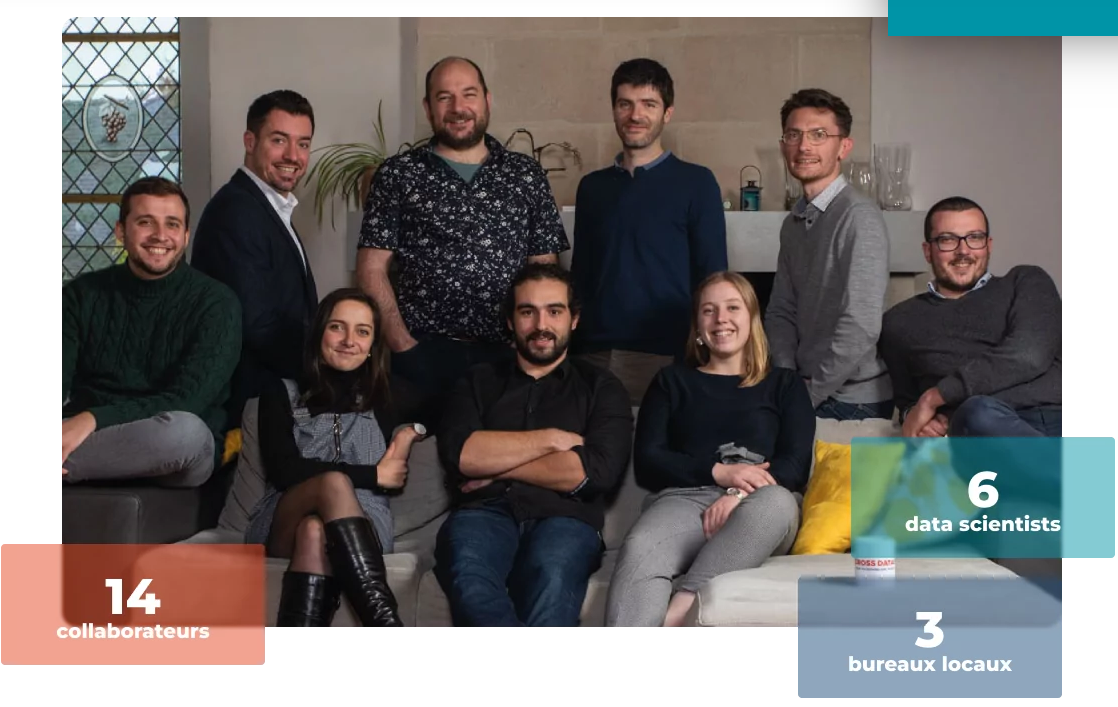
I’m one of the three co-founders of Cross Data. Our job is to help companies succeed with AI. We’ve built a company of 15 employees based on two core competencies: applied mathematics in artificial intelligence and understanding client needs. Today, we offer consulting, custom development, and training.
Our clients are diverse: they range from three-person startups to major groups like Keolis, Michelin, or Enedis. We work on very diverse projects. For example, we predict the number of burgers sold at Burger King, or we use image recognition to produce key duplicates for Leroy Merlin. We also design chatbots for regulatory needs in aeronautics. Cross Data covers a broad spectrum.
What unique aspect of your sector prompted you to integrate AI, and how has it transformed your operations?
Company needs are evolving rapidly: automation and process optimization have become essential to remain competitive.
For our clients, AI has often been a transformation driver. For example, companies facing recruitment difficulties have increased their productivity without hiring. With another client, we managed to automate 95% of customer service, which freed up time for higher value-added tasks.
For us too, AI has transformed the way we work. We use it extensively in support functions, such as writing quotes, reports, or preparing recruitment interviews. It’s an assistant that allows us to focus on strategic missions.
Which AI solutions have you selected?
We use several tools depending on needs. ChatGPT is a foundation for many cases, but we also work with Mistral or Copilot for coding.
The choice of solution depends on client constraints. For example, for international organizations linked to the United Nations, we must meet strict requirements and use appropriate technologies. On the other hand, in more flexible contexts, we use generative AI to facilitate writing summaries, quotes, or reports. AI is an assistant, not a magic solution. We strongly emphasize human supervision to guarantee reliable results.
How did you overcome cultural and human challenges when integrating AI?
There’s always resistance. On one side, people worried about change. On the other, enthusiasts who overestimate what AI can do. The truth is in the middle.
We involve users very early in projects. They need to express their needs, expectations, but also their concerns. Without this step, we risk designing unsuitable tools.
Teams also need to be prepared for AI’s limitations. With chatbots, for example, it’s impossible to achieve 100% correct answers. We explain what’s feasible, what isn’t, and we remain transparent.
What technical challenges did you encounter when implementing AI solutions?
The first challenge is identifying the right approach. Should we opt for an off-the-shelf solution, custom development, or simply train teams? Each situation is unique.
Security and confidentiality are also major issues. Some clients impose very strict rules, which forces us to adapt the technologies used.
Finally, there’s the gap between expectations and reality. Many think AI can do everything. However, for complex tasks, it must be guided by experts to be effective.
What positive changes have you observed in your team’s dynamics thanks to AI?
The time savings are immense. AI eliminates time-consuming tasks and allows focus on more strategic activities.
It also opens up new possibilities. Teams dare to test new ideas because they know they can rely on tools to prepare the work. For example, for a job interview, AI suggests a base of relevant questions that we then adjust. It saves valuable time.
What essential advice would you give to SMEs hesitating to take the leap into AI?
You must go for it, because your competitors are already doing it. AI is an advantage today. In two years, it will be the norm.
Start by analyzing what you can automate and how much it can earn you. You don’t need to develop in-house AI. Use existing tools and train your teams to leverage them.
Also take advantage of available support: BPI France, for example, offers AI diagnostics. See AI as a special machine that must address a clear need and deliver return on investment.
AI is a tremendous transformation lever, but it remains a tool. When used properly, it saves time, automates tasks, and opens new perspectives. For SMEs, it’s an opportunity to remain competitive.