Onepoint Revolution Summit: Emotional AI at the Crossroads
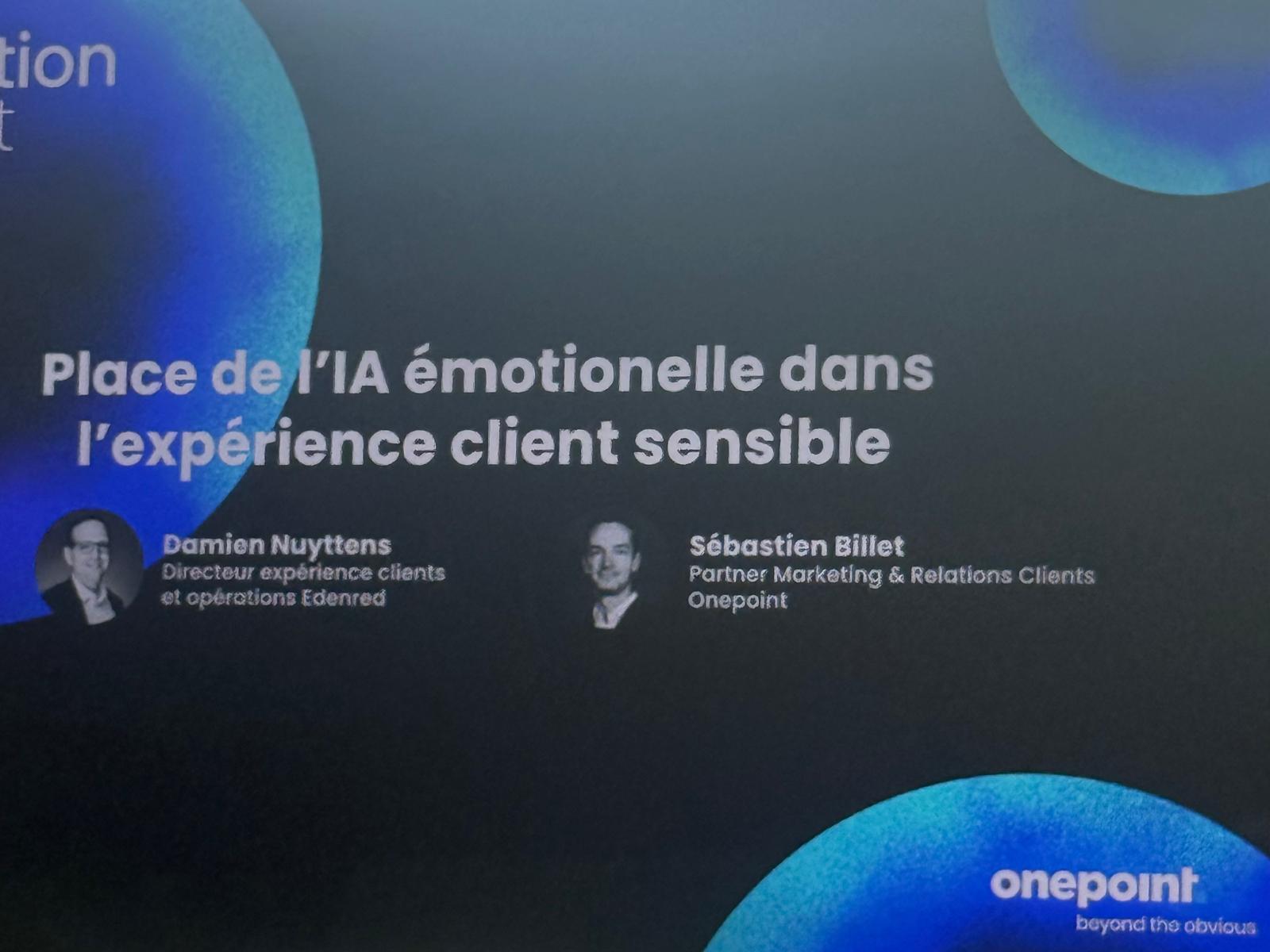
At the Revolution Summit organized by Onepoint, Damien Nuyttens—Customer Experience and Operations Director at Edenred—and Sébastien Billet—Partner Marketing & Customer Relations at Onepoint—discussed the evolution of artificial intelligence in customer relations. Specifically, they explored the role AI can play in understanding—not imitating—human emotions. Far from being a confrontation between cold machines and sensitive humans, this meeting was envisioned as an augmented collaboration.
Contrary to popular belief, AI does not feel. But it can learn to identify emotional markers. At Edenred, this translates into analyzing prosody in phone calls (intonation, pauses, tone variations) to pinpoint moments of tension in customer journeys. This approach enables a more nuanced reading of emotional pain points, often invisible to traditional measurement tools like NPS or isolated verbatim feedback.
Drawing on the theory of the “experience economy” (Joseph Pine, 1998), Damien Nuyttens reminds us that the real value perceived by a customer no longer resides solely in the product. It is the sum of emotions generated throughout the interaction. With AI, Edenred aspires to amplify this dimension, not through standardization of emotions, but through their contextual recognition in real time.
In a complex ecosystem involving businesses, merchants, and end users, Edenred makes ease of use the primary emotional promise. AI helps detect invisible friction points in journeys—repeated calls, misunderstandings, unnecessary escalations—and design proactive, fluid, and intuitive solutions.
The Voice of the Customer Reinvented
Post-interaction feedback is often incomplete. Damien Nuyttens points out a paradox: “We base our improvements on a minority of feedback, while the silent majority could contain the most critical signals.” Through automatic analysis of voice or text exchanges, AI provides an aggregated and contextualized view of the lived experience.
AI in Service of Hyper-Personalization
Far from the illusion of empathy, AI is used to anticipate expectations and adjust the human response. This allows teams to gain relevance, avoid repetition, and engage the right channel at the right time, in line with detected emotions. An augmented AI, but one that is guided.
Emotions and ROI: An Economic Equation
While emotional impact seems difficult to monetize, Edenred has found the balance. AI improves both operational performance indicators (reduced processing time, fewer repeated contacts) and satisfaction scores (increased NPS). The economic break-even point is calculated in number of contact avoidances. Result: the equation becomes virtuous, especially in a context where use cases are still underexploited.
AI: The Remedy for Taylorism in Customer Service
By automating repetitive, low-value tasks, AI frees up time for more qualitative interactions. This “de-Taylorization” helps re-humanize customer relations. The advisor once again becomes a problem solver, not just an executor.
Damien Nuyttens nevertheless warns: the machine must not pretend to be what it is not. He insists on transparency: informing the customer that they are interacting with a virtual agent, while preserving the fluidity of the interaction. The goal is not to deceive the user, but to support them.
Supporting Teams: A Key Challenge
The success of emotional AI depends on smooth internal adoption. Edenred has launched a training program around NLP and soft skills to help teams better understand themselves, interpret the signals provided by AI, and adapt their responses with discernment.
Far from causing anxiety among employees, AI is perceived as a support tool. By being trained in new uses, agents gain autonomy and comfort, while refocusing their role on relational intelligence.
Edenred is currently testing a composite indicator: a score derived from conversations, integrating tone, vocabulary, and contextual analysis. The idea: to no longer rely solely on post-interaction surveys, but to enrich KPIs with a continuous reading of the perceived experience.
Emotional AI: An Ethical and Cultural Challenge
The question of adoption also crosses cultural differences. In the 45 countries where Edenred operates, emotions are neither expressed nor interpreted in the same way. This requires fine-tuning of models and continuous vigilance regarding algorithmic and cultural biases.
Emotional AI: Catalyst for a New Customer Relationship
This discussion demonstrated that AI, far from being a threat to customer relations, can become its catalyst. Provided it is conceived as a tool for reading, not imitation. And provided it is backed by an ethical, human, transparent, and guided strategy. A demanding path, but a promising one.