Artificial intelligence (AI) is emerging as an essential driver of technological innovation, influencing a multitude of sectors, from healthcare to cybersecurity and digital infrastructure. Yet, as its development accelerates, concerns are growing about market concentration and monopolization risks.
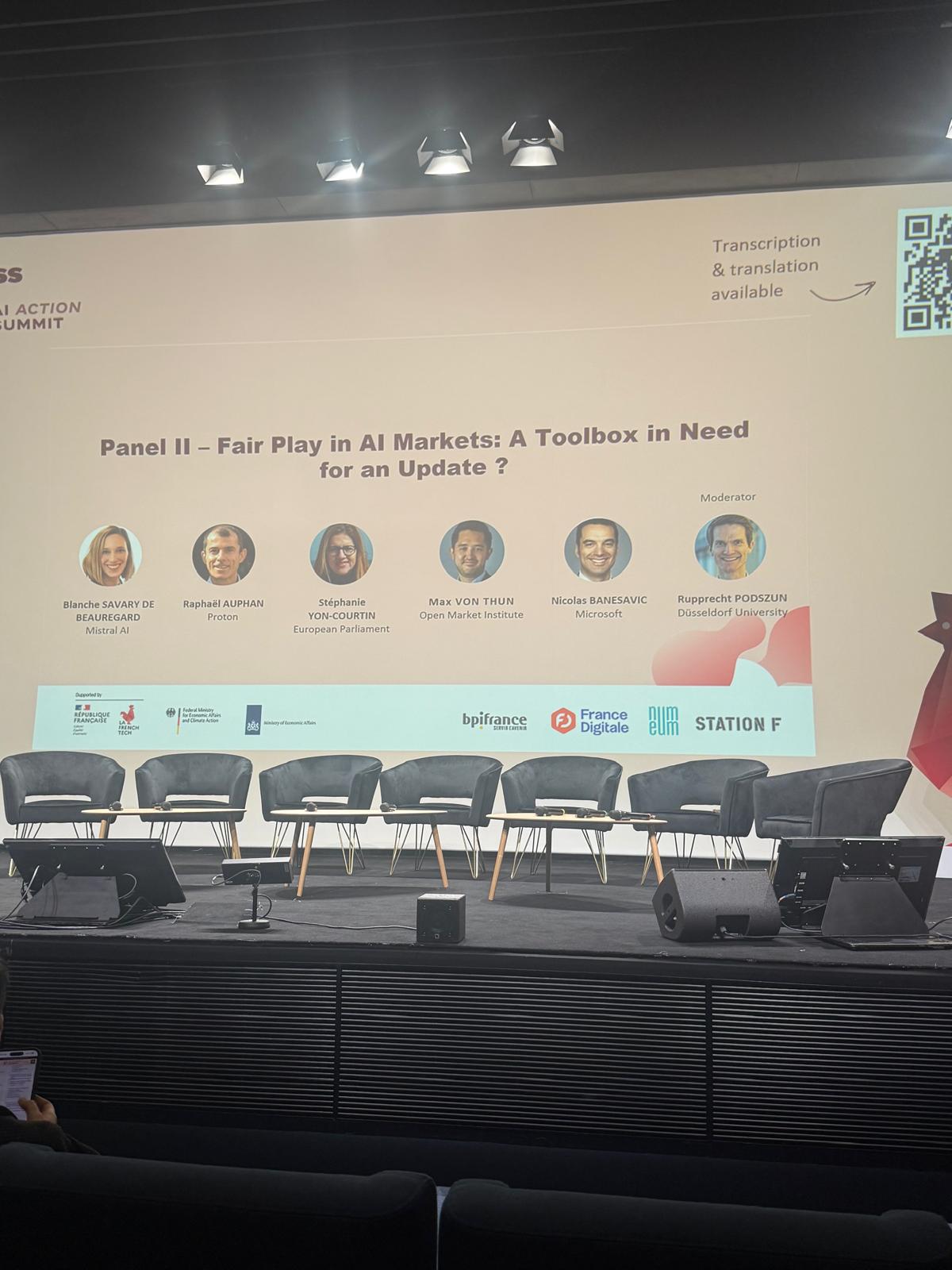
The panel Fair Play in AI Markets: A Toolbox in Need for an Update? brought together several experts and industry stakeholders to debate competition, regulation, and the challenges AI poses in ensuring an open and fair market. Moderated by Rupprecht Podszun from the University of Düsseldorf, the panel included representatives from the private sector and public institutions. Notably Blanche Savary de Beauregard (Mistral AI), Raphaël Auphan (Proton), Stéphanie Yon-Courtin (European Parliament), Max von Thun (Open Market Institute), and Nicolas Banasovic (Microsoft). The debate highlighted several key points. The importance of effective regulation, the need to strengthen enforcement of existing laws. Then the market asymmetries between Europe and the United States, as well as the challenge of developing privacy-respecting AI.
AI and its promises: a technology with great potential
The panel began with a discussion on AI’s promises and the most inspiring use cases for the future. Max von Thun emphasized the importance of leveraging AI to solve major societal challenges such as health and environmental sustainability. According to him, AI should be used to improve human life and reduce carbon emissions, rather than to replicate human behaviors or increase digital addiction.
For his part, Raphaël Auphan, CEO of Proton, expressed his interest in developing privacy-centered AI. He stressed that, for 20 years, giants like Google and Microsoft have accumulated immense amounts of personal data. With the rise of generative AI, this collection is intensifying, making it imperative to develop AI that guarantees user confidentiality.
For Blanche Savary de Beauregard (Mistral AI), AI has the potential to improve equal opportunities, particularly through accessible and open applications. She cited Mistral AI’s partnership with France Rallye as an example of a useful and innovative application.
Finally, Nicolas Banasovic (Microsoft) highlighted AI’s impact in healthcare and secure transportation, emphasizing the importance of partnerships to realize these advances.
A market biased in favor of tech giants?
A central point of the debate was the concentration of the AI market and the barriers to entry for new players. Blanche Savary de Beauregard presented Mistral AI as an example of a startup that has succeeded in establishing itself in a sector dominated by giants. She also detailed the many challenges encountered: fundraising, talent recruitment, and the need to build solid partnerships, to survive against the colossal budgets of competitors. She particularly emphasized that the three largest cloud computing companies plan to spend between 40 and 85 billion euros this year on AI, which makes competition extremely difficult for emerging players.
Max von Thun added that the AI value chain is now largely dominated by a few American companies. NVIDIA holds 90% of the advanced chip market necessary for AI, while data and distribution channels are concentrated in the hands of large platforms like Google and Microsoft. He described this situation as a structural monopoly, jeopardizing the diversity and competitiveness of the sector.
Europe: a digital colony of the United States?
Raphaël Auphan was particularly critical of Europe’s digital dependence on the United States. According to him, European cloud infrastructure is controlled by American companies, which prevents the continent from developing technological autonomy. He advocated for an “Europe First” policy, inspired by the protectionist strategies implemented by China and the United States to favor their own companies.
He also insisted on the need to financially support European authorities to strengthen enforcement of existing regulations such as the Digital Markets Act (DMA). For him, the European Commission lacks the means to face the armies of lobbyists and lawyers employed by tech giants to avoid any binding regulation.
The Digital Markets Act: a sufficient tool?
The Digital Markets Act (DMA) was at the center of discussions. This regulation aims to limit abuse of dominant position by large digital platforms, but several speakers emphasized that it remained insufficient and that better enforcement was necessary. Stéphanie Yon-Courtin insisted on the need for proactive and agile regulation. According to her, Europe’s past mistake was to wait for the market to consolidate before intervening. Now, it is crucial to act upstream to prevent AI from becoming a market locked by a few companies. Max von Thun supported the idea of going beyond the DMA, by considering corporate breakups to avoid excessive concentration. He cited the example of Google AdTech, where regulators are considering forcing the sale of part of Google’s advertising business to restore competition.
Toward new AI-specific regulation?
The question of a regulatory framework specific to AI divided participants. For Blanche Savary de Beauregard, adding new regulatory layers could penalize startups that have limited legal resources compared to tech giants.
In contrast, Max von Thun and Raphaël Auphan argued for a DMA extended to AI models. According to them, some open-source AI models have become essential platforms, and their owners could be qualified as “gatekeepers,” which would justify strengthened regulation.
Recommendations and perspectives
Several recommendations emerged from the panel:
- Strengthen DMA enforcement: Allocate more resources to competition authorities to effectively combat abuse of dominant position.
- Encourage an “Europe First” policy: Encourage European institutions to favor local technologies to reduce dependence on foreign players.
- Improve access to funding for AI startups: Implement investment funds and tax incentives to support the emergence of European champions.
- Monitor market concentrations: Strengthen control of mergers and acquisitions to avoid monopolization of the AI sector.
- Promote the emergence of ethical and privacy-respecting AI: Develop alternatives to the proprietary models of digital giants.
As AI redefines economic power dynamics, Europe must find a balance between innovation, regulation, and digital sovereignty to avoid becoming a mere consumer of foreign technologies. The challenge is immense, but there is still time to act.