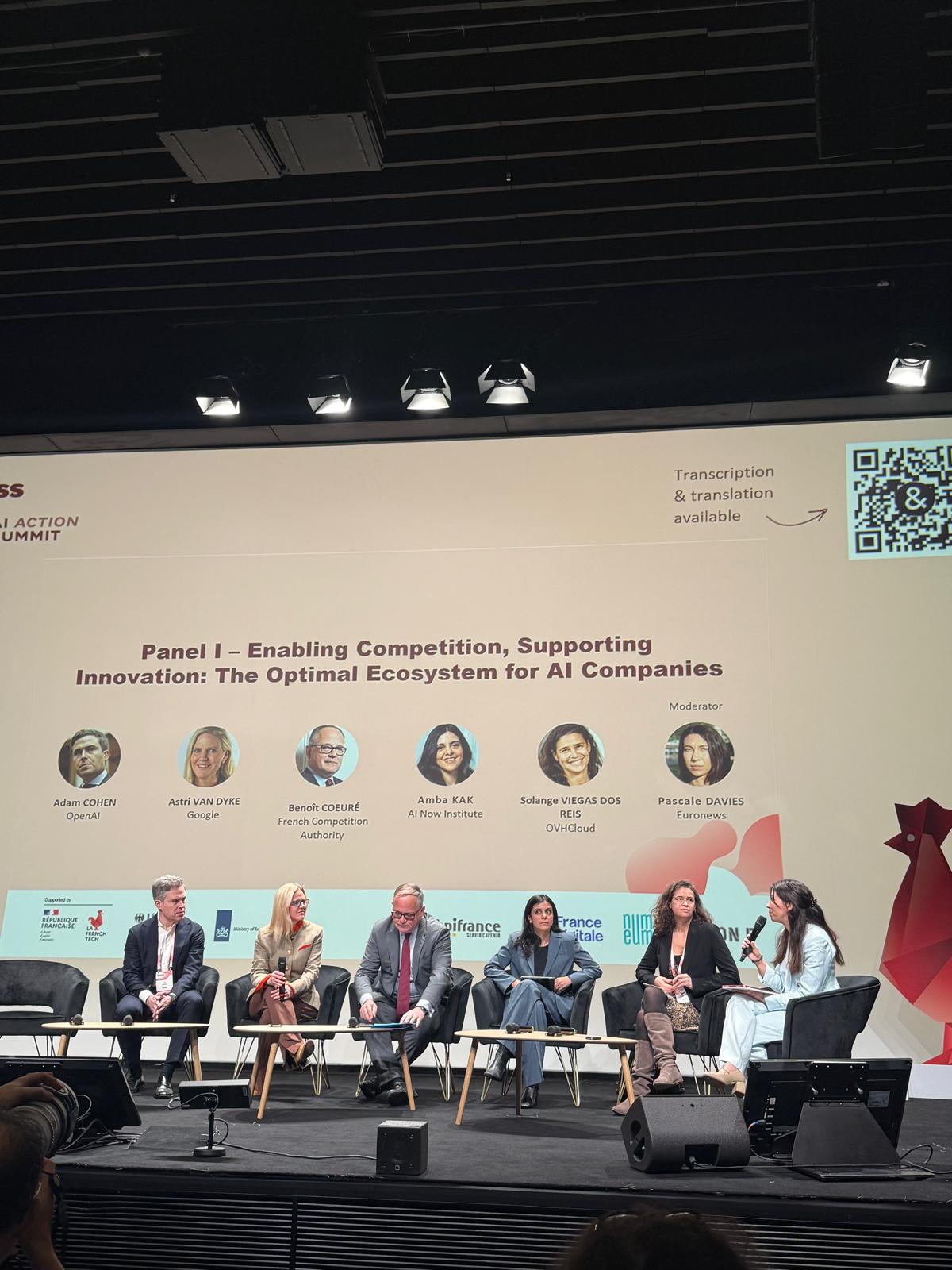
The first panel of the day, titled “Enabling competition, supporting innovation: the optimal ecosystem for AI companies”, brought together key figures from the sector:
- Adam Cohen (OpenAI)
- Astri Van Dyke (Google)
- Benoît Coeuré (President of the French Competition Authority)
- Amber Kak (AI Now Institute)
- Solange Viegas Dos Reis (OVH)
One of the central themes of the panel was AI regulation and its impact on competition. Benoît Coeuré emphasized the need for Europe to maintain a balance between innovation and regulation, ensuring that dominant players do not lock up the market. He highlighted the risks associated with the concentration of cloud infrastructure, where three giants hold 70% of the global market.
Solange Viegas Dos Reis from OVH echoed this sentiment. She highlighted the abusive practices of certain cloud providers, which hinder the emergence of new entrants and restrict access to essential resources for AI innovation.
Amber Kak emphasized a fundamental issue: access to data. For her, the real power in AI lies in controlling distribution channels and data sources. She cited the example of large targeted advertising platforms that use AI to maximize their revenue. This comes at the expense of diversity among market players.
The Challenge of Access to Resources
One of the friction points raised by the speakers is the dependence of startups on cloud giants. Adam from OpenAI specified that 90% of the funding raised by AI startups is reinvested in cloud infrastructure, often owned by the same companies that already dominate the market. This dynamic poses a major risk: increased dependence of young companies on infrastructure controlled by a few players, thus limiting diversity and innovation in the ecosystem.
The War for Talent
One of the major debates of the panel focused on the competition to attract and retain AI talent. Benoît Coeuré recalled that AI training is a key issue for Europe, which still lags behind in training specialized engineers. Astri Van Dyke, Google’s representative, pointed out that former employees of large tech companies regularly create startups valued at several million euros, thus contributing to market dynamics. However, Solange Viegas Dos Reis warned of the risk of brain drain to the United States. Working conditions and salaries are indeed more attractive there.
Public Investment and European Strategy
Amber Kak raised a fundamental question: do governments’ massive investments in AI truly benefit the public? She recalled that despite billions invested in public infrastructure, 75% of this funding is reinvested in licenses held by private companies like NVIDIA and major cloud providers.
Benoît Coeuré emphasized the importance of a coordinated European strategy, rather than isolated national initiatives. He cited as an example the European Commission’s initiative to create a sovereign cloud and computing centers open to startups.
Towards a European AI Ecosystem?
While the panel discussions highlighted challenges related to regulation, access to resources and competition, a consensus emerged on the need for a strong and coordinated European response. Open-source was mentioned as a lever to promote innovation and equitable access to AI models. However, as Benoît Coeuré pointed out, open-source alone is not enough to guarantee fair competition, especially if the underlying infrastructure remains centralized.