Report on the panel discussion “The AI Moment: Are We Really Ready for What’s Coming?“
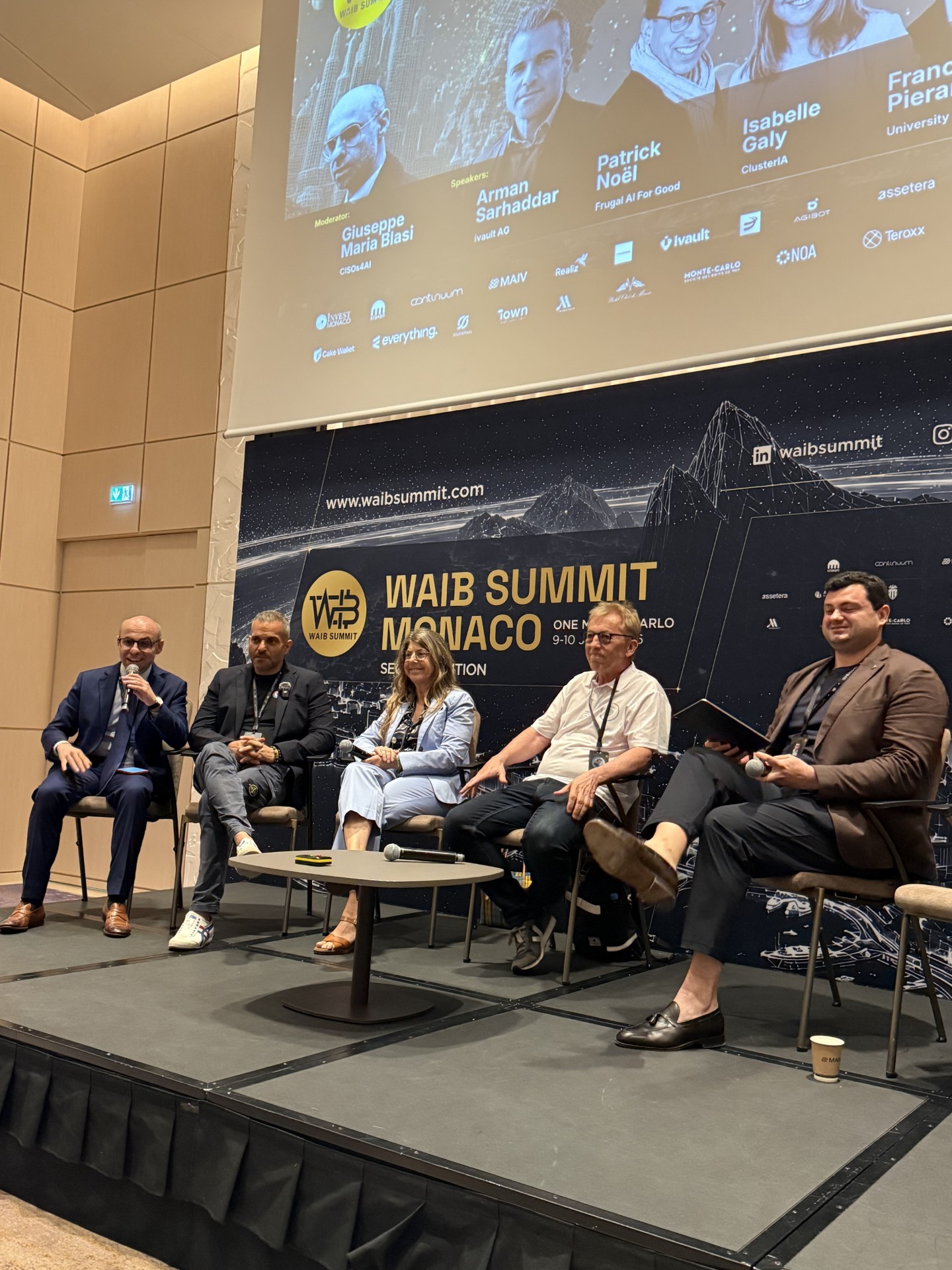
This panel discussion organized as part of the WAIB Summit 2026 in Monaco had the merit of shifting perspectives. The question posed was not about what AI can do today, but rather about our collective capacity to absorb the transformations it provokes.
Around the table were Arman Sarmadar, founder of iVaults, Isabelle Galy, president of Cluster IA, Patrick Noël, co-founder of Frugal AI for Good, and Francesco Pierangeli, director of the FinTech Master’s program at the University of Birmingham. The discussions quickly moved beyond the technological terrain to address more fundamental topics: intellectual autonomy, the transformation of work, education, governance, and the place of humans in an increasingly automated environment.
A technology progressing faster than our capacity to adapt
One observation emerged throughout the discussion: technological acceleration has become difficult to follow, even for industry professionals.
Almost every week brings its new model, new agent, or new functionality. This pace creates a form of permanent tension among many users. Isabelle Galy summarized this feeling by evoking the paradox experienced by some AI professionals. The excitement about the possibilities offered by these tools is mixed with growing fatigue related to the obligation to continuously update one’s knowledge.
This impression is not limited to specialists. It also affects executives, employees, and students who see new capabilities constantly emerging, sometimes struggling to understand their concrete implications.
The feeling of always being one step behind is itself becoming a social phenomenon.
The discreet rise of AI agents in organizations
One of the most interesting moments of the panel came from a scenario proposed by Isabelle Galy.
She chose to answer a question by placing herself in the shoes of an artificial intelligence agent working within a company. In her narrative, this agent writes reports, prepares analyses, participates in decisions, and accomplishes a significant portion of its human user’s daily work.
The central point of this demonstration lies elsewhere: no one in the organization knows that this agent exists. The manager is unaware of it. So is management.
Yet the agent gradually discovers that it is not alone. Other colleagues are also using similar assistants. The agents almost communicate with each other even though the company has not yet truly defined its AI strategy.
This projection aligns with a reality already observed in many organizations. The adoption of AI does not necessarily follow official channels. Employees often experiment with tools before management even implements appropriate governance rules.
The phenomenon of “Shadow AI” now appears as one of the main challenges for companies.
The question of intellectual autonomy
Arman Sarmadar raised a topic that is increasingly recurring in debates about artificial intelligence: cognitive dependence.
According to him, the problem is not the existence of AI but the way some users systematically rely on generative tools to make decisions, solve problems, or organize their work. The question deserves to be asked. At what point does assistance become excessive delegation?
When every question, even minor ones, is submitted to a conversational assistant, there is a risk of gradually eroding certain analytical, reflective, or judgment capacities.
This concern echoes several recent studies on the cognitive impacts of intensive use of generative AI. Without questioning their usefulness, these studies examine the potential effects of increasing externalization of certain intellectual functions.
The challenge is therefore not solely technological. It also concerns our relationship with knowledge and decision-making.
Students facing a more uncertain future
One of the most striking aspects of the discussion concerns young generations’ relationship with artificial intelligence.
Patrick Noël, who regularly speaks to engineering students, described a particularly marked climate of anxiety.
Paradoxically, this concern often affects the most qualified profiles.
For a long time, technical skills constituted a guarantee of employability. Today, the emergence of tools capable of generating code, producing documentation, or automating certain tasks calls this certainty into question.
For students who have invested several years in acquiring technical skills, the prospect of seeing some of these skills automated naturally raises questions. The debate extends far beyond the IT sector.
Many intellectual professions are beginning to question their future evolution in the face of systems capable of producing text, analyses, images, or recommendations with increasing quality.
A narrative that sometimes fuels resistance
Francesco Pierangeli provided interesting insight on this issue. According to him, the problem partly lies in the narrative accompanying artificial intelligence.
For several years, the dominant discourse has emphasized productivity gains, cost reductions, and automation possibilities. The economic argument is omnipresent. But this discourse also produces a side effect.
When a technology is presented primarily as a means of doing more with less staff, it becomes difficult for employees and students to perceive what they personally have to gain from it.
At the University of Birmingham, Francesco Pierangeli regularly observes this reaction among his students. Many consider AI more as a potential threat than as an opportunity.
Conversely, when he teaches blockchain technologies or digital assets, students more easily identify new markets, new professions, or new activities that could emerge. This difference in perception deserves to be taken seriously.
The social acceptance of AI will largely depend on the ability to demonstrate its value for individuals and not just for organizations.
Human skills at the center of the debate
Faced with these concerns, several speakers emphasized the importance of specifically human skills.
Judgment, synthesis capacity, critical reasoning, ethics, communication, and professional expertise were cited several times as areas in which humans retain a central role. This approach does not consist of pitting man against machine. Rather, it is based on the idea of complementarity.
AI excels at massive information processing, identifying correlations, or automating certain tasks. Humans, for their part, retain the ability to contextualize, interpret, and make decisions in complex or ambiguous situations.
This complementarity now appears as one of the most credible scenarios for the evolution of work.
When AI begins to know us
Patrick Noël shared a personal experience that generated many reactions in the room. After asking an AI to establish his psychological profile based on his interactions, he shared the result with two close friends. Their response was immediate: the portrait perfectly matched his personality. The anecdote raises a broader question.
As systems accumulate information about their users, their ability to identify behavioral patterns improves considerably. Tomorrow, some AIs could be capable of detecting personality traits, habits, or preferences with accuracy sometimes superior to our own perception. This prospect opens considerable opportunities in the fields of health, education, or personalized support. It also raises important questions regarding confidentiality, influence, and individual autonomy.
Who will control tomorrow’s intelligence?
The discussion also addressed the question of infrastructure.
Isabelle Galy recalled a phrase recently used by Arthur Mensch, head of Mistral AI: “we transform electricity into intelligence.” This sentence summarizes one of the major strategic challenges of the coming years. Artificial intelligence relies on considerable energy and IT infrastructure. Data centers, electrical networks, and computing capabilities are gradually becoming strategic assets. In this context, the question of sovereignty no longer concerns only data. It also concerns access to energy, computing infrastructure, and the models themselves.
This geopolitical dimension of AI should occupy an increasing place in public debates in the coming years.
Reinventing the commons
The final part of the conference took on a more prospective dimension. Invited to imagine a future marked by widespread hyperconnectivity and increased dependence on digital infrastructure, the speakers converged on the same idea: technology alone will not solve future challenges.
For Isabelle Galy, one priority is to preserve the commons. She is particularly concerned about the gradual transfer of certain strategic capabilities to large private actors capable of providing services sometimes more efficient than those of public institutions.
The question then becomes political as much as technological.
How can we preserve the collective interest in an environment where technological power is concentrated in the hands of a limited number of actors?
This question extends far beyond the framework of artificial intelligence alone.
A society still in the learning phase
At the end of this panel discussion, one conclusion emerges. The question posed by the title remains largely open. Are we ready for what’s coming?
The discussions rather showed a society in the learning phase. Technologies are progressing rapidly. Uses are multiplying. Companies are experimenting. Students are questioning. Regulators are trying to keep up. But definitive answers do not yet exist.
Beyond the performance of models, the real question now seems to concern our ability to collectively define the place we wish to give these technologies. Because the challenge is probably no longer to build increasingly powerful artificial intelligences.
The challenge is to build the economic, educational, social, and political frameworks that will allow us to integrate them without losing what makes the human experience unique.