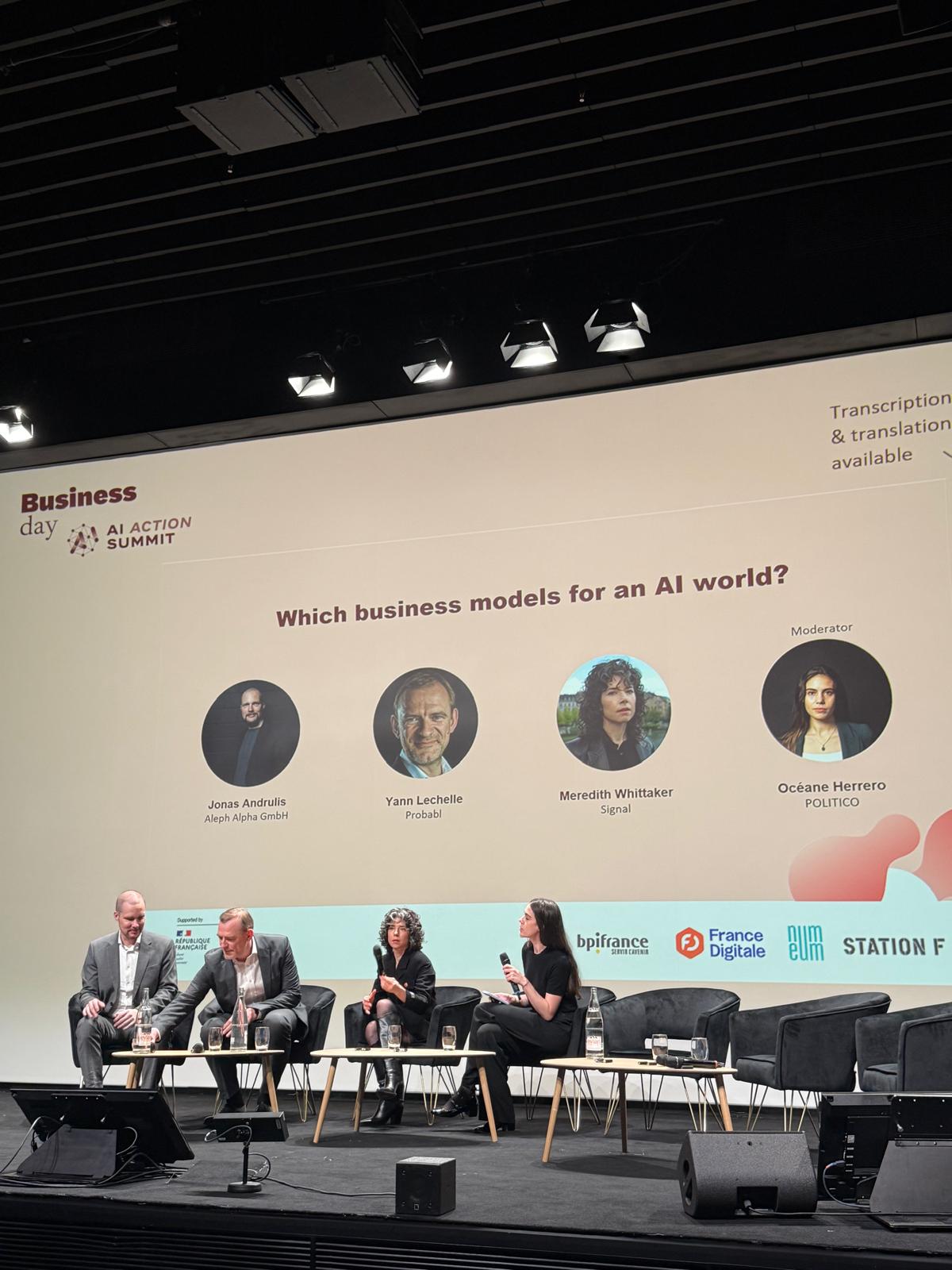
The rapid rise of artificial intelligence (AI) raises a crucial question: what economic models are viable and sustainable in a world where AI becomes ubiquitous? At the AI Summit, the panel “Which Business Models for an AI World?” explored this issue in depth. Moderated by Océane Herrero (POLITICO), this debate brought together key players in the sector:
- Jonas Andrulis, CEO of Aleph Alpha
Jonas Andrulis is a German economic engineer. Aleph Alpha focuses on developing large language models (LLMs) for businesses and administrations, emphasizing transparency in the sources used to generate results. The company aims to create a sovereign technology stack for generative AI, independent of American companies and compliant with European data protection regulations. In November 2023, Aleph Alpha raised over $500 million from a consortium of investors, including Schwarz Gruppe, Dieter Schwarz Foundation, Bosch, SAP, Hubert Burda Media, and Hewlett Packard Enterprise. Jonas Andrulis is recognized for his commitment to strengthening Europe’s position in artificial intelligence and promoting transparent AI models that align with European values.
- Yann Lechelle, CEO of Probabl
Yann Lechelle is a French entrepreneur and technology executive, currently co-founder and CEO of Probabl.ai, an INRIA spin-off dedicated to distributing open-source technologies in data science and machine learning.
Before founding Probabl.ai, Yann Lechelle served as CEO of Scaleway, the European cloud service provider. Throughout his career, he has successfully founded, grown, and sold several technology startups, including Snips.ai, a company specializing in privacy-respecting voice processing, acquired by Sonos.
Yann Lechelle is recognized for his commitment to open-source innovation and European digital sovereignty, promoting the adoption of transparent and accessible technologies in the field of artificial intelligence.
- Meredith Whittaker, President of Signal
Meredith Whittaker is the president of the Signal Foundation, a nonprofit organization dedicated to protecting freedom of expression and promoting secure communications globally. Before joining Signal, she co-founded and led the AI Now Institute at New York University, focusing on the social implications of artificial intelligence. She also worked at Google for over a decade, where she founded the Open Research group and co-founded M-Lab, an Internet performance measurement platform. As president of Signal, she strongly advocates for user privacy and opposes business models based on surveillance. She considers AI as arising from surveillance and advocates for technologies that respect privacy.
Together, they analyzed the economic challenges, funding models, and the future of businesses in a world where AI is redefining the rules of the game.
The Impact of AI on Markets and Investments
A market in full transformation: the panel began by revisiting an event that made recent headlines: the collapse of the economic model of a highly publicized AI company. This situation sent shockwaves through Wall Street, highlighting the risks of a speculative bubble in the sector. Jonas Andrulis emphasized that this event confirmed his predictions:
“We have always believed that the business model of large language models (LLMs) does not work. The market is biased by geopolitical interests and technological monopolies.”
Generative AI models, such as GPT, Llama, or Mistral, are extremely expensive to develop and maintain. Their profitability remains uncertain, particularly due to energy costs and massive infrastructure requirements.
According to Andrulis, large language models are not profitable in the long term, notably because:
- They require massive investments in computing and storage.
- Their development relies on an astronomical amount of data often captured through centralized platforms.
- They face growing competition from open-source models, which offer a more flexible and accessible alternative.
Open Source and Sovereignty: A Viable Alternative?
The debate quickly turned to open source and its role in the evolution of economic models related to AI. Yann Lechelle, CEO of Probabl, defended the idea that openness is an unavoidable force:
“History shows us that openness always prevails in the end. China has understood this well, and other players are beginning to take interest. Current monopolies will have to adapt.”
The Illusion of Universal and Homogeneous AI
Meredith Whittaker, President of Signal, emphasized an essential point: AI cannot be neutral or universal. It is the product of a cultural and historical context that influences its performance and biases. “Each country, even each company, will need to develop its own model to meet its specific needs.”
This reflection challenges the idea of a single, globalized AI model and highlights the need for sovereign solutions adapted to local contexts.
The Challenges of Centralization and Competition in AI
The AI market is currently dominated by a few major technology players who control:
- Cloud infrastructures (AWS, Azure, Google Cloud)
- Proprietary AI models
- Data flows necessary for model training
According to Meredith Whittaker, this creates a critical dependency situation for companies wishing to develop their own AI solutions:
“If you’re not paying, you are the product. This is the very logic of digital giants, who capture attention and data to make it their main source of value.”
The Role of Investors and the AI Funding Trap
The AI market is also influenced by significant speculative dynamics. According to Jonas Andrulis, many investors are not necessarily seeking to fund viable projects, but rather to optimize their own financial returns. He cites the case of large investment funds, which inject billions into startups without real consideration for the profitability of their business models.
Toward New AI Monetization Models
One of the economic models envisioned is based on the concept of Knowledge-as-a-Service (KaaS). Yann Lechelle warns against this model. It could lead to a total capture of knowledge by a few large companies:
“The risk is that all human knowledge becomes locked into paid services, where we would simply become tenants of knowledge.”
AI and Respect for Copyright
The panel addressed the issue of respecting copyright in the use of AI models. Currently, generative AI models are trained on massive amounts of data without always respecting intellectual property rules.
Jonas Andrulis emphasized that companies must anticipate probable regulation on this subject and imagine business models that respect content creators.
Infrastructure: A Key Issue for Technological Independence
Companies developing AI models are currently dependent on hyperscalers (Amazon, Microsoft, Google) to host and run their models.
Meredith Whittaker insisted on the need for Europe to develop sovereign alternatives to ensure its technological independence:
“If we do not control our infrastructure, we remain at the mercy of large American companies.”
The Trap of Centralized Data Centers
The debate also covered the environmental and strategic impact of data centers and the latest summit announcements. According to Yann Lechelle, the real challenge is knowing who controls these infrastructures: “If we simply build data centers for hyperscalers, we have gained nothing. We need a real local value chain.”
AI Security, Regulation, and Ethics
The panel highlighted several risks related to AI:
- Data poisoning attacks
- Security vulnerabilities in AI models
- The impact of biases in automated decisions
Meredith Whittaker insisted on the need for a rigorous approach to security and ethics to prevent potential abuses.
Finally, the discussion focused on AI regulation and governance issues. Europe is attempting to structure a solid regulatory framework, but the challenge is to avoid stifling innovation while protecting users.
What Future for AI Economic Models?
The panel highlighted the challenges and opportunities related to AI economic models:
- Proprietary LLMs remain difficult to sustain profitably in the long term.
- Open source could offer a viable and sovereign alternative.
- Resource centralization poses a dependency problem on digital giants.
- Knowledge monetization through AI raises ethical and economic questions.
- Sovereign infrastructure is a key lever for ensuring technological independence.
The future of AI economic models will result from the strategic choices of businesses and regulators. One thing is certain: AI cannot be a monopoly; it must be a common good.