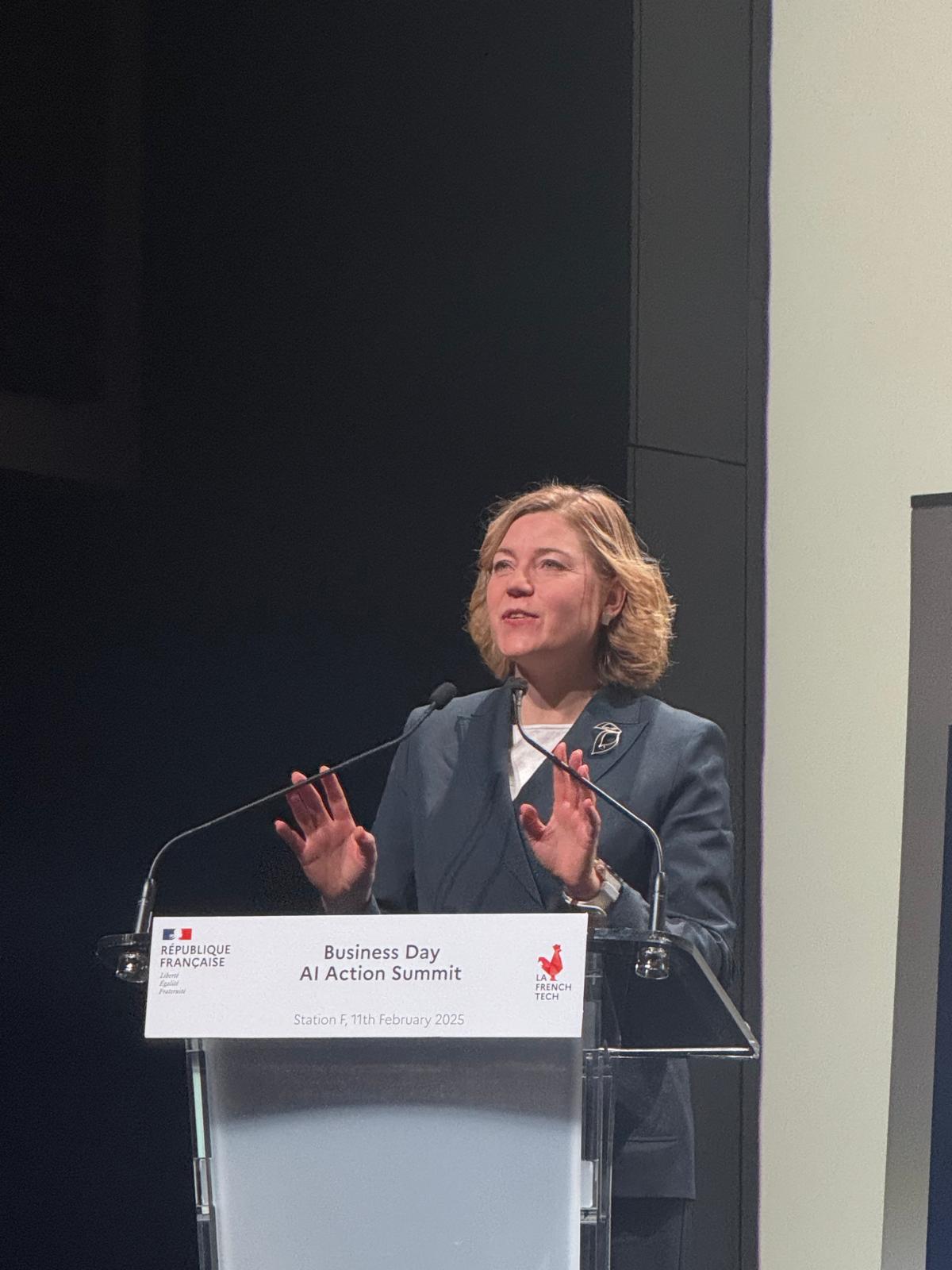
Henna Virkkunen, Executive Vice-President for Tech, Sovereignty, Security and Democracy at the European Commission, outlined the Union’s strategy to assert its role in the field of artificial intelligence (AI). Under the title “Winning with AI: How Competition Fuels Innovation”, her speech highlighted the importance of competition and innovation as drivers of digital transformation in Europe.
Faced with the dominance of the United States and China, Europe seeks to establish a unique AI model based on three pillars: a structuring regulatory framework, massive investments, and the development of technological skills. The goal is to create an environment that fosters the growth of startups and SMEs while ensuring ethical and responsible AI.
Technological sovereignty at the heart of the European strategy
Henna Virkkunen emphasized a key point: AI is a strategic issue for Europe’s technological and economic independence. The European Commission is putting in place financing and support mechanisms to reduce the continent’s dependence on foreign technologies. One of the obstacles to AI development in Europe is the lack of computing capacity accessible to startups and researchers. To address this, the Commission has decided to invest massively in supercomputers to increase available computing power fivefold within a year.
The Invest AI fund, announced by Commission President Ursula von der Leyen, aims to mobilize 200 billion euros to finance AI in Europe. This fund combines public resources and private capital to support technology startups and SMEs. These initiatives are part of a digital sovereignty approach, where Europe wants to control strategic infrastructure and reduce its dependence on major American and Chinese platforms.
A regulatory framework for responsible and secure AI
Europe is adopting a unique regulatory approach with the AI Act, which classifies AI systems according to their level of risk. The goal is to strike a balance between innovation and protection of citizens. Henna Virkkunen announced the creation of an artificial intelligence office to support startups and SMEs in complying with this legislation. A help desk service will also be set up to assist companies in understanding and applying current regulations.
One of the obstacles to the development of European startups is the burden of administrative constraints. The commission is committed to reducing paperwork-related costs by 35% for SMEs and by 25% for the entire industry.
By simplifying procedures and reducing bureaucracy, Europe wants to encourage the emergence of technological champions capable of competing with American and Asian giants.
European Innovation: a model based on research and competition: a dynamic ecosystem of startups and researchers
Europe has a pool of thousands of startups and research laboratories specialized in AI. However, these players struggle to access the infrastructure and funding necessary to develop their technologies on a large scale.
With increased computing capacity and financial support, Europe wants to turn its potential into industrial and commercial reality.
The title of Henna Virkkunen’s speech, “Winning with AI: How Competition Fuels Innovation”, reflects a vision where competition is essential to stimulate creativity and accelerate technological advances.
Europe is banking on an AI application strategy that aims to encourage the adoption of these technologies in industrial sectors. Today, only 13% of European companies use AI, a figure that the Commission wants to rapidly increase.
Training Talent and Attracting AI Experts to Europe
The development of AI relies on the availability of a skilled workforce. Henna Virkkunen emphasized the importance of strengthening training in computer science and artificial intelligence. Europe must train more AI experts to meet the growing needs of businesses. According to some analysts, within two years, AI could surpass humans in many areas, which underscores the urgency of investing in digital skills.
Europe must also become a magnet for talent from around the world. The Commission plans to facilitate the establishment of foreign entrepreneurs and researchers in Europe to enrich its innovation ecosystem.
The goal is to create a competitive environment where the best AI experts choose Europe to develop their projects and startups.
An ethical and sustainable model of artificial intelligence
Europe wants to differentiate itself by promoting responsible AI that respects democratic values. Unlike Chinese and American models, where AI is sometimes used intrusively or exploited by technological monopolies, Europe wants to impose a framework guaranteeing transparency, data protection, and respect for fundamental rights. Henna Virkkunen highlighted the importance of building a European AI model based on trust and responsibility, where companies can innovate without compromising user security.
Can Europe Win the AI Race?
Henna Virkkunen’s speech at the Paris AI Summit demonstrates that Europe has a clear ambition: to become a key player in artificial intelligence. With strategic investments, a structuring regulatory framework, and a willingness to strengthen technological skills, the European Union is laying the foundations of a competitive AI ecosystem.
However, several challenges remain:
- Accelerating the adoption of AI by traditional industries
- Facilitating access to private financing
- Attracting international talent
If these challenges are overcome, Europe could establish a unique model, combining innovation, ethics, and competitiveness, and thus assert its leadership in the global race for artificial intelligence. The stakes are high: Europe wants to prove that one can win with AI by relying on competition and innovation, while preserving a framework of trust and digital sovereignty.