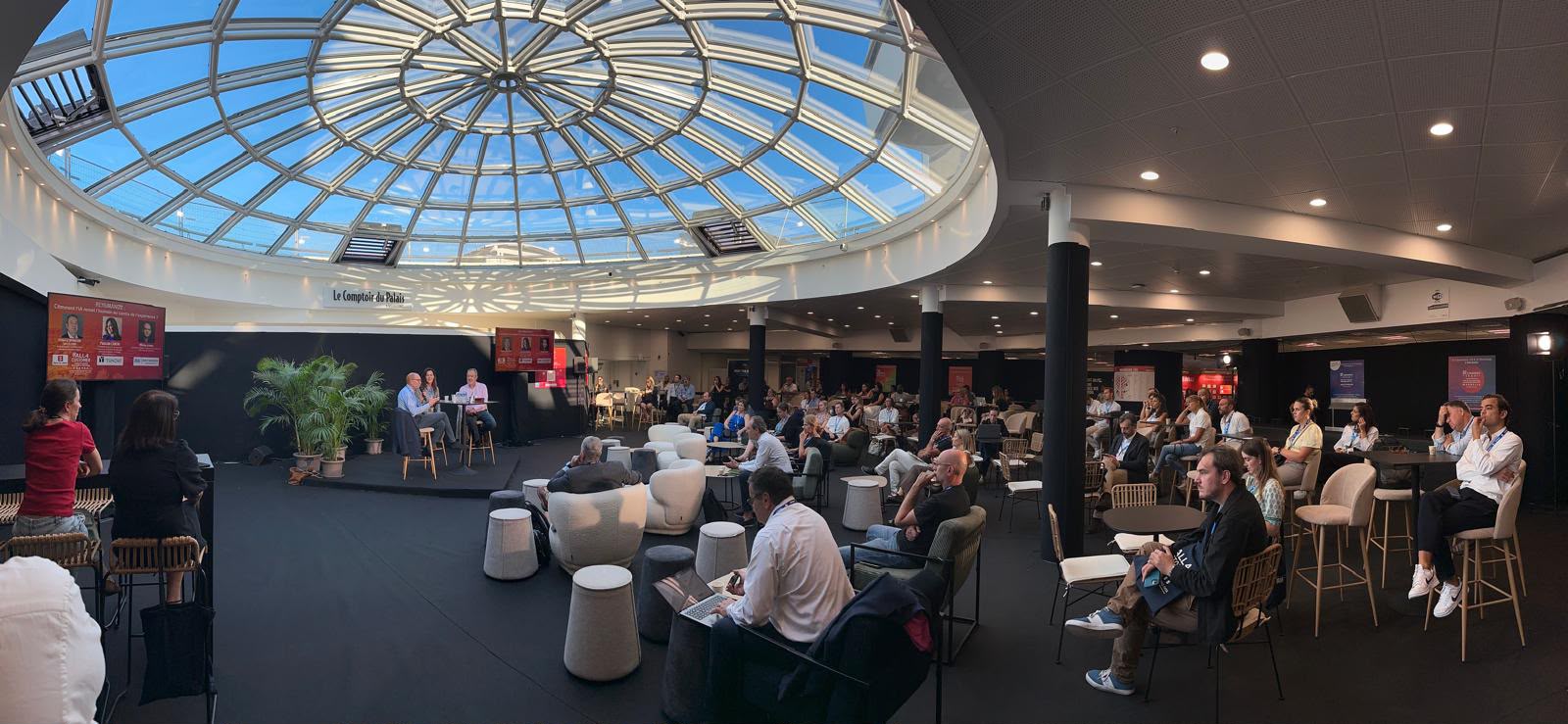
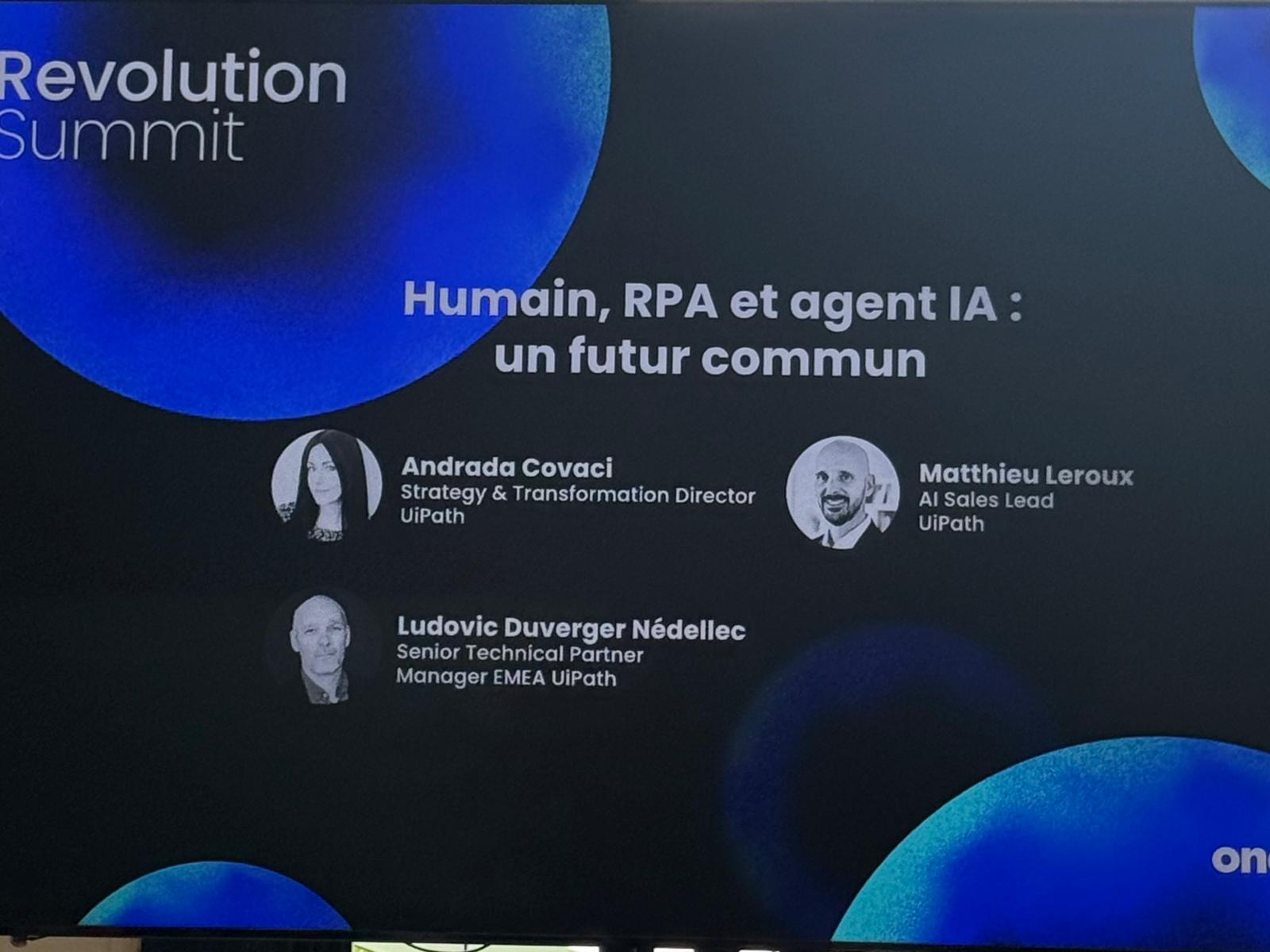
How can we reconcile the power of AI agents, the robustness of RPA solutions, and the subtlety of human judgment? This essential question was addressed by UiPath representatives during their conference at the Revolution Summit. Led by Andrada Covaci (Strategy & Transformation Director), Matthieu Leroux (AI Sales Lead), and Ludovic Duverger Nédellec (Senior Technical Partner), this presentation outlined the contours of a hybrid, controlled automation fully anchored in the operational reality of enterprises.
From RPA to AI Agents: A Decade of Evolution
UiPath, a pioneer in Robotic Process Automation (RPA), has seen its solutions deployed in over 10,000 companies worldwide. Initially designed to automate simple, repetitive, and standardized processes, RPA has gradually evolved. However, as the speakers highlighted, these automated systems quickly reach their limits when faced with variability, ambiguity in business decisions, or the complexity of information flows.
This is where AI—and particularly AI agents—comes into play. Capable of interpreting, reasoning, learning, and above all acting, these agents ideally complement RPA bots. Their function is not to replace RPA, but to add a level of intelligence and flexibility previously unattainable.
A Tripartite Alliance: AI, RPA, and Human
UiPath does not advocate for dehumanized automation. On the contrary, the goal is to build an ecosystem in which each component—human, algorithmic, or robotic—plays a role suited to its strengths. The proposed triad is based on:
- The human, bearer of vision, ethical discernment, empathy, and supervision.
- RPA, in charge of structured, reliable, high-frequency tasks.
- The AI agent, capable of intervening in areas of uncertainty, making conditional decisions, and exploring alternative actions in context.
This dynamic orchestration paves the way for augmented and more refined automation of so-called “end-to-end” processes.
Concrete Use Cases, Proven Results
To illustrate this synergy, UiPath experts presented a demonstration centered on a very real case in the retail sector. The task was to automatically analyze the GTC (General Terms and Conditions) sent by suppliers and identify any contentious clauses compared to framework contracts.
The process mobilized several AI agents:
- A legal analysis agent, responsible for comparing the GTC to the general purchase agreement using RAG (Retrieval-Augmented Generation).
- A drafting agent, capable of generating a well-argued and polite response in case of disagreement.
- An orchestrator (Maestro), which triggers RPA robots and distributes tasks between agents and humans based on context.
The results were impressive: ROI in less than a month, over 150,000 hours of manual analysis saved, massive scalability capacity, and above all a considerable gain in legal precision.
The Promise of LAMs: Large Action Models
Following in the footsteps of LLMs, UiPath introduces a new concept: LAMs (Large Action Models). Where LLMs generate language, LAMs generate automated actions. Tomorrow, they could trigger an expense report from a simple email by opening the right applications, filling in the appropriate fields, and proceeding with final submission without human intervention.
This convergence between natural language, robotic execution, and intelligent orchestration marks a technological breakthrough. It transforms the very way business processes are conceived: no longer as sequences of codified steps, but as dynamic, self-adaptive, fluid, and goal-oriented chains.
Governance, Supervision, Security: Essential Safeguards
Andrada Covaci emphasized a crucial point: this new power must not be synonymous with opacity. On the contrary, the more intelligent automation becomes, the more it must be governed.
This involves: Educating teams about AI and its limitations, shared governance between IT, business units, and compliance. Also, strict control of inputs and outputs of AI agents (data, prompts, models) and centralized management of escalations to humans.
Human supervision is not an option but a necessity. It ensures that decisions made by agents align with the company’s values, strategy, and legal requirements.
No-Code Tools to Democratize Agent Creation
Another key lever: implementation simplicity. UiPath offers no-code tools allowing business users to design their own agents without deep technical expertise. They can configure the roles, objectives, knowledge bases, and behavioral rules of agents through a visual and intuitive interface.
This paradigm shift promotes the appropriation of AI solutions by employees themselves, transforming each user into an active contributor to innovation.
Multi-Sector Use Cases
The use cases presented are not limited to retail. The RPA + AI combination applies to many sectors:
- Finance: contract analysis, anomaly detection, automation of accounting controls.
- HR: data extraction from resumes, responses to recurring payroll questions, automatic drafting of employment letters.
- Supply Chain: demand forecasting, automated replenishment, supplier dispute processing.
- Marketing: persona generation, customer interview simulation, content personalization.
In each case, AI agents enable a new level of precision, responsiveness, and operational productivity.
An Imperative for Co-Construction
At UiPath, the conviction is clear: automation cannot be driven exclusively by IT. It must be co-constructed with business units, in an agile and iterative approach. This hybrid working mode—technicians + users + AI—fosters better understanding of objectives, greater relevance of solutions, and easier adoption.
Matthieu Leroux reminded that the most effective use cases are often those that emerge directly from business pain points observed in the field.
Challenges Still to Overcome
Despite these advances, several challenges remain:
- The risk of disconnection between human intentions and agentic actions, in case of vague objective definitions.
- Issues of responsibility and compliance, particularly regarding personal data processing.
- The difficulty of ensuring sufficient explainability when multiple agents interact in a distributed architecture.
- Risks of algorithmic biases undetected by humans, particularly in high-impact decisions (legal, financial, social).
These issues call for constant vigilance and continuous updating of governance tools.
Toward an Augmented Enterprise
More than a simple technological evolution, this convergence between human, RPA, and AI agent outlines the contours of a fundamentally augmented enterprise: more responsive, more intelligent, more ethical. An enterprise in which each actor—whether human or artificial—finds its place in service of a shared objective: delivering value with efficiency, security, and purpose.