Laurent Alexandre is a French entrepreneur, speaker and essayist, specializing in topics related to technology, artificial intelligence (AI) and biotechnology. A graduate of the École nationale d’administration (ENA), he is also a trained physician, which gives him cross-disciplinary expertise in the fields of health and innovation.
Co-founder of Doctissimo in 2000, a major health information platform in France, he was a pioneer in digital healthcare before selling the site in 2008. Author of several books, including Artificial Intelligence is Disrupting Humanity (2023), he is recognized for his positions on the economic, societal and ethical impacts of AI and biotechnology. His analysis, both forward-looking and often controversial, sparks numerous debates about humanity’s future in the face of technological disruption.
An Unprecedented Technological Revolution
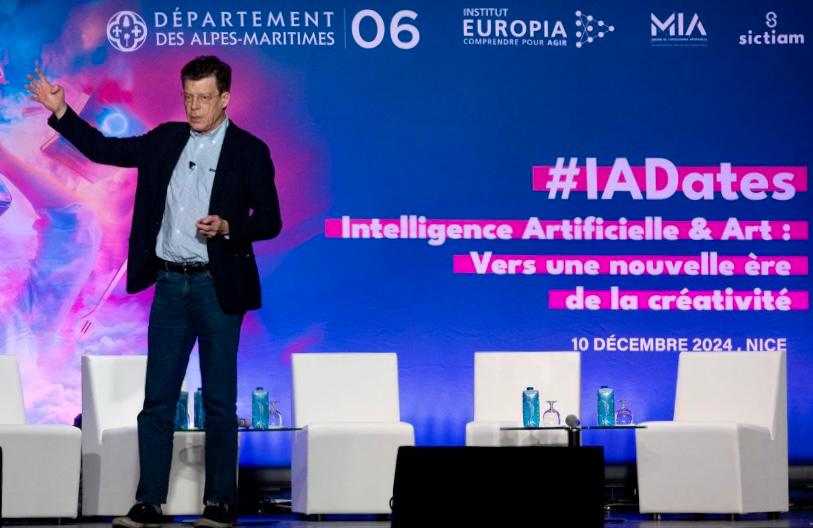
Laurent Alexandre delivered an in-depth analysis of ongoing transformations during a conference given in December 2024 for the EuropeIA Institute. His speech puts into perspective the rapid evolution of technologies, the societal challenges they pose and the opportunities they offer.
An Unprecedented Technological Revolution
Laurent Alexandre began by tracing the major milestones in technological history. He emphasized that since the invention of the transistor in 1947, technological capabilities have experienced exponential growth. Today, a single chip can contain billions of transistors, symbolizing the rapid evolution of computing power. This continued progress offers unprecedented opportunities, particularly in the field of AI.
According to him, AI represents a major breakthrough in human history. The sums invested by companies like Google, Microsoft and OpenAI illustrate this trend. These entities are dedicating colossal budgets to develop increasingly advanced models. However, Laurent Alexandre warns that this technological advancement requires adequate preparation by society.
Revolutionary AI Applications
In the medical field, AI has already demonstrated its potential. For example, determining the three-dimensional structure of millions of proteins, which would have taken the scientific community decades, was accomplished in a few days thanks to AI. This breakthrough enables significant progress in understanding complex diseases and developing personalized treatments.
However, this efficiency raises questions. For example, studies show that AI alone achieves higher medical diagnostic rates than when combined with doctors. This observation highlights the need to redefine the role of healthcare professionals so they can collaborate fruitfully with these tools.
Transformation of Economic Models and Societies
Laurent Alexandre also addressed the economic impact of AI. According to him, some companies could eventually operate without any employees, relying solely on automated systems. This reality raises questions about the future of employment and the need to rethink traditional economic models.
The experimentation with universal basic income, mentioned during the conference, illustrates the current limitations of proposed solutions. Contrary to expectations, this measure did not encourage participants to pursue training, but led to increased consumption of stress-related substances. Laurent Alexandre emphasizes the importance of training to enable complementarity between humans and AI, instead of seeking to replace jobs.
Ethical and Philosophical Issues
AI also raises major ethical questions. Advances in genetic manipulation and neural implants are examples of this. In the United States, some companies already offer services allowing selection of embryos’ intellectual characteristics, which could create profound inequalities between societies that adopt these technologies and those that reject them.
Laurent Alexandre also mentions the development of neural implants, such as those offered by Neuralink, designed to enhance human cognitive abilities. While promising, these technologies pose dilemmas about their potential impact on humanity and the gaps that could emerge between those who benefit from them and others.
The Urgency of Collective Preparation
Laurent Alexandre calls for deep political and societal reflection. He asserts that current institutions are not ready to face these disruptions. He emphasizes that training leaders, teachers and decision-makers is essential to take advantage of the opportunities offered by AI.
In this context, he advocates for territories like the Nice region, with its assets in terms of quality of life and technological ecosystems, to become centers of excellence. He also emphasizes the role of universities and schools in fostering cutting-edge research and attracting global talent.
A Future Full of Promise and Risk
Despite concerns, Laurent Alexandre remains optimistic about the opportunities created by AI. He evokes scenarios where humans collaborate with intelligent systems to solve global problems, such as pandemics, climate change and social inequalities. He believes these technologies can also extend life expectancy and improve quality of life.
However, he warns against the dangers of unregulated adoption. Risks include job losses, increased economic disparities and widespread use of AI for military purposes or against ethics.
Conclusion
Laurent Alexandre’s conference offered an enlightened and nuanced vision of AI’s impacts. While this technology promises to open unprecedented horizons, it also demands crucial choices. To meet these challenges, a collaborative and forward-looking approach is essential. The future will depend on the ability of individuals, institutions and territories to adapt to these transformations.