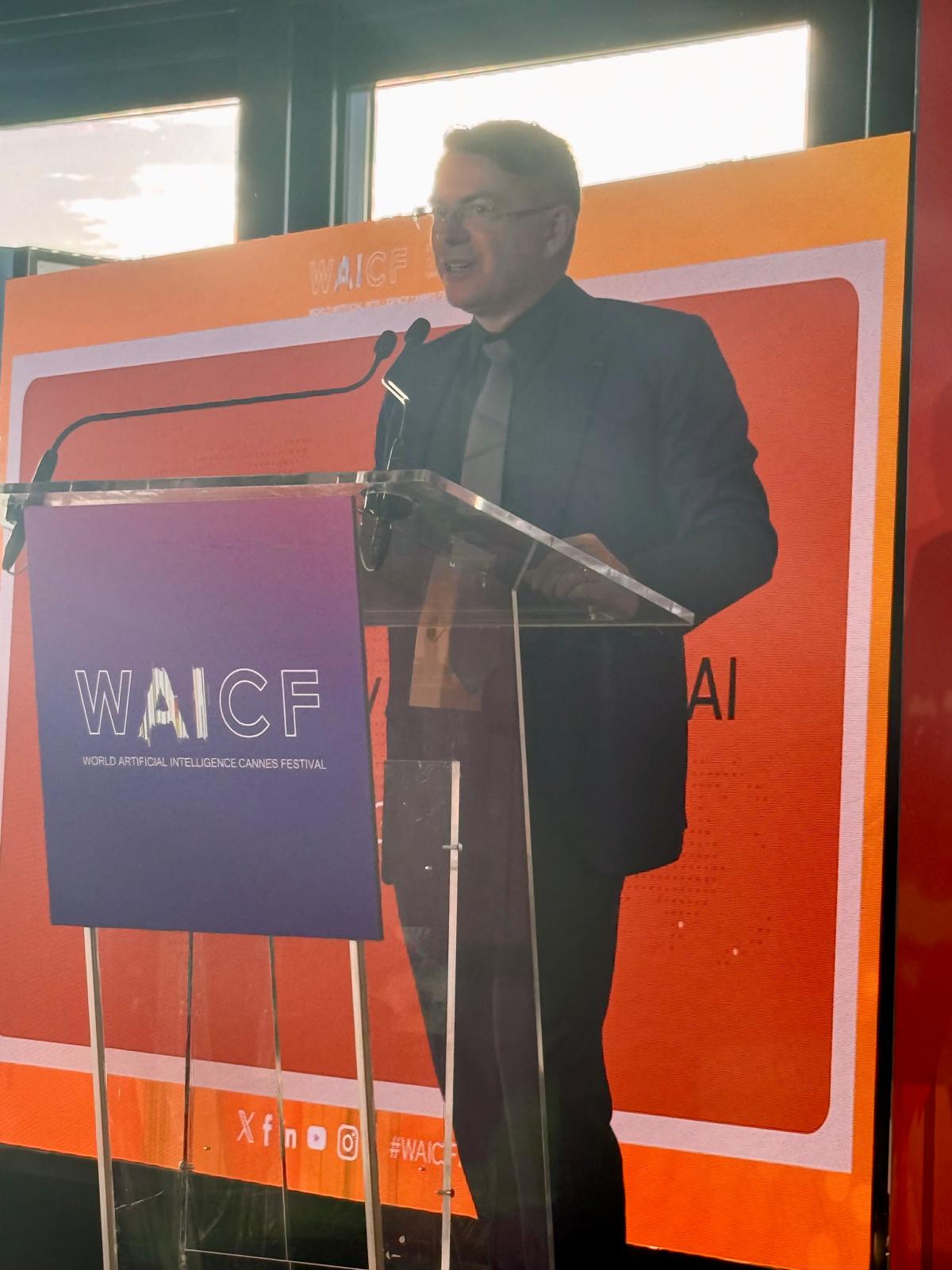
Artificial intelligence (AI) is now at the heart of technological advances, but its energy cost and environmental impact are often underestimated. During his conference, David Gurle, CEO of Hivenet, offered a striking analysis of this issue and presented a bold alternative: distributed computing.
AI and Its Unsuspected Energy Cost
David Gurle opened his conference by introducing a reality often ignored: the enormous amount of energy and water required to power AI models. He used a simple query sent to ChatGPT as an example, illustrating its energy impact through striking comparisons.
A single prompt generated by ChatGPT consumes the equivalent of a full iPhone charge. This figure may seem trivial, but when scaled to ChatGPT’s 300 million users, the situation becomes alarming. If 10% of these users performed one prompt per day, energy consumption would reach 87 MW and would require 15 million liters of water to cool the servers.
Data centers are becoming increasingly gigantic to meet the growing demand for artificial intelligence. Gurle illustrated this explosion with a surprising comparison: ChatGPT’s daily energy consumption represents the equivalent of 9,395 Tesla Cybertruck batteries or 16 football fields filled with Cybertruck batteries.
This problem doesn’t only concern ChatGPT. He reminded us that companies like Google, Meta, and OpenAI continue to deploy massive infrastructures, with thousands of GPUs dedicated to training ever more powerful models. According to a conversation with Mark Zuckerberg, no maximum efficiency threshold has yet been found: more GPUs mean better results, which fuels a frantic race for resources.
To illustrate the scale of energy consumption, David Gurle compared ChatGPT’s usage to that of the city of Cannes. Each year, Cannes consumes 215,000 MWh for a population of 75,000 inhabitants (and 300,000 during high season). However, ChatGPT consumes this same amount of energy in just 62 days!
Why is the current model unsustainable?
The continuous increase in AI demand poses a major problem: the current model relies on centralized data centers that require enormous amounts of electricity and water to operate. This paradigm is inefficient and ecologically unsustainable.
The myth of the impossibility of distributed computing: During a discussion at the Élysée Palace, former Google CEO Eric Schmidt stated that large-scale distributed computing was impossible. He explained that attempts had been made, but without success, because latency and synchronization constraints made this model inefficient.
David Gurle, on the other hand, is convinced of the opposite. He demonstrated that with advances in connectivity and computing power, this outdated vision can be overturned.
HiveNet: A Disruptive Alternative Based on Distributed Computing
The fundamental idea: use existing devices. Rather than investing in gigantic data centers, why not use the computing power already available? Tens of billions of connected devices exist around the world (computers, smartphones, tablets) and remain unused most of the time. The idea behind HiveNet is to create a distributed network, where each connected device participates in the computing effort, thereby reducing the need for energy-intensive data centers.
How does it work?
David Gurle explained that GPUs are really just parallelized computing units on a compact chip. This concept can be extended to a global scale, where each device shares part of its power to perform AI calculations.
This model is based on:
- Task splitting: A task manager divides a complex operation into several sub-tasks.
- Work distribution: These tasks are sent to different devices available on the network.
- Distributed processing: Each device performs part of the calculation.
- Result aggregation: Once the calculations are completed, the results are assembled to produce the final answer.
Why is it possible today?
Historically, the main obstacle to distributed computing was slow networks. But today, with speeds of 100 Gbit/s, these limitations are gradually disappearing. In reality, the limiting factor is no longer GPU power, but the connection between servers.
HiveNet is not just a concept: it is already in application with impressive results. The Hivenet team has set up the world’s largest decentralized storage infrastructure, by aggregating users’ unused space. In just 14 months, this network has stored 1.4 billion data blocks and continues to grow at a rate of 5% per week.
Spectacular energy savings: HiveNet’s current experiment demonstrates that the same calculation performed in a distributed infrastructure consumes 50% less energy and zero liters of water. This drastic reduction in ecological footprint proves that the centralized vision of AI is obsolete. As Gurle emphasizes, “The impossible is an opinion, not a fact.”
A Necessary Paradigm Shift
David Gurle’s conference highlighted a fundamental problem with modern AI: its colossal environmental cost. While large companies are investing massively in ever more demanding data centers, an alternative exists: distributed computing. HiveNet proves that this approach is not only viable, but that it can reduce energy consumption by half and eliminate water waste. With the rise of connectivity and the improvement of hardware capabilities, it’s time to rethink our AI model to make it more sustainable, more equitable, and more efficient. The future of artificial intelligence should not be a frantic race for raw power, but an intelligent optimization of already available resources.