By Pascale Caron
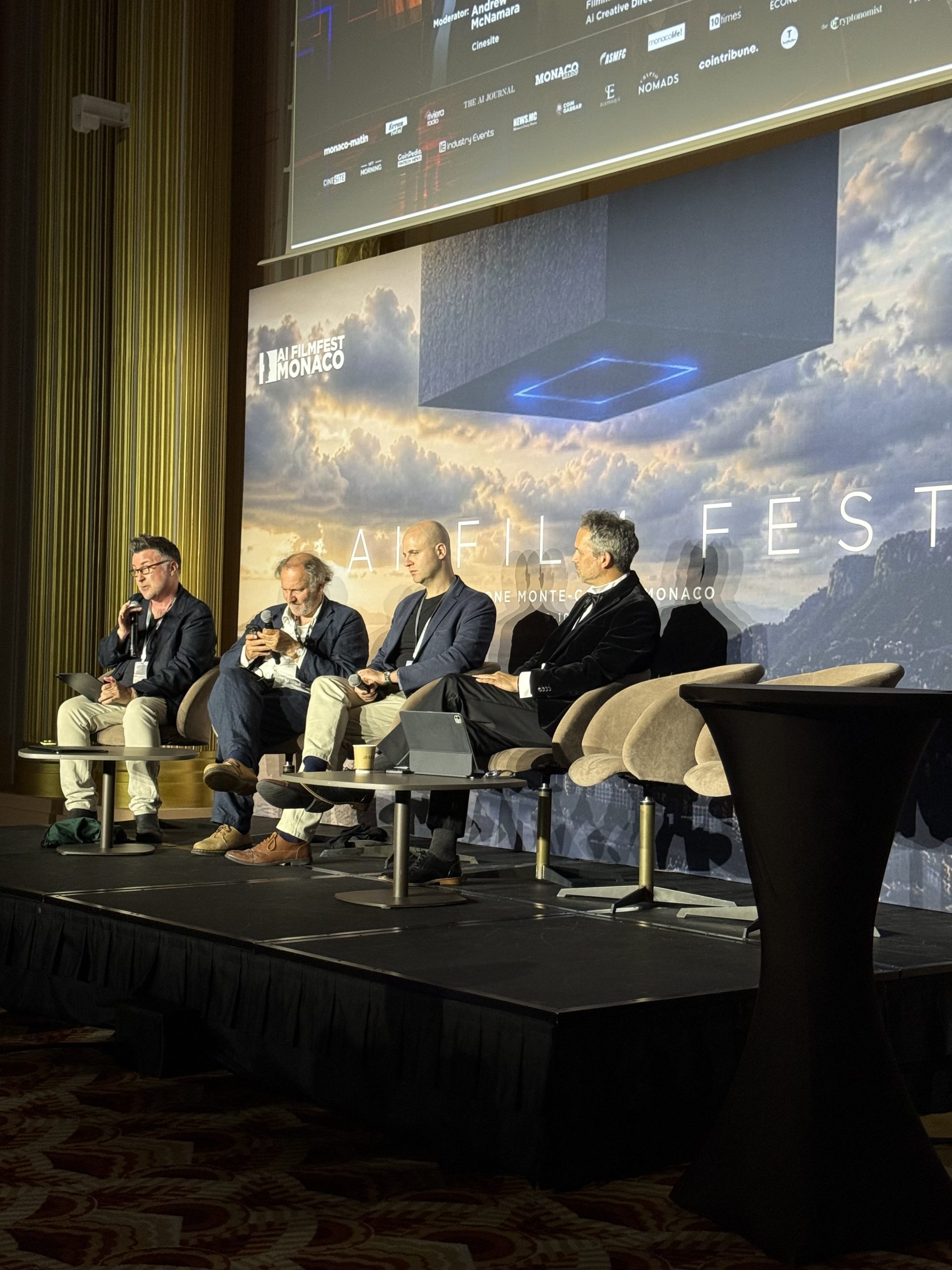
Can we still speak of experimentation when nearly 180 films generated or assisted by artificial intelligence are submitted to an international festival? This question was at the heart of the conference “Creator and Creation: Philosophy and Art in the AI Era,” organized as part of the AI Film Festival Monaco.
To attempt to answer it, four personalities from complementary backgrounds confronted their analyses. The debate was moderated by Andrew McNamara, representative of Cinesite and observer of transformations in the audiovisual sector. Alongside him were Nick Shoolingin-Jordan, director and creative director specialized in AI-assisted productions, Vincent Lowy, former director of the École nationale supérieure Louis-Lumière and specialist in the transformation of image professions, as well as Anthony Bourached, researcher at University College London (UCL) and entrepreneur engaged in developing creative applications of artificial intelligence.
What do they have in common? All participated in evaluating the 180 works submitted to the festival before selecting forty for the official selection and then designating the winners. A privileged position to observe the spectacular progress made by artificial intelligence tools over the past twelve months.
The assessment made by the speakers is unambiguous: generative cinema is entering a new phase. The technical demonstrations that characterized early productions are gradually giving way to genuine narrative works. The challenge is no longer just to produce impressive images. It has now become possible to build coherent universes, develop complex characters, and tell stories capable of evoking emotion.
A Global Laboratory for AI-Assisted Creation
For the jury members, the corpus of 180 films constitutes an exceptional observatory of the sector’s evolution. The evaluation criteria went far beyond visual performance alone. Storytelling, creativity, narrative coherence, relevant use of artificial intelligence, production quality, and artistic mastery were carefully examined.
Nick Shoolingin-Jordan highlights the remarkable diversity of the proposed universes. One of the most striking phenomena concerns creators’ ability to build entire worlds using generative tools. Just a few years ago, creating such environments would have required the involvement of top-tier special effects studios and budgets of several million dollars. Today, these possibilities are becoming accessible to independent filmmakers.
This democratization of creation is one of the festival’s main lessons. For the first time, creators who would never have had access to traditional production circuits can realize their vision and present it to an international audience.
From Technological Spectacle to Narrative Maturity
One of the most significant changes observed by the jurors concerns the evolution of the themes addressed.
Early AI productions were often dominated by dystopian scenarios, apocalyptic visions, or reflections centered on the dangers of technology. This year, the selected works demonstrate greater narrative diversity.
Andrew McNamara notes the emergence of more sophisticated narratives, more focused on human emotions, memory, interpersonal relationships, or the quest for identity. Several films stand out for their ability to touch viewers rather than merely impress them with technological performance.
This evolution reveals a paradigm shift. Artificial intelligence is gradually ceasing to be the main subject to become a tool in service of more universal stories.
The Screenplay Remains the True Differentiating Factor
Despite the spectacular progress in video generation, the speakers are unanimous on one point: the quality of writing remains decisive.
Vincent Lowy reminds us that the most convincing films at the festival are not necessarily those using the most advanced models. They are above all those with a solid narrative, clear intention, and strong artistic coherence.
According to him, most of the works presented today benefit from impressive visual quality. What truly distinguishes the best productions lies in their ability to tell a story.
This observation aligns with Anthony Bourached’s analyses. For the British researcher, AI allows creative possibilities to be extended, but replaces neither imagination nor the author’s vision. When used passively, it produces technically correct but rarely exceptional results. The remarkable works remain those where artificial intelligence serves a clearly assumed artistic intention.
Significant Technical Quality Improvement
Jury members also noted a spectacular improvement in production standards.
Editing, color grading, sound design, and post-production demonstrate creators’ rapid skill development. Anthony Bourached estimates that this progress results as much from model improvement as from users’ accelerated learning.
Generative cinema is gradually developing its own codes and expertise. Directors are learning to integrate AI into a comprehensive creative process rather than using it as a simple image generator.
This professionalization directly contributes to raising the general level observed at the festival.
Training Tomorrow’s Creators
For Vincent Lowy, one of the central questions now concerns training.
The former director of Louis-Lumière observes that many film schools remain structured around a traditional vision of audiovisual professions. Yet boundaries between disciplines are becoming increasingly porous.
Future professionals will need to learn to collaborate with engineers, data specialists, developers, and artificial intelligence experts. Conversely, technical profiles will need to understand the fundamentals of cinematographic language.
This convergence of skills appears as one of the great challenges of the coming decade.
Limitations Remain Visible
The speakers’ enthusiasm does not exclude a critical perspective.
Vincent Lowy notably noted a recurring representation of female characters in the selected films. Women appear very often young, idealized, and highly sexualized, while male characters benefit from greater representational diversity.
This observation refers to broader debates about biases present in artificial intelligence models and their potential impact on cultural production.
Another shared observation: the scarcity of humor. The majority of works presented adopt a serious, melancholic, or dystopian tone. For Vincent Lowy, humor remains one of the most complex expressions to reproduce artificially, as it relies on subtle mechanisms of context, rhythm, and culture.
A Revolution That Is Only Beginning
At the end of the discussion, the speakers shared a common conviction: artificial intelligence profoundly transforms production methods, but it does not change the essence of cinema.
Anthony Bourached sees in these technologies an unprecedented opportunity to expand the field of human creativity. Nick Shoolingin-Jordan perceives it as a means of giving new talents their chance. Vincent Lowy insists on the need to accompany this transformation through training and dialogue between different professional communities.
All converge, however, toward the same conclusion.
The tools will evolve.
The models will progress.
Production costs will continue to decrease.
But the value of a film will always rest on its ability to tell a story capable of moving, questioning, and lasting in the audience’s memory.
The AI Film Festival Monaco thus shows that the future of cinema is not played out in opposition between human and machine. It is built on their ability to collaborate to invent new forms of storytelling.