By Pascale Caron
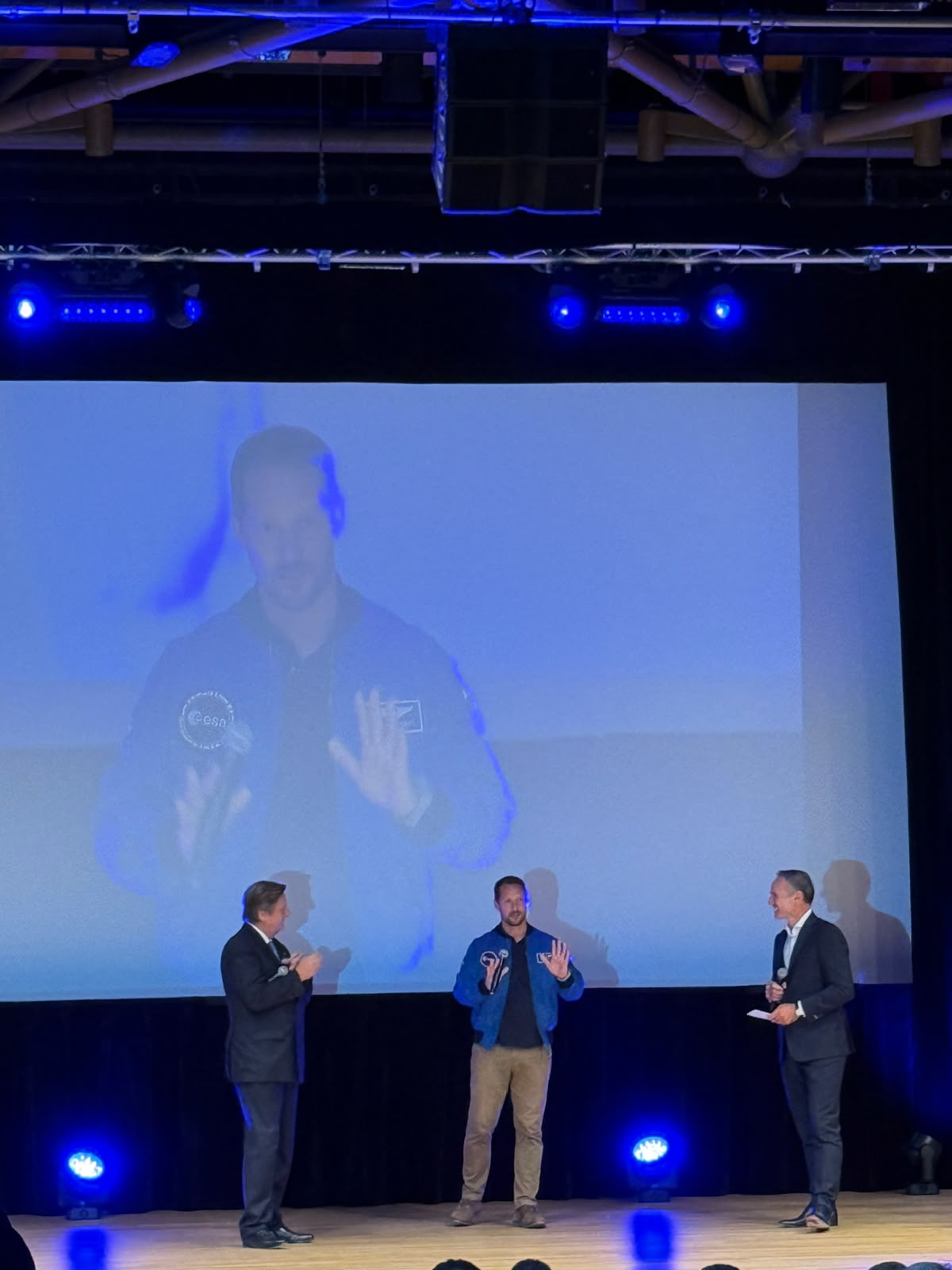
In Monaco, Thomas Pesquet took his audience far beyond the spectacular images of the International Space Station. Through the account of his Alpha mission, the European astronaut spoke about science, cooperation, sovereignty and transmission. Above all, he showed what makes exploration possible: years of preparation, patiently built trust and a collective ability to face the unexpected.
More than a thousand people, according to the organizers, gathered on September 11, 2026 at the Auditorium Rainier III for this conference by the Monaco Méditerranée Foundation. The turnout testifies to the fascination that Thomas Pesquet inspires. But the man who appears on stage quickly knows how to close the distance. His humor accompanies a precise account, in which the great moments of space adventure stand alongside the ordinary gestures of life on board.
Jean-Luc Allavena opens the meeting by recalling the astronaut’s ties with the French-American Foundation. A member of the 2017 class of Young Leaders, Pesquet had sent a filmed application from space, with the French and American flags. On this anniversary day of the September 11 attacks, Allavena also evokes the foundation’s mission of bringing people together. International cooperation thus enters the evening even before the account of the mission.
The introduction recalls a career as an aeronautical engineer and pilot, but also judo, foreign languages and the saxophone. These activities outline a curiosity that goes beyond mere technical mastery. A new mission is also announced. According to CNES, Thomas Pesquet is preparing his return to the ISS in 2027, as part of Vast-PAM-1, of which he is to take command. This schedule remains provisional.
His day in Monaco held a discovery for him: the facilities of Venturi Space, chaired by Gildo Pastor.
“I was impressed, I didn’t expect to find so much cutting-edge technology,” he confides.
Behind the facades of an urban building, teams are developing equipment intended for lunar exploration. Wheels, batteries and rovers give industrial reality to missions that the public still imagines are distant.
“I saw myself on the Moon driving electric vehicles,” he recounts.
The phrase expresses his enthusiasm, without announcing a lunar assignment. Allavena emphasizes Gildo Pastor’s perseverance and the work of the teams. Asked about reliability, Pesquet recalls the value of human presence: faced with a breakdown, an astronaut can observe, interpret and intervene. Automated exploration and crewed exploration provide complementary capabilities.
Before joining the conference, he met with high school students. These exchanges matter because vocations often take shape early, through a book, a film or an encounter. “It’s at that age when you’re a sponge, when you’re still open to everything,” he explains. He mentions children capable of knowing all the dinosaurs, then adds:
“It’s a shame that adults are a little less passionate.”
Transmission takes on a face when Jean-Luc Allavena reads a letter written in February 2022 by Clotilde, present in the room. In it, she recounts her museum visits, her readings and her passions for space, medicine and politics. She dreams of joining the station with her guitar. Allavena had kept the letter; the young girl can finally hand it to its recipient herself. Pesquet notes, amused, that it bears the date of his birthday.
The conversation then addresses Europe’s place, after the International Space Summit organized in Paris.
“Europe needs to take its place,” the astronaut states.
Dependence on Russian then American partners makes geopolitical tensions directly felt. He argues for a Europe with its own means in order to carry weight in its cooperations.
“We want to be powerful to be respected,” he summarizes.
His diagnosis distinguishes available resources from the ability to mobilize them. “We have everything we need, but sometimes we lack a little political ambition.” Technologies, universities and industrialists exist. On funding, he recalls that ESA does not represent all European effort: national programs and defense also participate. The amounts mentioned orally cannot, however, be added together without examining their scopes and overlaps.
“We duplicate things we shouldn’t duplicate, we do things at the national level that we should do at the European level.”
His conclusion is clear:
“It’s more a question of governance than a question of total amount and technological level.”
Concerning absences from the summit, he emphasizes the actors present and the projects built over ten, fifteen or twenty years, beyond political changes.
Galileo, Copernicus, satellites and scientific instruments illustrate European capabilities. Pesquet notably cites Thales, Airbus Defence and Space and OHB. He also qualifies the debate on reusable launchers. Recovering a stage requires keeping fuel, therefore making trade-offs with the performance available for the payload. The economic value depends on the frequency of launches. Technology is evaluated under the real conditions of its use.
Crewed transportation constitutes another challenge. “We’ve never had our own vehicle,” he recalls about Europe. Developing its own capability would require effort, but would allow better control of access to space. Then the screening dedicated to Alpha brings the room back to the lived experience: a mission begun on April 23, 2021, which led him to spend 199 days in space.
In Houston, preparation teaches astronauts to use the station and repair it. “We do everything ourselves with the control center,” Pesquet explains. Fire, depressurization and toxic atmosphere are among the emergencies repeated in the simulator. Scenarios progressively become more complex. An emergency return must also be prepared and several days of survival at sea before recovery must be envisaged.
In the pool, extravehicular activities are rehearsed for hours. At Star City, near Moscow, training concerns Russian equipment. For his first mission, Pesquet had to master the Soyuz, its documentation and its communications in Russian. In Cologne, teams notably prepare research for the European Columbus laboratory. The astronaut thus describes international training where each partner brings its facilities, systems and methods.
He distinguishes the time needed to reach a first mission from that devoted to preparing the next one. Nearly seven years separate his selection from his first departure; preparation for the second takes about eighteen months. Experience counts, without eliminating learning. Changing vehicles, moving from Soyuz to Crew Dragon, involves understanding a different architecture and new procedures. Competence is built over time, then renewed with each assignment.
Departure concentrates emotion. In the midst of the pandemic, Thomas Pesquet joins Crew Dragon with Shane Kimbrough, Megan McArthur and Akihiko Hoshide. Farewells to families precede final checks.
“A rocket launch is, in my opinion, the most spectacular thing you can see in the world,” he recounts.
He describes the light, the vibrations, the noise, then the stopping of thrust and objects that float.
It takes nearly a day to reach the ISS by gradually adjusting the orbit. The station appears “like a castle in the sky.” The whole thing moves around the Earth at some 28,000 kilometers per hour, while relative speed becomes minimal at docking. After checks and opening of hatches, a bell welcomes the arrivals. They find colleagues known on the ground, sometimes companions from a previous mission.
Daily life quickly asserts itself. Filters must be replaced, equipment maintained and breakdowns anticipated. “It’s difficult for the space station to operate in the extreme environment that is the space environment.” The body requires comparable attention. Weight training, cycling and treadmill occupy part of the day to limit muscle and bone loss. Straps hold astronauts during exercise: physical effort also requires adapted organization.
“We try to recreate a little family structure with people we’re going to spend a lot of time with,” Pesquet explains.
Meals, birthdays and national holidays maintain this closeness. During the Tokyo Games, two teams, Soyuz and Dragon, organize their own events, including synchronized floating. Humor and play find their place in a demanding environment, where everyone shares the space of others for an extended period.
This common life is not self-evident. Astronauts do not necessarily choose all their companions, but must be able to count on them. Pesquet describes a closeness that is built in small habits as much as in exceptional situations. Sharing a pizza, celebrating a birthday or improvising a competition contributes to making the station a livable place. The attention paid to relationships thus appears in his account as a concrete component of the crew’s functioning.
The guided tour reveals a three-dimensional station. Depending on body orientation, landmarks change. Modules present different shapes and colors, inherited from partners and years of construction. Storage is sometimes lacking; walls accommodate equipment. Pesquet even anticipates the question of toilets, which operate by suction. These details make tangible a daily life that spectacular images might cause one to forget.
Resupply constitutes another essential activity. Cargo ships bring food, clothing, water, equipment and experiments; waste is loaded in return. This logistics allows continuity of stay. Moving a very heavy load becomes possible without bearing its weight, but one must know how to stop its movement: inertia remains. The apparent ease of gestures masks a necessary mastery of trajectories, even in the most ordinary operations.
“This station, you may know, is a research laboratory.”
Microgravity makes it possible to observe phenomena under conditions difficult to maintain sustainably on Earth. Gravitation has not disappeared: the station and its contents are in free fall. Experiments exploit this situation to study materials, fluids or the adaptation of the human body. Scientific activity gives meaning to the crew’s daily organization.
Pesquet takes the example of alloys and the effects of gravity on mixtures. “We don’t produce metals in the station,” he specifies. Results are transmitted to researchers. He also evokes the brain, which must learn to function in an unusual environment. Knowledge is built through observations and experiments, then through their interpretation on the ground, within teams that the public does not see.
“The station is not an end in itself.” It prepares for extended stays on the Moon and, in the longer term, human exploration of Mars. Growing plants participates in this reflection on the resources needed far from Earth. Pesquet also emphasizes the opening of certain experiments to universities and small companies. Exploration thus mobilizes diverse contributions, each of which answers a particular question.
The arrival of the Russian module Nauka brings new equipment and significant installation work. His colleagues joke, he recounts, about this cargo lacking apples for the crew. Then come the extravehicular activities. Attached by his feet to a robotic arm, Pesquet transports new solar panels with Shane Kimbrough. The operation is prepared, but a difficulty prevents the planned installation: “It didn’t work the first time.”
The site is secured, the astronauts return and exchanges with control allow preparation of a new attempt. “We had our little Apollo 13 moment too,” he jokes. Three outings are necessary for this sequence. The successful deployment of the panels brings shared relief.
“An extravehicular activity is a marathon of the upper body.”
For hours, every movement encounters the resistance of the pressurized spacesuit.
Another episode reveals trust within the crew. A colleague reports shoulder pain, at the risk of giving up an outing. Pesquet replaces him and intervenes with Akihiko Hoshide, with less specific preparation than usual. The mission also relies on this ability to declare a difficulty. Recognizing a limit allows the team to adapt before it becomes a risk for the operation.
The change of command is accompanied by a symbolic key transmitted by Hoshide. This Japanese then French relay reminds Pesquet of that of the Tokyo Games to Paris. “Someone who has authority is needed if things go wrong, we don’t have time to discuss.” Daily cooperation is thus articulated with a clearly identified decision-making responsibility. Trust does not dispense with knowing who arbitrates.
During his command, the ISS also welcomes a Russian actress and director, accompanied by a cosmonaut, to shoot a film. The crew first wonders about the consequences for their work. Pesquet finally recounts professional visitors, invested and capable of adapting. This encounter with people outside aeronautics and engineering enriches life on board. Space also becomes a place of creation and confrontation of experiences.
Then the Cupola opens the account to Earth. An orbit lasts about 90 minutes; landscapes, days and nights follow one another. “You can find all colors and all shapes in nature,” Pesquet marvels. His photographs show Everest, deserts, cities, then Mont-Saint-Michel, Marseille or Tahiti. They tell as much about the diversity of landscapes as about the personal attachments of the one who observes them.
He estimates having brought back some 85,000 photographs from his two missions, counting automated sequences. Finding the right lighting requires anticipation; the speed of movement complicates night images. The beauty of auroras is matched by disturbing scenes: hurricanes, fires and smoke over vast distances. These images make the scale of phenomena tangible, without replacing scientific analysis of their causes. The admired Earth also remains a vulnerable planet.
Before return, photography becomes a technical tool. The crew performs a maneuver around the ISS to document its external condition. Pesquet mentions about 2,000 images intended for engineers. Then come deorbiting, atmospheric reentry heating, deceleration and parachute opening. Splashdown in the Gulf of Mexico marks the end of the stay, but the body must still regain its terrestrial bearings.
Weight seems considerable, balance is disturbed. Quickly brought back to Cologne, the astronaut finds the scientists, eager to study the first hours of readaptation.
“We then spend the following six months doing debriefings, getting back in shape, redoing protocols.” This “after-sales service of the mission” extends the experience well after the flight.
Data collected before, during and after the stay allow lessons to be drawn from it.
What follows is called Artemis: returning to the Moon to build a lasting presence there, “not just to plant a flag.” Mars constitutes a more distant horizon. Pesquet does not know if he will participate in this adventure himself.
“Perhaps the person who will do it will be in the room.”
The sentence brings the conference back to transmission. Who will transform today’s wonder into knowledge, skills and future missions? The journey already continues in this question.