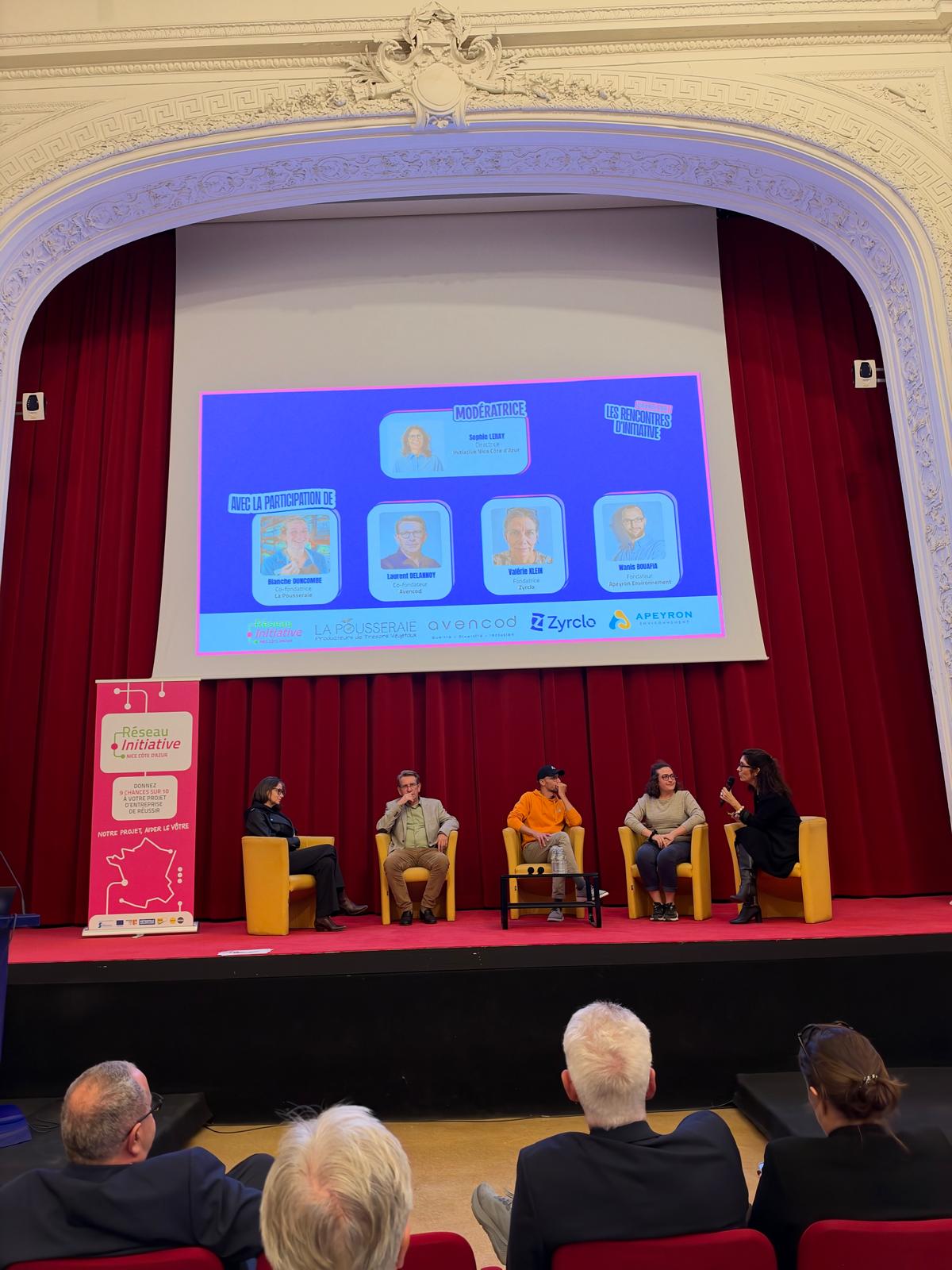
When a company can list Airbus Helicopters among its clients, the next meeting is undoubtedly easier to secure. But how did it land the first one? On November 27, 2026, at the Grand Château de Valrose in Nice, Laurent Delannoy recalled a stage in Avencod’s history that you would search for in vain in a client reference list. Ten years ago, when he was struggling to convince IT departments to entrust a mission to beginners with disabilities, Initiative Nice Côte d’Azur was among the first to believe in the project and support its founders. Laurent wanted to tell those who were in the room. Then he recounted how two of his employees ended up being recruited on permanent contracts by Airbus Helicopters.
By organizing its Initiative Gatherings, the network had chosen to devote an afternoon to commitment. After an initial roundtable on community action and a presentation of its financing and support missions, Initiative Nice Côte d’Azur gave the floor to four entrepreneurs. Laurent Delannoy for Avencod, Blanche Duncombe for La Pousseraie, Wanis Bouafia for Apeyron Environnement and Valérie Klein for Zyrclo answered a question that I found particularly interesting:
Did you find the client you imagined at the start?
Their answers shed light on four leadership decisions. Who should we ask to trust us? How do we price what we know how to produce? When can we count on the first orders? And which clients can we reasonably serve?
Avencod. Accepting that a client recruits the employees you have trained
Laurent Delannoy knows well the recruitment habits of IT companies. They look for a candidate who already has several years of experience with the client’s technologies. For someone waiting for their first assignment, the requirement is difficult to meet. With Laurence Vanbergue, he created Avencod to open digital professions to people with disabilities. Their choice was to ask clients to entrust work to the company, which its employees would carry out as a team, in an adapted environment. The IT department could thus judge the quality of what was delivered to them. dora.inclusion.gouv.fr
At Airbus Helicopters, the relationship begins with a file transmitted at the end of a meeting and an initial software testing assignment. On the return journey between Vitrolles and Nice, Laurent wonders how far his small team can hope to go with such an industrial player. The trial is conclusive. The client entrusts Avencod with a mission on software used in research and development. Two employees acquire such mastery of it that Airbus Helicopters offers them permanent contracts. They accept. The relationship then continues with Capgemini Sogeti and, according to Laurent, seven people now participate in the checks that precede the deployment of new versions.
What struck me was the satisfaction with which he recounts these two hires. Yet any manager of a service company knows the cost of losing two experienced employees, especially when they know the client’s file so well. For Laurent, these recruitments fulfill the initial ambition: to make Avencod a springboard for people who had struggled to obtain a first experience matching their skills. Initiative had taken this ambition seriously when it remained to be proven. Later, an IT manager agreed to entrust a trial to the team. Each of these decisions counted, at a different moment in the journey.
La Pousseraie. Knowing how to produce a microgreen, then learning to sell it
Blanche Duncombe remembers very well La Pousseraie’s first sales meeting. The three founding engineers show up at Mauro Colagreco’s, the chef of Mirazur, with a Deliveroo insulated bag and trays of microgreens grown in their living room. They have just solved a technical difficulty about which they had little certainty at the start: succeeding in producing microgreens in aquaponics, in a circuit where nutrients from fish farming feed the plants. In front of the chef, they still need to explain what these few shoots will bring to a dish and how much they will cost him.
Their market study had correctly identified the clientele. Restaurateurs were numerous on the Côte d’Azur and local production still underdeveloped. The first exchanges in the kitchen gave another content to this study. When Blanche talks about her products today, she describes a woody note, a hint of bitterness, the color or shape that a chef is looking for in a dish. On the other hand, she acknowledges how difficult it was for her, at the start, to announce a price. It is at this point in her story that she thanks Initiative and the networks that supported the partners. The need was very concrete: three engineers knew how to cultivate an original product and had to learn to make a living from it.
Blanche now mentions about 200 clients between Menton and Saint-Tropez and more than 120,000 boxes produced per year. She herself raises the question of plastic packaging, for which she is still looking for solutions. I appreciated that she brought these two subjects together. During the first meeting at Mirazur, the founders’ attention naturally focused on the shoots. At 120,000 boxes per year, the choice of container in turn becomes an industrial decision.
Apeyron Environnement. A regulatory deadline does not give the date of the first order
A former management controller in the automotive industry, Wanis Bouafia had good reasons to believe in his forecast. Apeyron Environnement launched its bio-waste collection activity for professionals in 2023. The generalization of source sorting was taking place in 2024. The company would therefore be ready when hotels and restaurants looked for a service provider. There was indeed renewed interest and a few signatures. The expected acceleration, however, was delayed.
His testimony will speak to many managers. In a business plan, a regulatory deadline has a precise date. The moment when each restaurateur will review their practices, choose a solution and commit the expense is much more difficult to predict. Wanis had clearly identified the need. It was the speed at which it would translate into contracts that he had overestimated. Winner of Initiative Nice Côte d’Azur in 2023, he places this support at a pivotal moment: the activity was starting, the collection means had to be in place and the pace of orders remained uncertain. His account gives full meaning to the possibility, for an entrepreneur, of finding interlocutors in their area to whom they can submit their hypotheses, then come back to talk about what is actually happening.
Zyrclo. Choosing the clients you can serve and passing on what you have learned
For Valérie Klein, the first decision concerned the location. She wanted to set up a workshop dedicated to furniture reuse in a rural area. Her reasoning deserves to be heard on the Côte d’Azur. If you want to keep schools and shops in villages, businesses must also choose to create activity there. In Villars-sur-Var, it was necessary to find a former industrial wasteland, acquire it and decontaminate it. The workshop itself testifies to Zyrclo’s approach. Doors, acoustic panels and sinks recovered from the former École internationale de Monaco have found a new use there.
Asked about her first clients, Valérie answers with an example that any entrepreneur can understand. Delivering one chair to an individual or ten chairs to a company does not mobilize the same time or the same means per chair delivered. During the ramp-up period, favoring local authorities and companies responds to this economic reality. Her ambition for the future is more singular. Valérie documents the project stages so that others can create a comparable workshop in their department. A door removed in Monaco can be reused in Villars-sur-Var. For a door recovered at the other end of France, it is better that an entrepreneur knows how to valorize it on site. What Zyrclo has an interest in making travel is the experience acquired in the Nice hinterland.
Initiative Nice Côte d’Azur alongside entrepreneurs from their beginnings
The merit of this roundtable is to have allowed entrepreneurs to revisit decisions that were still uncertain when they made them. Seeing Avencod ten years after its beginnings gives Initiative Nice Côte d’Azur valuable perspective on its actions. We better understand the scope of initial support when the manager can explain what happened next, but also what could have stopped before they even had the opportunity to prove themselves. The testimonies of Blanche, Wanis and Valérie complete this reading. A project can be technically accomplished and its price difficult to set. Its usefulness can be recognized and its first orders delayed. Its ambition can be territorial and its viability depend very concretely on the number of chairs delivered to the same address.
For the managers present at Valrose, I see this as an invitation to also look at our own purchasing practices. Initiative Nice Côte d’Azur can finance a startup, support a founder and open a first door for them. At some point, someone must agree to taste the microgreens, to entrust furniture or to have software tested.
In our companies, what first assignment could we entrust to a team that already has the expertise, but still lacks the reference we ask of them?