Interview by Pascale Caron
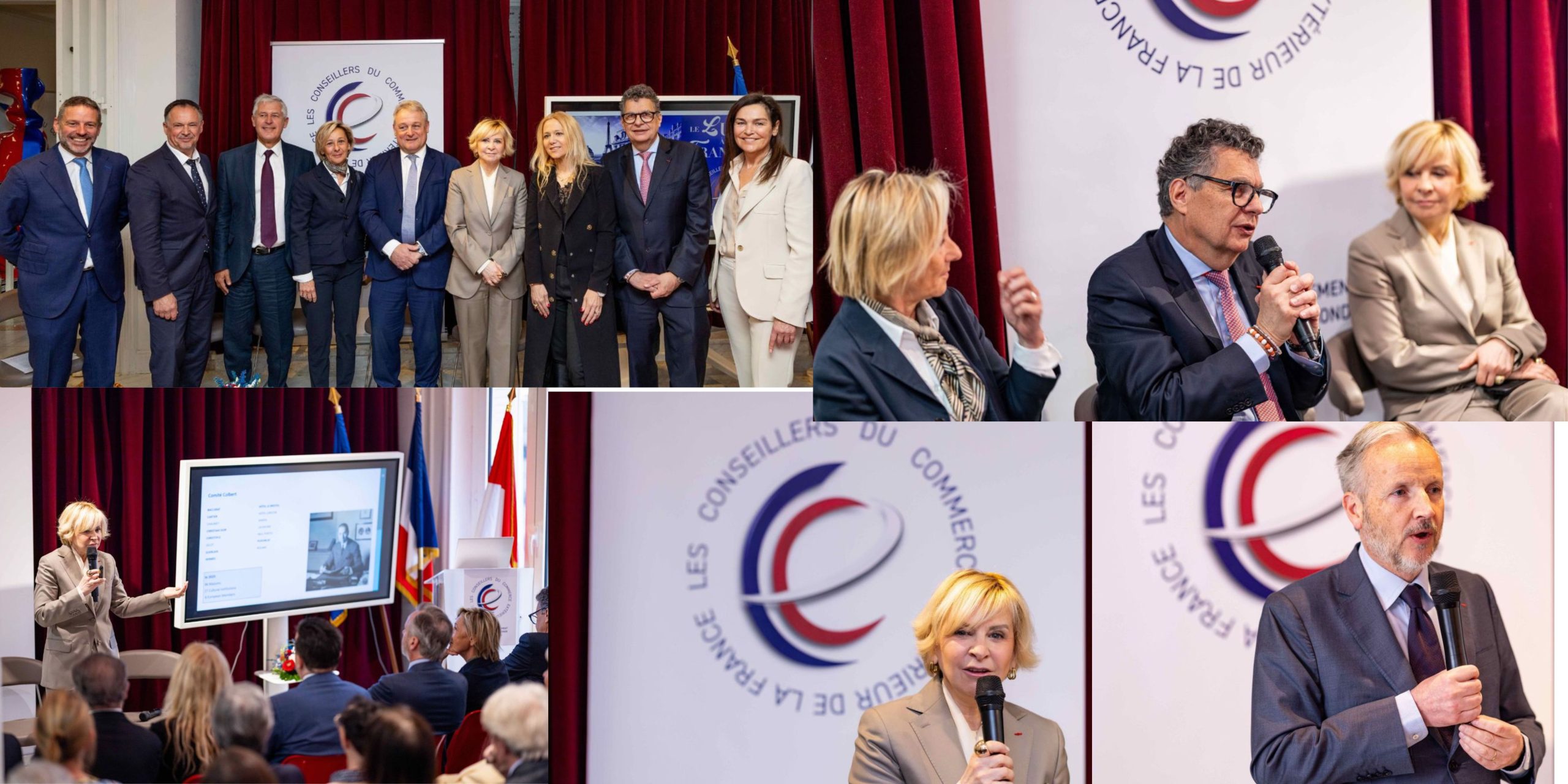
Monaco, April 2, 2025. It was at the Maison de France, in the heart of Monaco, that the French Foreign Trade Advisors (CCE) organized a round table on the theme of “French Luxury”. For the occasion, the venue was decorated with works by Laurence Jenkell and Marcos Marin.
The inaugural conference was of high symbolic and strategic value, bringing together emblematic figures from the luxury ecosystem. Bénédicte Épinay, president of the Comité Colbert, Luc Lesénécal, president of the Institut pour les savoir-faire français, Jean d’Haussonville, French Ambassador to Monaco, and Sylvie Tarbouriech, Vice President of Global Image for the Air France group. This round table was moderated by Sophie Arnaud Deromedi, member of the Executive Board of the CCEs, and President of Adstoria.
All shared one conviction: French luxury is much more than a market. It is a heritage, a culture, a strategic economic lever, and a shared responsibility.
The Comité Colbert, backbone of French luxury
The first to speak was Bénédicte Épinay, head of the Comité Colbert, this alliance founded in 1954 by Jean-Jacques Guerlain. She recalls that from the outset, French luxury was structured around an innovative idea: to act together, to hunt as a pack, to unite houses that are nonetheless competitors in order to promote a unique art of living.
Today, the Comité Colbert brings together 96 houses, 17 cultural institutions and six European members. But what unites them is not just a commercial ambition. It is a common foundation: the defense of artistic crafts, artisanal excellence, and the patient transmission of know-how rooted in history.
“Our ties with institutions such as the Paris Opera or the Palace of Versailles are obvious: they too preserve rare crafts. What unites us is culture, creation, and dreams.”
A long history, a collective present, a future to build
She places French luxury in historical perspective: from the Crown Jewels established by François I to the universal exhibitions of the 19th century, via Colbert, who structured the French economy around royal manufactories. These roots run deep, but are only valuable if they nourish the present.
This is how giants like Chanel, Hermès and Dior continue, 70 years after the Committee’s creation, to commit collectively. “They understood that they were part of something greater than themselves. No single brand can embody French luxury alone. It is together that this identity takes shape.”
The urgency: passing on artistic crafts
But this excellence is now under threat. France faces a critical shortage of craftspeople. “We are missing 20,000 hands in our houses,” warns Épinay. In the craft sector as a whole, this figure rises to 50,000. A paradoxical situation in a country where luxury is a global showcase. The cause is well known: the devaluation of manual trades. “The vocational certificate is still seen as a relegation path. I meet parents who are horrified at the idea that their child wants to become a jeweler or dressmaker.” To reverse this trend, the Comité Colbert is multiplying initiatives. Participation in the European Days of Artistic Crafts, collaboration with the Musée d’Orsay, and above all the “Les Deux Mains du Luxe” event, organized from October 2 to 5 at the Grand Palais. An immersive exhibition, free and open to all, to inspire young people—and adults in retraining—to join these exceptional trades.
An industry deeply rooted in the regions
Luc Lesénécal, president of the Institut pour les savoir-faire français, and also CEO of Tricots Saint James, continues: “We have 188 craft territories in France. An exceptional network, but fragile.” He too emphasizes the urgency to recruit, transmit and promote manual crafts. “We will never be competitive on price. But on quality, yes. And quality is the fruit of the hand.” He reveals the results of the “Les Éclaireurs” study, conducted over two years with a scientific committee. With figures to back it up: artistic crafts in France generate a turnover greater than that of the pharmaceutical industry. “That’s huge. And yet, we still lack recognition.”
It is in this context that the CCEs have made a strong commitment. A convention will be signed so that each advisor, in France or abroad, sponsors a craftsperson, an artistic craft or a living heritage company. “We are going to open markets, create bridges, offer mentoring. This is a national and international mobilization.” The CCEs will also accompany regional delegations to the Osaka World Expo in 2025, with one objective: to give global visibility to French know-how.
Cultural influence based on dialogue
In terms of international outreach, one of the most inspiring projects presented is that of the “Conversations de savoir-faire”, organized in China in 2024 on the occasion of the 60th anniversary of Franco-Chinese diplomatic relations. At the initiative of the French Ambassador in Beijing, French and Chinese craftspeople shared techniques, gestures, tools—and cultural differences.
A moment of emotion, but also a demonstration of active cultural diplomacy. “We are not an ordinary industry. We are a cultural industry.” This is why the Comité Colbert engages internationally not only to promote, but also to understand, dialogue, and forge connections.
Regulatory battles in Brussels
This prestige does not spare the luxury industry from another, more technical battle: European regulation. Bénédicte Épinay minces no words: “We are facing an avalanche of regulations. 152 texts in two years under the Green Deal.”
Some bring progress. Others, absurdities. A striking example: the proposal to authorize only ten bottle shapes for perfumes, with a view to standardization. “But what about intellectual property? Brand identity?” Another aberration: equating the recycling of unsold goods with their destruction, disregarding the sustainability efforts deployed by the houses. “The danger is that luxury becomes a dirty word, that cultural exception is ignored. We are not H & M. We must be considered a special case.”
The Comité Colbert carries this voice to Brussels. A voice of vigilance, education, and economic diplomacy.
Air France: transporting French elegance
For Sylvie Tarbouriech, Vice President of Global Image for the Air France group, French luxury is also embodied in travel. “Since 1933, Air France has been a showcase of the best of France. And First Class is the quintessence of it.”
The airline has managed to make the sky an extension of the art of living. Uniforms designed by fashion designers, Bernardaud china, champagne in all classes… “We have a mission: to offer a comprehensive luxury experience, combining know-how, relationships, and elegance.” The key word? Personalization. “Good service means knowing when to speak, and when to remain silent. It’s the art of the right distance.”
A plural definition, but a common ambition
At the end of the conference, each speaker is invited to define what “French luxury” represents to them. The answers, varied, form a coherent landscape: anchoring in history, excellence of gestures, transmission of knowledge, attention to detail, but also creative boldness and the ability to make people dream.
Jean d’Haussonville, French Ambassador to Monaco, concludes aptly: “Luxury, etymologically, comes from lux: light. It illuminates, it creates, it transcends.” For him, French luxury is like a French garden: geometric, rigorous, but open to emotion, to nature, to the unexpected. A subtle balance between reason and dream, heritage and desire.
And if, as Jean-Louis Dumas said, luxury was that desire that prevails over reason? In an era marked by geopolitical tensions, climate challenges, and transmission issues, French luxury remains a rare, precious… and inspiring resource.